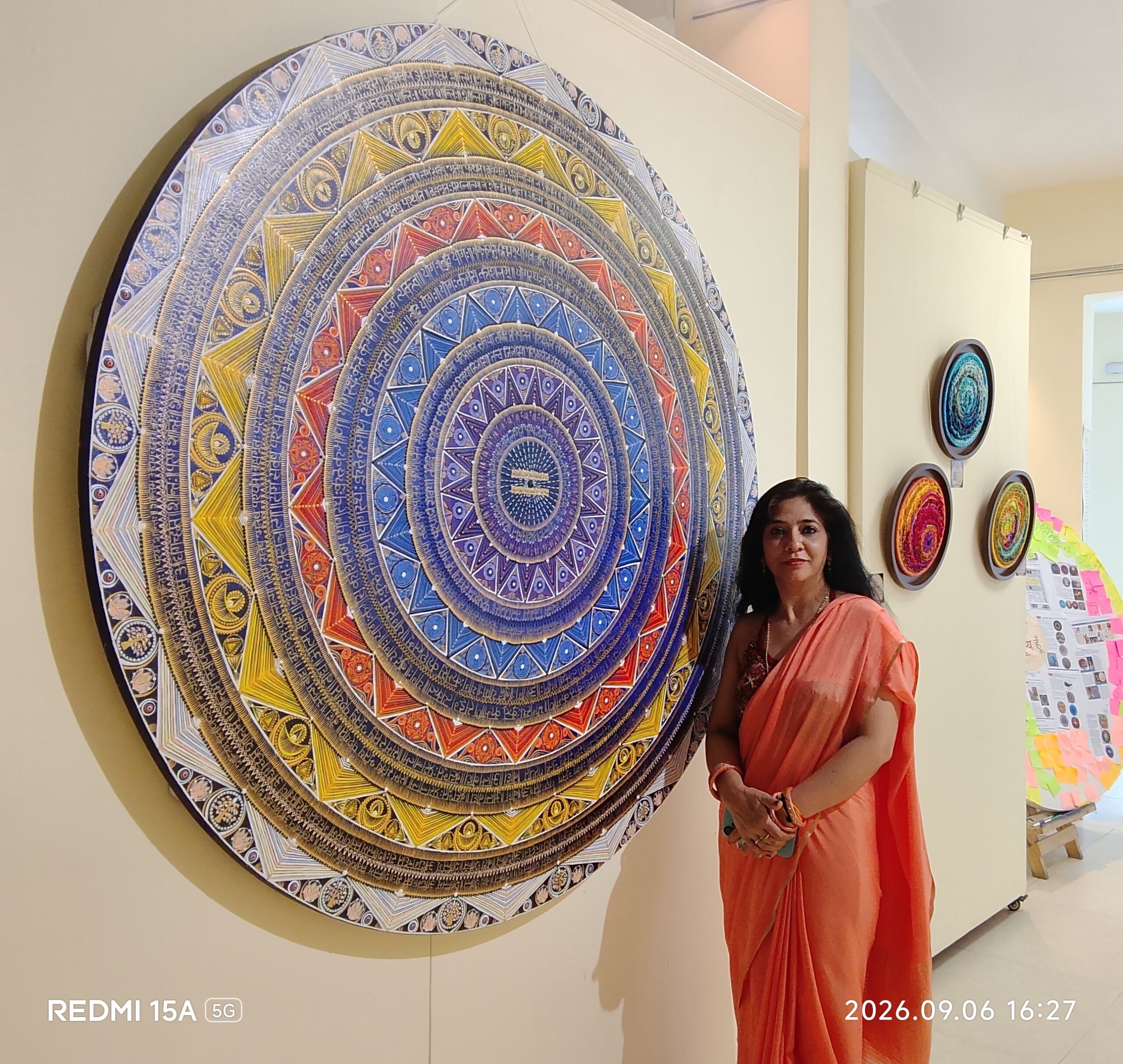
Dilip Guha, Sasraya News ★ New Delhi: Manantar Art presented its inaugural three-day exhibition, 4- 6 Sept 2026, Main Shunya Hun: From Formless to Form at Lokayata Art Gallery, Hauz Khas, New Delhi. At the heart of the showcase lies an exploration of the profound philosophical idea of Shunya (Zero), expressed through contemporary Mandala and Symbolic Art. Conceptualised by curator Shipra Bhatia, the exhibition stands as a vibrant celebration of creativity, imagination, and the timeless dialogue between the formless and form.
She explained the concept ‘मैं शून्य हूँ ‘ : “While Shunya is often interpreted as emptiness or nothingness, within the Indian philosophical imagination it signifies something far more expansive: the silence before expression, the space before form, and the infinite potential from which creation itself emerges.”
Also Read : Priyanka Mohan Walks the Red Carpet at IFFD 2026; Made In Korea Garners Global Acclaim
The exhibition does not begin with the question “What is form?” Instead, it asks: “What exists before form?” From this inquiry unfolds a creative process — tracing how the invisible becomes visible through thought, geometry, symbol, colour, material, and human imagination. The journey moves from Formless to Form, and ultimately circles back, inviting reflection on the formless once again.
One of the most meaningful aspects of मैं शून्य हूँ was the dedicated space created for neurodiverse children and young creators, offering them the opportunity to present their artwork alongside established and emerging artists. In keeping with Manantar’s belief that every individual has a unique way of seeing, creating, and expressing, the exhibition sought to transform the gallery into a space of inclusion, recognition, and equal creative participation.
She informed that this initiative was made possible through collaboration with Prabhat, an effort led by Madhumita Puri, whose work with neurodiverse children beautifully aligned with the vision of मैं शून्य हूँ. Their participation added a deeply human dimension to the exhibition, reinforcing the belief that art transcends labels and creates a space where every voice can be seen, heard, and valued.
The Five-Phase Journey
Around 50 Artists whose artworks were on display were invited to structure the exhibition as an experiential journey through five states of being — each phase guiding the visitor deeper into the philosophy of Shunya:
Awakening: The recognition that there is more than what we see. Awakening disturbs certainty, urging us to pause and look beyond the surface. Here, the artwork becomes an invitation to awareness.
Seeking: When questions become a path. Awareness naturally leads to inquiry: Who are we? What lies beneath identity and form? Where does creation originate? Art, symbolism, and reflection become tools to explore what words cannot fully express.
Transformation: When the invisible begins to take form. Ideas become symbols, thought becomes geometry, emotion becomes colour. Consciousness finds expression through creation. The artist becomes the bridge between the unseen and the seen.
Enlightenment: When form reveals what lies beyond form. The Mandala, with its centre, symmetry, repetition, and circularity, becomes a mirror — reflecting the relationship between the individual and the universal, the visible and the invisible.
Peace: Returning to stillness. After awakening, seeking, transforming, and understanding comes a quieter state. Peace is not the absence of movement, but the ability to remain centred within it. The journey returns to Shunya — not as emptiness, but as possibility, stillness, and wholeness.
WHY THE MANDALA
The Mandala is central to the exhibition because it offers an extraordinary visual language for this philosophical journey.
A circle has no obvious beginning and no end. It contains a centre, yet extends towards infinity. It suggests order while allowing endless interpretation. For the architect, the Mandala speaks through geometry, proportion, symmetry, spatial relationships and structure. For the artist, it becomes a vocabulary of creation. For the collector, it becomes an artwork carrying both aesthetic and conceptual resonance. For the viewer, it becomes an invitation to contemplate the relationship between self and universe.
ART AS A BRIDGE BETWEEN THE ANCIENT AND THE CONTEMPORARY
Main Shunya Hun does not attempt to recreate the past. Instead, it asks: How can timeless Indian ideas find contemporary expression?
The participating artists interpret Mandala and symbolic traditions through their own individual practices, materials, perspectives and visual languages. Alongside the artworks, verses from the Bhagavad Gita become part of the conceptual landscape, creating a dialogue between ancient wisdom and contemporary creation. The intention is not to tell the visitor what an artwork must mean. It is to allow the artwork to open a question.
The three-day exhibition unfolded with each day carrying its own distinct character and rhythm.
Day One — Shunya Pravesh (Entry into Shunya) opened with the inaugural ceremony, marked by the curator’s address, the felicitation of distinguished guests, the launch of the coffee-table book, and an address by the Guest of Honour. The evening continued with artist felicitations, viewing, and networking. Among the Guests of Honour were senior artist and President Awardee Roop Chand, Ms Rupal Dalal, Managing Director of JD Institute of Fashion Technology, sculptor Sanjay Bhola (Dheer), and Ms Madhumita Puri, Founder of the Society of Child Development. The distinguished guest was Padma Shri Dr Chandrakant Pandav, renowned as the Iodine Man of India. The opening established the philosophical foundation of the exhibition and welcomed artists, patrons, collectors, cultural leaders, and guests into the world of Manantar. A special inaugural message was shared by Padma Shri Tilak Gitai, maestro artist and sculptor, who represented India in Greece during the event and therefore could not be physically present. Day Two — The Journey Within shifted the focus from viewing to dialogue and contemplation. The programme brought together diverse perspectives, including Vaastu & Art with Ms Sonal Kapoor and Mental Health & Art with Ms Pooja Raina. The day culminated in an extended open interaction with the artists, creating an intimate space for visitors to engage directly with the creators and explore the ideas, processes, and stories behind the works. Day Three — Shunya Visarjan (The Dissolution of Shunya) began with a workshop by Sh. Kamal Seth, on Art and moved towards closure and reflection. The final day included conversations and felicitations, awards and recognition, the curator’s closing address, a collective photograph, and the ceremonial Mandala dissolution — Shunya Visarjan. The dissolution carried profound significance: a Mandala is created with intention, experienced in its fullness, and ultimately dissolved. What disappears is the form, but what remains is the experience. Form dissolves, but Meaning remains.
The Philosophy Behind the Platform
Manantar Art was conceived with the belief that art is not merely an object of visual appreciation, but a language through which we encounter thought, memory, culture, emotion, and consciousness.
The word Manantar itself evokes an inner transition — a movement from one state of understanding to another. The platform seeks to create spaces where art, artists, ideas, and audiences converge, allowing the artwork to serve as a starting point for dialogue rather than simply an endpoint of viewing.
Working at the intersection of contemporary artistic expression and timeless Indian thought, Manantar Art aims to discover and nurture artists, spark meaningful conversations and engage art with society in transformative ways
Its guiding philosophy can be expressed in three words: Awaken to an idea, Arise into possibility, and Arrive at deeper understanding
Beyond the exhibition itself, Manantar Art envisions cultural engagement as something that extends far beyond the gallery walls. Main Shunya Hun therefore brought together several interconnected dimensions.
Lotus, Mandala, and the Inner Self: Exploring Emptiness
Pooja Singhal, a self-taught contemporary artist from Faridabad, brings to her practice a deep engagement with introspection, spirituality, and emotional expression. With a background in computer science and professional experience in the IT industry, her transition to art reflects a conscious return to her creative calling. Her works explore themes of peace, silence, mystery, and the deeper layers of human consciousness. Through intuitive compositions, expressive colours, and symbolic elements, she invites viewers to pause, reflect, and connect with their inner selves. As a participating artist in Main Shunya Hun, her exploration of emptiness and stillness is not presented as absence, but as spaces for reflection, strength, and transformation.
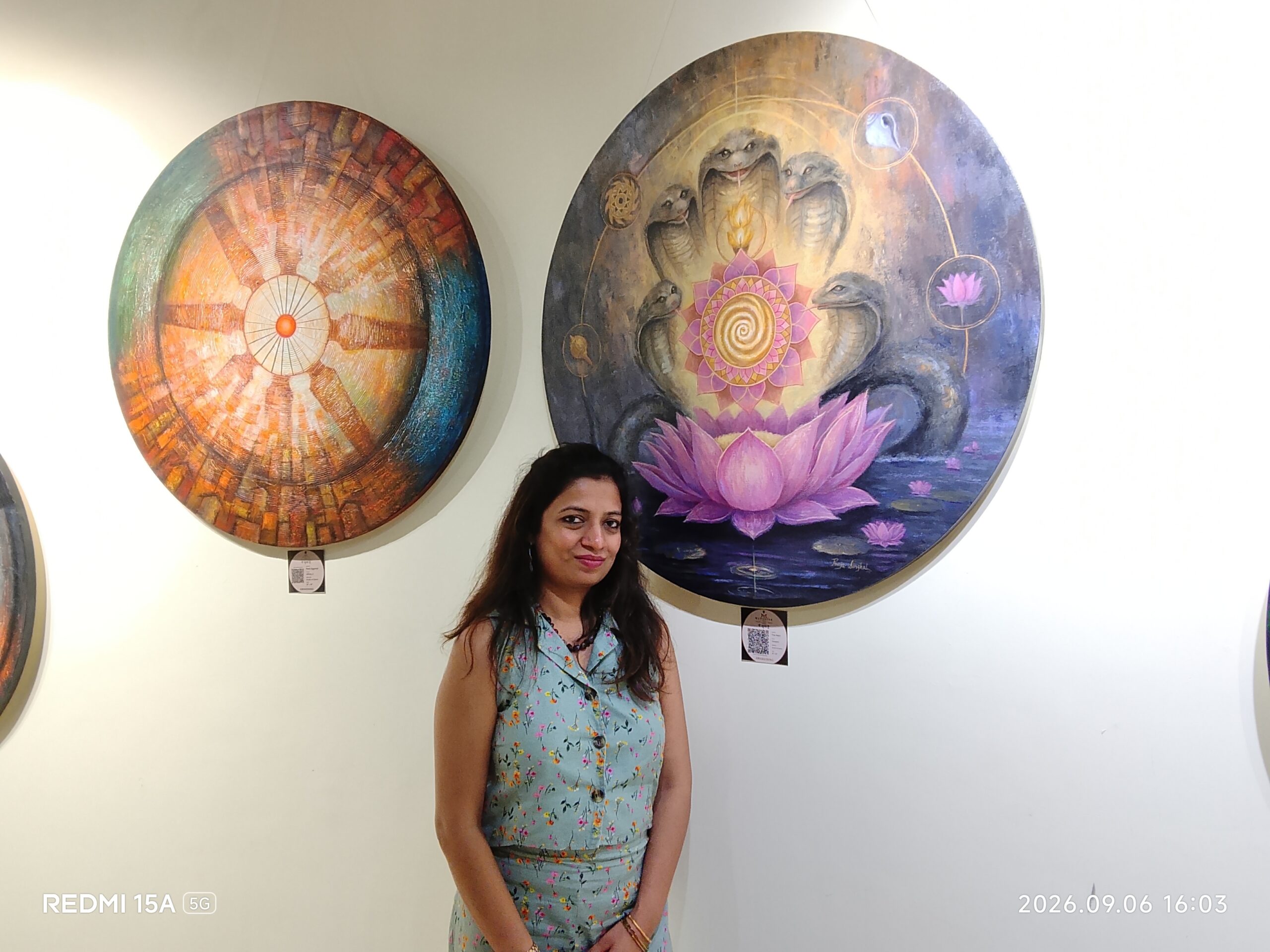
Her artwork Emergence represents the quiet awakening of consciousness — the journey from darkness towards light. Speaking about the piece, she explains: “The lotus rising from the depths symbolises transformation and the unfolding of the soul. The serpents evoke Ananta Shesha, connecting the work with Vishnu and the eternal cosmic energy that sustains the universe, while also suggesting the awakening of the inner self.” She further adds, “The mandala at the heart of the composition becomes a gateway inward, symbolising the continuous unfolding of awareness. Together, these elements reflect a journey of personal awakening and the idea that what we seek outside may already be unfolding within.”
Also Read : Murder, Mystery and Laughter: Play Bitongsho Brings Classic Comedy Alive
Floral Rhythms of Reflection
For artist Shruti Bhalla, art is more than expression– it is a source of joy, balance and introspection. With a Master’s in Fine Arts, Bhalla has built her creative journey through teaching, experimentation and a deep connection with nature.
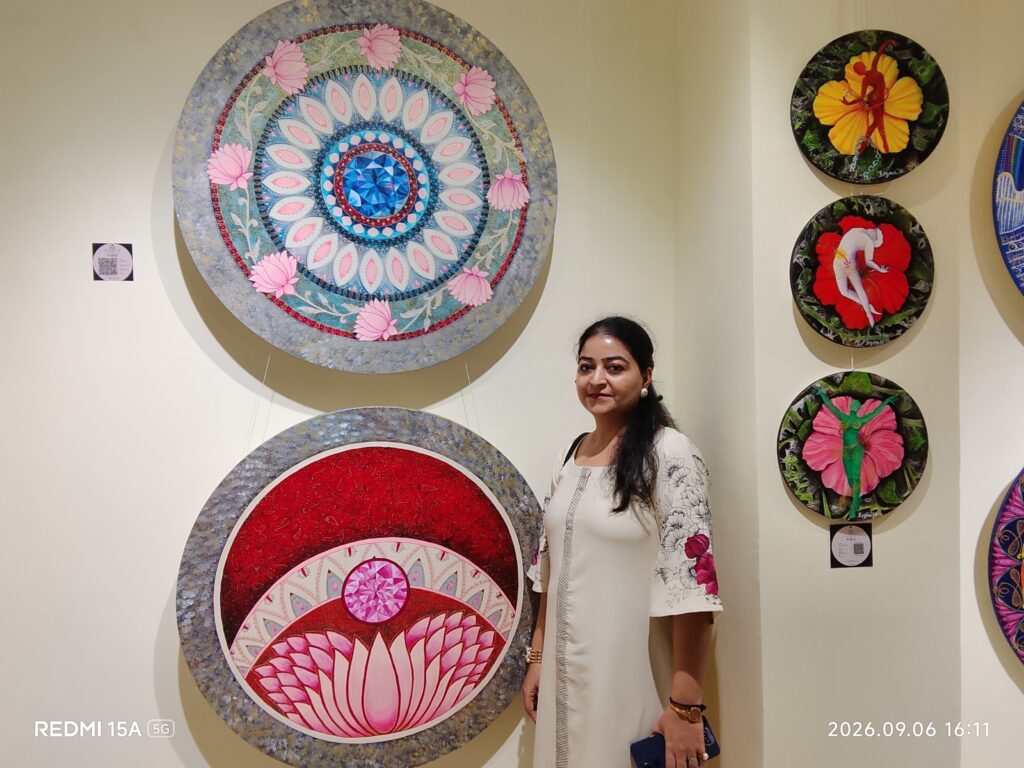
Her interest in art began during her school years and developed into a serious practice in college, when she started teaching art. She says the exchange of ideas with students has played an important role in shaping her own artistic journey.
Bhalla’s work focuses on floral compositions and intricate line art, created through pen and ink, watercolours, acrylics and mixed media. Her compositions explore rhythm, repetition, natural growth and inner transformation.
Among her notable works are Whispers of Clarity, a floral mandala featuring blue topaz and lotus imagery, and Whispers of Love, which uses rose quartz and lotus motifs to explore love, compassion, self-love and emotional healing.
“Teaching has shaped me as much as my own practice,” Bhalla said, adding that her work seeks to create “a calm and reflective” visual experience.
Through delicate floral forms and meditative compositions, Bhalla invites viewers to pause and reconnect with themselves, transforming nature’s quiet patterns into a language of calm, balance and inner clarity.
Also Read : Purbo Diganta Foundation Celebrates 7th Annual Day and Founder’s Day with Cultural Extravaganza
Art as a Gateway to Inner Harmony
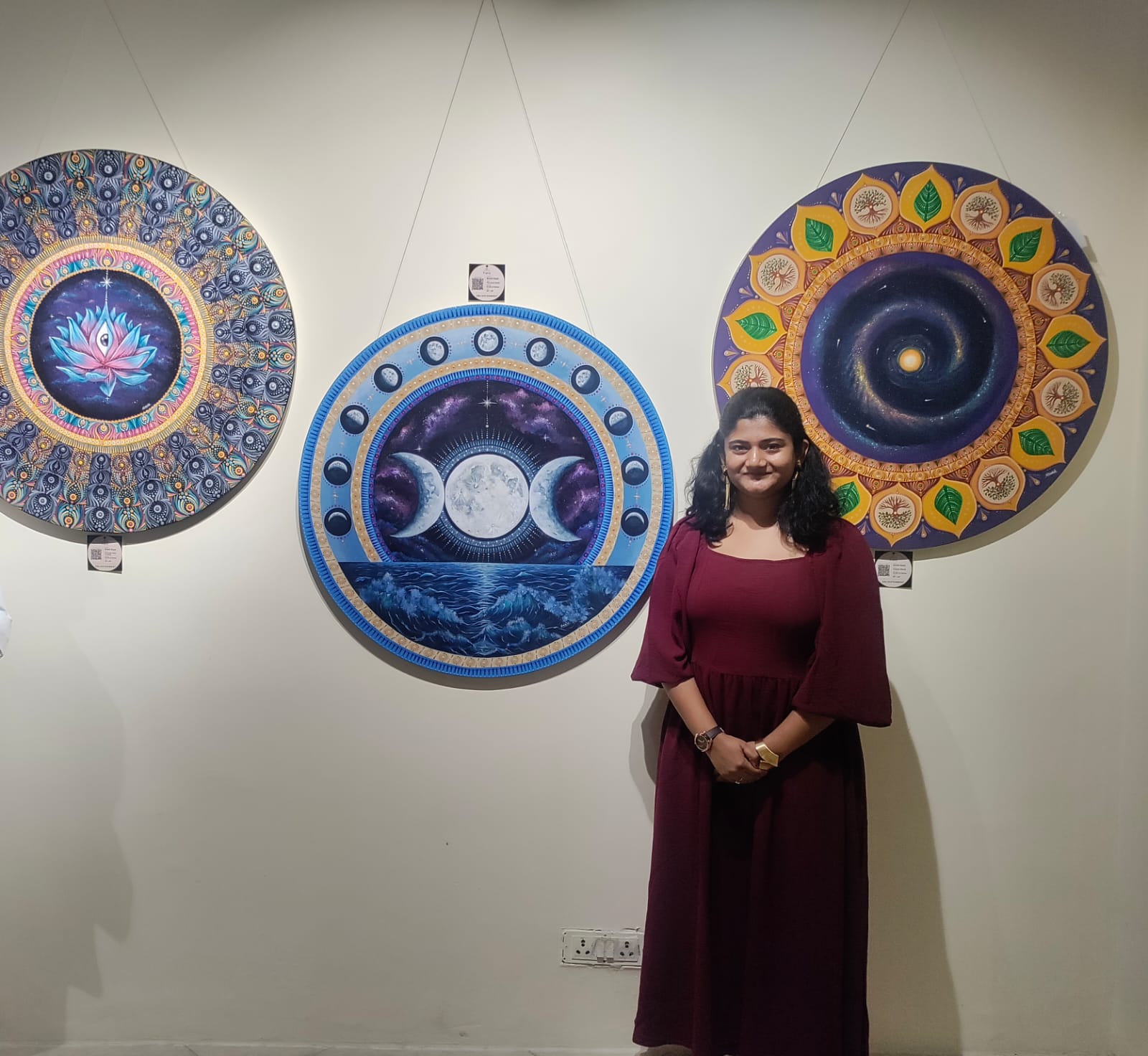
Srishti Goyal is a Spiritual Visual Artist and Visual Designer with eight years of professional experience. A BFA graduate from Kurukshetra University and currently pursuing her MFA, her artistic practice explores the intersection of spirituality, nature, cosmic intelligence, and human consciousness. Working across canvas, paper, and digital mediums, her work is rooted in sacred geometry, intricate detailing, symbolism, and meditative compositions. She views art as a conscious medium for translating spiritual ideas and subtle energies into visual experiences. Inspired by spiritual philosophy and Vastu principles, her practice aims to create harmony within spaces while making deeper concepts more accessible, relatable, and experiential.
Her acrylic-on-canvas creation, The Lunar Ocean Within, reflects the inner tides of human emotion. She describes it as an inner ocean where feelings move, settle, and reveal what lies beneath. Just as the moon draws tides from the ocean, its phases echo the rhythms of our inner world. The full moon brings hidden emotions into light, while calm waters reflect clarity and stillness. Rising waves represent the inner churning that allows recognition, understanding, and release of what has long remained unseen. For her, enlightenment begins when we learn to witness these tides with awareness and find stillness within them.
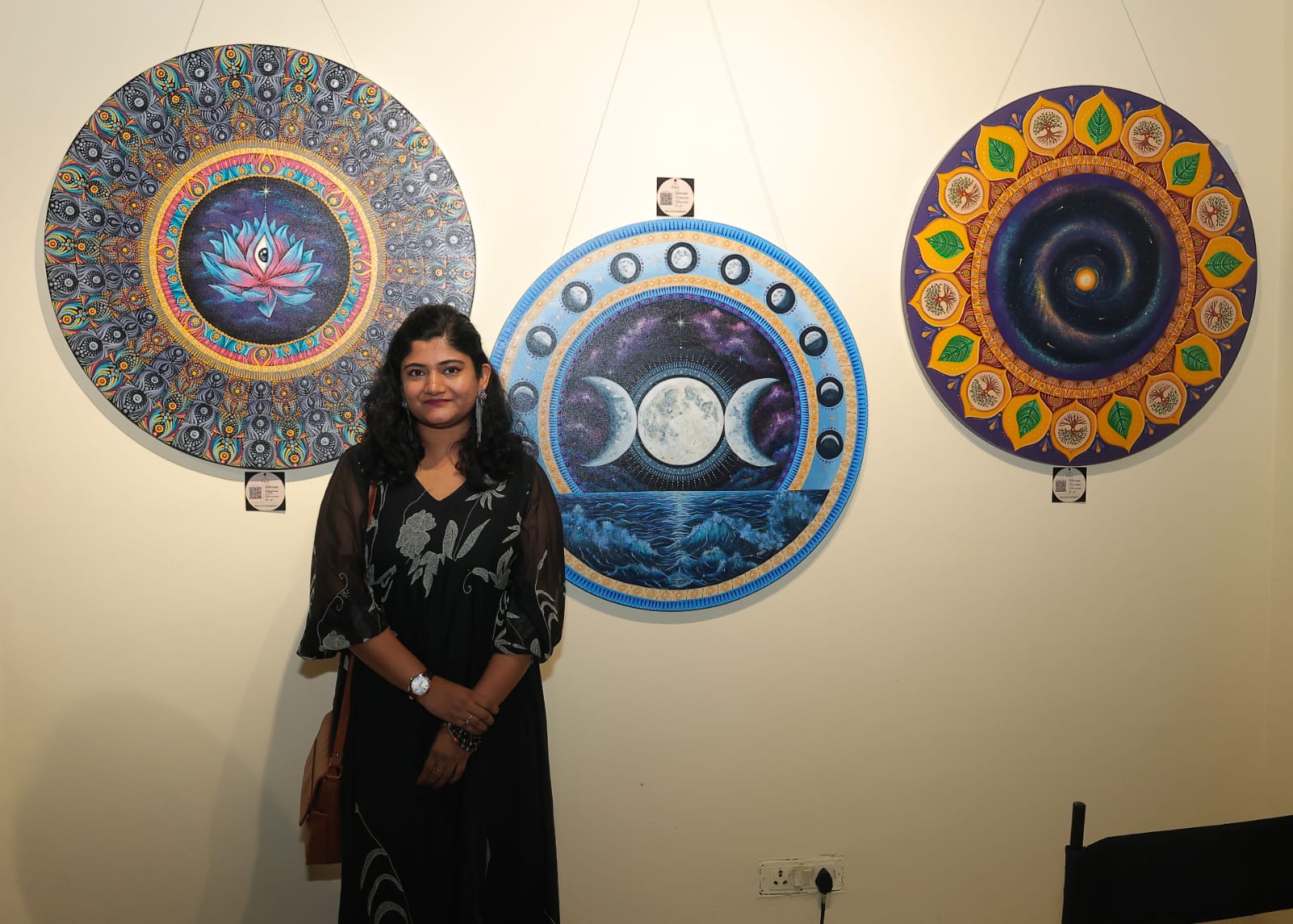
In The Grounded Vessel of Infinity, she explores the duality of earth and space. The Tree of Life symbolises the need to remain rooted while growing in awareness, while the cosmic centre represents consciousness held within the earthly vessel. The work reflects enlightenment not as an escape from the physical world, but as awakening to deeper consciousness and embodying that awareness in everyday life.
Also Read : IFFD 2026 Launches Nationwide AI Filmmaking Hackathon to Redefine Storytelling
Her third work, The Womb of Cosmic Flow, portrays the quiet universe within each of us — a sacred space where consciousness can heal, grow, and awaken. The blooming lotus represents this awakening, with its open eye symbolising the moment of true inner vision. Surrounded by a protective field of energy, the Cosmic Womb reflects the eternal flow of existence, receiving what nourishes and releasing what no longer serves. For Srishti, enlightenment is not about becoming someone else, but about returning to the awareness of who we truly are.
Honouring artistic excellence, Manantar recognised creators whose works resonated deeply with the five stages of the मैं शून्य हूँ journey. Awards were conferred across Awakening, Seeking, Transformation, Enlightenment, and Peace, alongside the Shunya Award and the Curator’s Choice. These honours celebrated not only the mastery of technique but also the artists’ profound engagement with concept, emotion, and consciousness.
Recipients are: Awakening Honour — Nishika Chopra, Seeking Honour — Ekta Adwani, Transformation Honour — Sapna Aggarwal, Enlightenment Honour — Ranjana Sharma, Peace Honour — Mitali Asthana, Shunya Award — Neeti Aggarwal and Curator’s Choice Award — Seema Sinha. Through these recognitions, Manantar reaffirmed its belief that art is more than what we see — it is what stirs within us. Form may dissolve, but meaning endures.