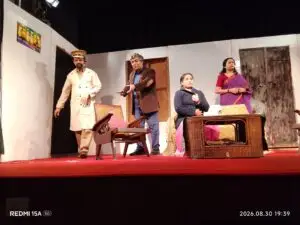
Dilip Guha, Sasraya News ★ New Delhi : The centenary celebrations of world-renowned Italian playwright and Nobel Prize-winning author Dario Fo were marked by a special Bengali theatrical presentation of Parchhi Na, Dichchi Na, staged by the Chittaranjan Park Bangiya Samaj on Saturday and Sunday, 29th & 30th Aug, 2026 at their auditorium in C R Park, New Delhi.
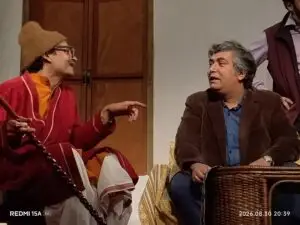
The production was based on Fo’s celebrated 1974 play Can’t Pay? Won’t Pay! and featured a Bengali adaptation translated by Manas Roy and directed by Shri Siddhartha Dasgupta. The play, known internationally for its blend of satire and farce, brought Fo’s distinctive theatrical language to a contemporary Bengali audience.
Also Read : New Hope and Light: Commemorating 163 Years of Swami Vivekananda at Vivek Utsav 2026 in Delhi
Fo, who received the Nobel Prize in Literature in 1997, was much more than a playwright. He was also a theatre director, set designer, songwriter and political activist. His theatrical style drew considerable inspiration from Commedia dell’arte and street theatre, traditions that gave his works their characteristic combination of humour, social criticism and political commentary.
Parchhi Na, Dichchi Na bangla version, retained this spirit, presenting a sharply humorous yet socially relevant narrative. Despite having been written decades earlier, the themes of the play continued to resonate with contemporary Indian society and offered the audience an opportunity to view familiar social realities through the lens of satire and farce.
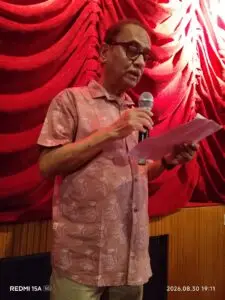
The production also received a goodwill message from Andrea Anastasio, Director of the Italian Embassy Cultural Centre. Addressing the production’s director, described the initiative as “highly impressive and truly appreciable” and wished the team success with the event.
The director also informed that the staging also carried a connection with Delhi’s theatre history. Parchhi Na, Dichchi Na had previously been produced in 1990 by the well-known Delhi theatre group Dhumketu on the AIFACS stage. The new presentation thus revisited a work that had already found a place in the city’s theatrical tradition while introducing Fo’s enduring satire to another generation of theatre-goers.
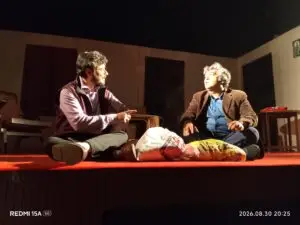
Through laughter, absurdity and social observation, Parchhi Na, Dichchi Na celebrated the enduring relevance of Dario Fo’s theatre and demonstrated how a play written in 1974 could continue to speak meaningfully to audiences decades later.
Also Read : Poush Mela & Folk Festival: Bengal’s Heritage Blooms in Delhi
Strong Ensemble Drives the Energy of Parchhi Na, Dichchi Na
The cast featured Ritoja Basu as Anima, Debasmita Thakur as Mamata, Shubhayan Ganguli as Bimal, Shiladitya Bhattacharya as Samar, and Priyadarshi Banerjee in multiple roles including Sergeant, Inspector, Undertaker and Jethamoshai. The ensemble’s performances formed the core of the production, bringing energy and comic timing to Fo’s satirical world.
The technical and production team included Ranjan Basu for lighting, Sridatri Bhattacharyya for music and sound effects projection, Dilip Chakraborti for makeup, Sudip Biswas for set design, Sudip Ghosh and Ruma Dasgupta for stage management and Joydeep Bhattacharyya as production manager
Storyline of the play:
Set in a working-class suburb of a city, the play begins when rising prices and worsening economic conditions push a group of housewives to the point of desperation. Unable to afford basic necessities, they stage a spontaneous protest at a local supermarket and, in the chaos, empty the shelves and take away groceries without paying.
Also Read : Kisaanka Expands Footprint with Delhi Launch, Strengthening Farmer Empowerment
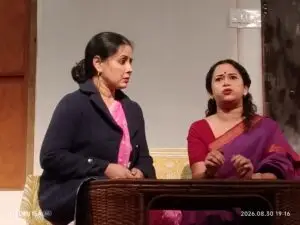
Among the women is Anima, who is immediately worried about how she will explain what has happened to her husband. Rather than admitting that she has participated in the supermarket raid, she and the other women invent increasingly absurd stories to conceal their actions.
The situation becomes more complicated when their husbands become involved. Anima’s husband is unaware of what she has done, while the police begin investigating the supermarket theft. The women resort to a series of outrageous excuses—including fake pregnancies, invented religious stories, and other elaborate deceptions—to avoid being identified.
Meanwhile, the stolen goods have to be hidden and moved from one place to another. Coffins, an undertaker, and a series of mistaken identities become part of the increasingly chaotic attempt to conceal the groceries. What begins as a protest against inflation therefore develops into a chain of comic disasters, misunderstandings and frantic cover-ups.
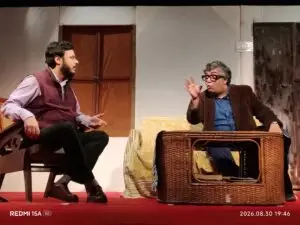
Beneath the farce, however, the playwright makes a serious political point. The women’s decision to take food is presented against a background of unemployment, inflation, class inequality, and economic insecurity. Their slogan of “ Parchhi Na, Dichchi Na !” captures the idea that when people can no longer afford necessities, refusing to pay becomes an act of protest as well as survival.
The play ultimately combines political satire with physical comedy and absurd situations, using the women’s rebellion and the chaos that follows to question economic inequality and the social conditions faced by ordinary working people.
A Bengali adaptation of Dario Fo’s Can’t Pay? Won’t Pay!, drew attention for its brisk pace, comic energy and spirited ensemble performance. The production relies heavily on the chemistry among its performers, who sustain the rhythm of the play while negotiating its sharp social humour. The play retained the sharp political and social flavour of Fo’s original while giving it a distinctly Bengali theatrical idiom.
In terms of performance:
Ritoja Basu, as Anima, brings considerable spontaneity and stage energy to the central character. Her performance balances comic timing with the character’s impulsive responses to the situations unfolding around her. She remains a strong presence through the changing pace of the narrative and the character’s reactions to the increasingly chaotic circumstances.
Debasmita Thakur, a Bharatanatyam dancer by profession, stepped into the theatrical role of Mamata with striking ease. Her presence complements Anima effectively, adding depth to the comic exchanges. “Her expressions and reactions brought a fresh rhythm to the play’s lively interpersonal dynamics,” observed one audience member.
The humour particularly shone in scenes where escalating situations drew laughter through the characters’ spontaneous reactions. The interplay between Mamata and Anima emerged as one of the production’s most engaging highlights, keeping the audience invested in their spirited exchanges.
As Bimal, Shubhayan Ganguli provides a steady counterpoint to the more overtly energetic performances of Anima. His handling of the character’s reactions and his exchanges with the other actors help maintain the rhythm of the scenes. His performance works particularly well within the production’s ensemble framework.
A particularly notable feature of the play was Priyadarshi Bannerjee’s handling of multiple roles—Sergeant, Inspector, Undertaker, and Jyathamoshai. Moving between distinctly different characters, Bannerjee demonstrates versatility and a keen sense of comic timing. His ability to differentiate the characters while keeping the transitions fluid adds variety and energy to the production.
Shiladitya Bhattacharya, as Samar, husband of Mamta, makes a distinct contribution to the proceedings. An assured stage presence and a clear understanding of the comic situations mark his performance. He works effectively with the ensemble and helps sustain the momentum as the narrative develops. His interaction with the other characters added to the rhythm of the scenes and helped sustain the dramatic flow. Linguistics professor Shiladitya has found a second calling in theatre. “My journey began with Rabindra Sangeet, but music soon led me to the stage,” he said.
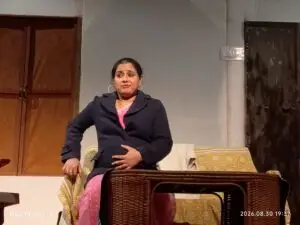
Over the past three years, he has acted in several productions, including playing Dhritarashtra in Ātmodāho, the comeback play of Rangan Natya Dal. “It was my privilege to shape the play’s mood and score,” he noted. Now a regular member of Rangan, Shiladitya credits leader Shri Shubhayon Ganguly for his first steps in theatre. He also acknowledges director Shri Siddhartha Dasgupta of Dhumketu as a mentor. “It is my fortune to learn from such a scholar and seasoned director,” he said. For him, acting is self-discovery. “Each time, I break myself down to rebuild in the shape of a character. That is why my ‘unauthorised entry’ into theatre will continue,” he concluded.
This play’s brilliant farce struck a chord with audiences, feeling remarkably relevant to the present situation in India. When spectators can see reflections of their own times and connect with what unfolds on stage, the production can rightly be called a success.
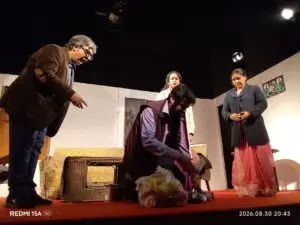
Despite the limitations of the auditorium’s lighting facilities, Ranjan Basu delivered commendable work in designing the lights. The director deserves praise for assembling such an engaging performance, while special appreciation goes to Dilip Chakraborty for his meticulous makeup design.
Reflecting on the production, the director remarked, “The only thing I can tell is that I am fortunate to have a young and talented team who could deliver my conception of the play. I am grateful to them.”
Taken together, the performances create a cohesive ensemble. Rather than functioning as isolated comic turns, the actors build upon one another’s timing and reactions, which helps keep the production moving at a lively pace. The performers’ collective energy, supported by Dasgupta’s direction, appears to have been a key factor in keeping the audience engaged throughout.
The result was an entertaining and energetic theatrical experience in which the performances remained central to the production’s appeal. The cast’s ability to maintain pace and ensemble chemistry ensured that the audience remained engaged while the play delivered its sharper observations on society and everyday struggles.
The production ultimately succeeds through the combination of its socially relevant subject, comic treatment, and committed performances. The cast’s ability to sustain the pace while allowing the humour to emerge naturally gives the adaptation an accessible and entertaining theatrical quality.
Also Read : National Theatre Festival: 18th All-India Bangali Short Drama competition concluded successfully.