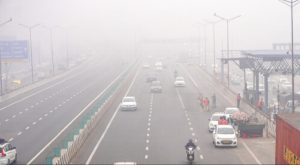
Delhi’s air quality remains ‘very poor’ with AQI over 370 as thick smog blankets the capital
Dilip Guha ★ Sasraya News, New Delhi : Delhi-NCR reeled under harsh winter conditions on December 18 as dense smog, biting cold, and severe air pollution continued to blanket the region. Delhi and the entire NCR are witnessing a strong combination of dense fog and pollution today, December 18. Thick smog significantly reduced visibility across the capital, while air quality remained in the very poor to severe category, with the Air Quality Index (AQI) crossing 370 in several areas. The India Meteorological Department (IMD) issued a yellow alert for smog-like conditions, warning of poor visibility during early morning and night hours, as hazy skies and limited sunshine intensified the winter chill. “The sky will remain largely hazy, with very little sunshine throughout the day, making the winter chill feel more intense.”
Weather conditions remained gloomy across Delhi and surrounding NCR cities, including Noida, Gurugram, Ghaziabad, and Faridabad. Daytime temperatures hovered around 18°C, while minimum temperatures dipped to nearly 8°C. Cloud cover dominated most of the day, preventing adequate sunlight, while cold north-westerly winds added to the discomfort. According to the IMD, temperatures are expected to fall further over the next two to three days, making mornings and nights increasingly colder.
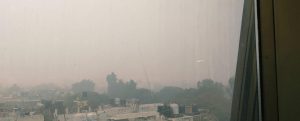
Air pollution emerged as a major concern, with several areas recording dangerously high AQI levels. RK Puram reported an AQI of 374, while the Jawaharlal Nehru Stadium area recorded 349, both falling in the very poor category. Najafgarh showed relatively lower levels at 284, though it too remained enveloped in toxic smog. With no rain or strong winds forecast, pollutants remained trapped near the surface, worsening air quality and posing serious health risks, particularly to children, the elderly, and people with respiratory ailments.
Expressing concern, 68-year-old Ramesh Kumar, a resident of East Delhi, said, “The cold and pollution together make it very difficult to breathe. I have stopped my morning walks because my chest feels heavy.” Echoing similar worries, a working woman from Noida, Priya Sharma, said, “Stepping out early for work has become exhausting. The smog irritates the eyes and throat, and it feels unsafe to commute in such low visibility.” A college student from South Delhi added, “The air smells toxic, and even short outdoor activities cause headaches and coughing. It’s affecting our daily routines.”
In response to the deteriorating air quality, the Commission for Air Quality Management (CAQM) invoked all GRAP Stage-IV measures across Delhi-NCR. The toxic smog also disrupted visibility, affecting road, rail, and flight operations, while smoggy conditions extended to parts of Uttar Pradesh, including Ayodhya.
Large parts of the capital were blanketed by a dense layer of toxic smog, significantly reducing visibility and causing discomfort for residents. RK Puram was shrouded in thick smog, with an AQI of 374, placing it in the ‘very poor’ category, according to CPCB.
A thick layer of smog also engulfed areas around Jawaharlal Nehru Stadium, with an AQI reported to be 349, placing the area in the ‘very poor’ category. The AQI around the Najafgarh area was a bit low, and reported to be 284, though it was surrounded by a toxic smog as well, according to the CPCB data.
CAQM (Commission for Air Quality Management) has invoked all GRAP Stage-IV measures in Delhi-NCR to control pollution levels in the capital.
A thick layer of fog also blanketed the city of Ayodhya in Uttar Pradesh.
According to AQI categorisation, 0-50 is ‘good’, 51-100 ‘satisfactory’, 101-200 ‘moderate’, 201-300 ‘poor’, 301-400 ‘very poor’, and 401-500 ‘severe’.
Earlier, the Commission for Air Quality Management in NCR and Adjoining Areas (CAQM) deployed 19 teams for a road-inspection drive on December 12.
This drive was conducted as part of the Commission’s ongoing monitoring and enforcement under the statutory framework and provisions of the extant GRAP. According to the release, a total of 136 road stretches within the Delhi Development Authority (DDA) jurisdiction were inspected across Delhi.
According to the final compiled data, 15 road stretches exhibited high visible dust levels, 38 showed moderate dust, 61 recorded low dust intensity, and 22 stretches had no visible dust. Road stretches with accumulation of MSW and C&D waste were reported to be 55 and 53, respectively. 6 stretches were reported to have evidence of MSW/ Biomass burning, the release said.
The above observations clearly indicate gaps and recurring negligence in the maintenance of the affected stretches. It highlighted the need for DDA to enhance operational efficiency and implement prompt corrective measures through consistent, timely dust-mitigation interventions. The agency also needs to improve compliance across all road stretches for MSW/Biomass burning, it was highlighted.
The Commission emphasised that such lapses directly contribute to rising particulate matter levels in Delhi and called for strengthened on-ground action. It stressed the need for regular mechanical sweeping, timely dust disposal, maintenance of road shoulders and central verges, effective water sprinkling and dust-suppression measures, and stricter enforcement to prevent open burning across all DDA-maintained stretches.

The deteriorating air quality has prompted the Commission for Air Quality Management (CAQM) to invoke all GRAP Stage-IV measures across Delhi-NCR, triggering the latest enforcement push by the city government. The restrictions are aimed at curbing emissions from vehicles, construction activity and dust, as authorities step up on-ground action to prevent further deterioration in pollution levels.
What is banned or restricted in Delhi from today
· Fuel for vehicles without a valid PUC: Vehicles without a valid Pollution Under Control (PUC) certificate will not be supplied fuel at petrol pumps.
· Entry of non-BS VI vehicles from outside Delhi: Only BS-VI compliant vehicles registered outside Delhi are permitted to enter the city.
· Trucks carrying construction material: Such vehicles remain banned from entering or operating in Delhi.
· Construction activity: Construction work continues to be prohibited under GRAP norms, with strict action promised against violators.
· Full workforce attendance: Government and private establishments are required to operate with 50 per cent work from home to reduce vehicular congestion.
Enforcement teams, ANPR cameras and police deployment at petrol pumps and border checkpoints will regulate and restrict polluting vehicles.