Dilip Guha, Sasraya News ★ New Delhi : Rabindranath Tagore’s Chaar Adhyay is a work that refuses to offer easy answers. Written against the turbulent backdrop of India’s freedom struggle, the novel examines revolutionary idealism, political violence, loyalty, love and the difficult choices that arise when an individual’s conscience comes into conflict with a larger political cause. Bringing this complex work to the stage is therefore a demanding theatrical exercise.
Navapalli Natya Sanstha, a Bengali literary and theatre organisation based in Delhi, took up this challenge with its full-length Bengali production of Chaar Adhyay, dramatised by Biswajit Sinha and Soma Sinha and directed by Biswajit Sinha. The production formed part of the organisation’s continuing effort to preserve and popularise Bengali literature and theatre among audiences in the capital, particularly the younger generation.
For more than 15 years, the group has presented literature-based productions, including works inspired by Tagore and Bankim Chandra Chattopadhyay. Its earlier Tagore productions included Shesher Kabita, Ghare Baire and Raktakarabi. With Chaar Adhyay, the group ventured into a work that is markedly different in its treatment of politics, psychology and personal relationships.
A difficult Tagore work brought to the stage
Tagore’s Chaar Adhyay, published in 1934, was his final novel and one of his most politically charged works. It examines the psychological consequences of revolutionary politics through characters caught between the ideal of national freedom and the methods adopted in its pursuit.
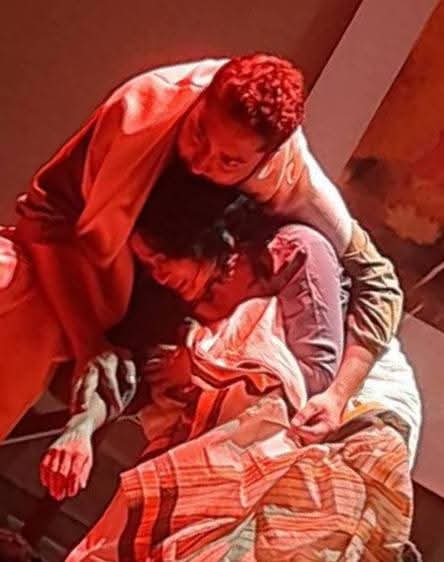
The production retained the central relationship between Atin and Ela while placing it within the charged world of the revolutionary movement. Atin is drawn into the movement through Ela and the powerful influence of Indranath, but gradually finds himself confronting the moral cost of a politics that demands unquestioning obedience. Ela, meanwhile, is torn between her commitment to the revolutionary cause and her feelings for Atin.
The result is not simply a political drama or a love story. It is a study of individuals struggling to retain their identity and conscience in a world dominated by ideology.
Director Biswajit Sinha said the group had chosen the work because of its continuing relevance and its exploration of the relationship between political idealism and human values.
According to Sinha, Tagore’s central concern was that political ideals should never overwhelm humanity. He noted that Tagore had been critical of aggressive nationalism and deeply disturbed by political violence, particularly when ordinary people became its victims. For Sinha, Chaar Adhyay remains relevant in a world still confronted by war, terrorism and political conflict.
Balancing love, revolution and conscience
The production’s strongest dramatic element lay in the interplay between the three central figures—Atin, Ela and Indranath.
As a full-length production of more than two hours, Chaar Adhyay demanded considerable stamina and ensemble coordination. The cast, comprising veteran performers, experienced Delhi theatre actors and newcomers, generally maintained a cohesive stage presence.
The performances were strongest in the character-driven scenes, particularly those involving Atin, Ela and Indranath. The quieter exchanges between Atin and Ela provided emotional depth, while Indranath’s scenes carried the ideological weight of the production.
Pradip Ganguly, a veteran of Bengali theatre and Jatra in Delhi, played Indranath, the charismatic revolutionary leader around whom much of the narrative revolves. His portrayal gave the character an imposing presence, particularly in scenes where Indranath’s authority and ideological conviction influence the younger members of the group.
Ganguly has been associated with theatre in the capital for several decades. He began his performing career with Jatra and Srimati Opera before moving increasingly towards theatre as the traditional form began to lose ground. His association with Navapalli Natya Sansthan spans more than a decade, and his experience brought maturity and restraint to the production.
Soma Sinha, who played Ela, brought another important dimension to the production. She described Ela as significantly different from Nandini, the character she had portrayed in the group’s earlier production of Raktakarabi. While Nandini possesses a more vivacious and open quality, Ela is inwardly complex, disciplined and deeply committed to her political beliefs.
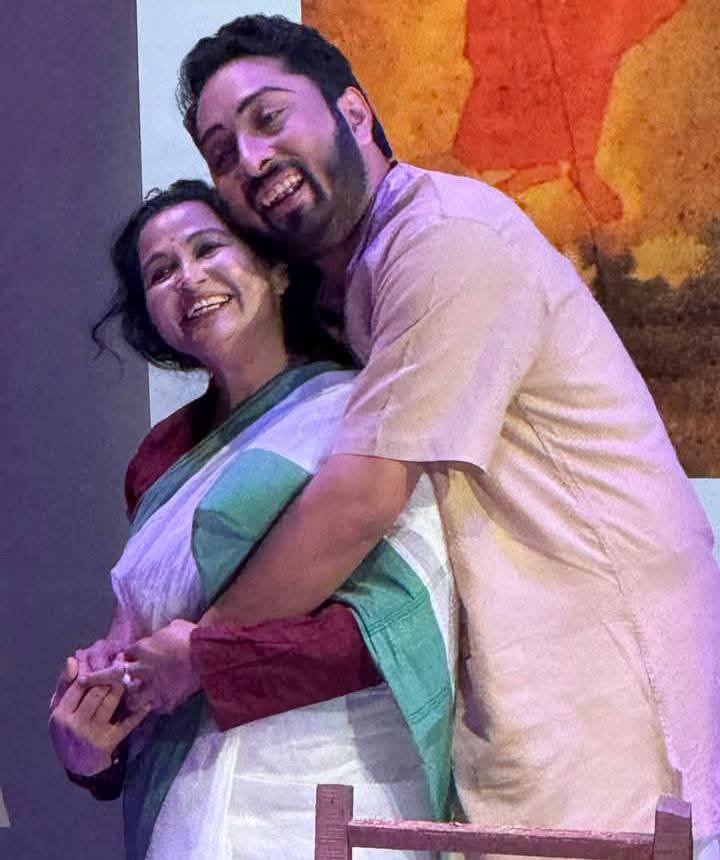
Sinha portrayed Ela as a courageous young woman from an aristocratic family who, after coming to the city for her studies, becomes increasingly involved in the Swadeshi movement. Her attraction to Indranath’s ideology and her relationship with Atin place her at the centre of the play’s emotional and ideological conflict.
Her performance captured Ela’s difficult position between personal love and political commitment. The tragedy of the character emerges not because she lacks conviction, but because her convictions demand sacrifices that ultimately become impossible to reconcile with her personal emotions.
Seshadri Mitra, who played Atin, brought an understated intensity to the role, portraying him as a man caught between conviction and doubt. As Atin’s conflict is largely psychological, the performance effectively conveyed his growing discomfort with the world into which he had been drawn. Mitra was particularly effective in the quieter moments, where hesitation, vulnerability and emotional conflict carried more weight than dialogue. Mitra said the role allowed him to explore a different dimension of performance. He also expressed hope that the production would encourage younger audiences to revisit Tagore’s original text.
Also Read : Delhi Govt to Unveil International Film Festival to Boost Film Tourism and Creative Economy
The supporting cast further strengthened the production.
Pratik Das, as Sukumar, brought energy and conviction to the production. Sukumar represents the uncompromising revolutionary driven by the dream of independence, and Das captured the intensity of a young man consumed by his political ideals. His contribution extended beyond acting, as he was also involved in the stage-design process, reflecting the collaborative spirit of the production, while Pallavi Guha, as Uma, brought quiet strength and emotional depth to the character.
Tapas Chanda, a veteran actor, is the senior-most active actor on stage in the entire Delhi NCR as Naresh Dasgupta, effectively conveying authority and intellectual depth.
Ashish Dutta, as Kanai, delivered an intense and layered performance, while Bilas Chakrabarti, as Botu, brought youthful zeal to the stage. Indrani Chakrabarti, as Mayamayi, stood out for her dignity and compassion. Abhijit Chakrabarti, as Bhogilal, added sharpness and wit, while Roop Sinha impressed with his versatility in the dual roles of a Freedom Fighter and a British Officer.
The impact of Chaar Adhyay was also shaped by the dedicated work of its production team. Gaurav Ganguly, an architect by profession, was awarded for lighting in the National Theatre Festival, 17th All India Drama Competition 2025; his lighting design created an appropriate dramatic atmosphere, while Abhijit Chakrabarti handled the make-up with precision. Pratik Das and Biswajit Sinha handled the minimal stage décor, with Sudeep Biswas overseeing stage execution. Soma Sinha’s costumes added authenticity to the period setting, while properties were coordinated by Pratik Das and Bilas Chakrabarti.
Music played an important role in establishing the production’s mood, with Subhra Das serving as musical director and Kaushiki Deb providing the vocals. Mouli Ganguly Bhattacharya anchored the presentation, while Manosh Chaudhury, as production controller, ensured smooth coordination among the various departments.
The production’s greatest achievement was perhaps its willingness to treat Chaar Adhyay not as a museum piece but as a living text. Instead of simplifying Tagore’s political questions, it allowed the contradictions within the characters and the period to remain visible.
Together, the cast and crew created a cohesive theatrical experience, bringing together acting, music, lighting, costume and stagecraft to present a compelling interpretation of Tagore’s Chaar Adhyay. The production succeeded in combining the play’s political and psychological dimensions with a strong visual and performance vocabulary, keeping Tagore’s concerns relevant to a contemporary audience.
An experimental production
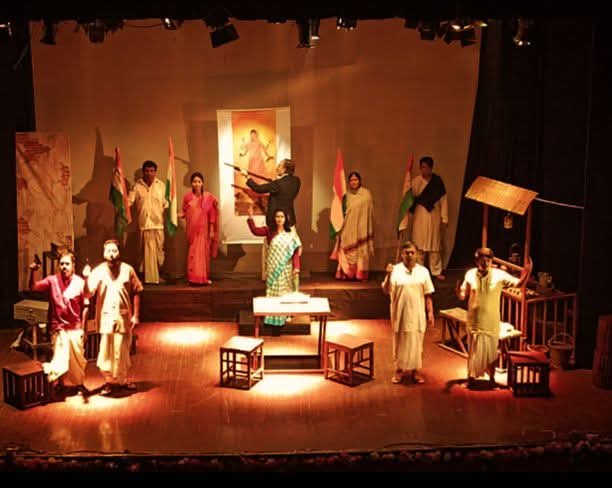
The production did not restrict itself to a conventional dramatic presentation. Biswajit Sinha adopted an epic-theatre approach, bringing together dialogue, poetry, music and selected episodes from the freedom struggle.
The musical treatment was particularly noteworthy. Instead of relying exclusively on Tagore’s compositions, the production incorporated patriotic songs by Rajanikanta Sen and Atulprasad Sen, along with Mohini Choudhury’s Muktir Mandir Sopanotole. The choice expanded the emotional vocabulary of the production and connected the dramatic narrative with the larger cultural atmosphere of the freedom movement.
This experimentation worked best when music and poetry complemented the emotional progression of the narrative rather than functioning merely as decorative interludes. The songs helped establish the historical atmosphere while also creating transitions between personal and political episodes.
Also Read : IFFD 2026 to Celebrate Guru Dutt’s Birth Centenary with 4K ‘Pyaasa’ Screening
The production also incorporated short episodes from the freedom struggle around the central story of Atin and Ela. These additions gave the play a broader historical canvas without substantially disturbing its central narrative.
A Tagore classic with contemporary resonance
Navapalli Natya Sanstha’s Chaar Adhyay ultimately succeeds as an attempt to bring a difficult Tagore text before a contemporary audience. It preserves the novel’s central emotional relationship while opening it out into a larger theatrical narrative about political commitment, personal freedom, love and moral choice.
The production also serves another important purpose: encouraging audiences to return to the original literature. In an age when literary classics are increasingly encountered through abbreviated versions and digital summaries, a stage adaptation such as this can act as a bridge between performance and reading.
For a Delhi-based Bengali theatre group working to keep its literary heritage alive, that is a significant achievement. Chaar Adhyay may not be an easy work to stage or watch, but its complexity is precisely what makes it worth revisiting.
What the audience said
The response from viewers reflected the production’s ability to generate discussion beyond the performance itself.
A Bengali theatre enthusiast from Delhi, who has been associated with theatre audiences in the capital for several years, said the production offered a fresh perspective on a familiar period of Indian history. “What stayed with me was the conflict between the personal and the political. The play does not simply glorify the freedom struggle; it makes us think about the cost of extreme ideological commitment. The combination of acting, music and poetry also gave the production a distinctive character.”
Another viewer, a young Bengali literature enthusiast, said the performance had encouraged her to explore Tagore’s original novel. “I knew Tagore mainly through his poetry and songs, but Chaar Adhyay showed me a very different side of his writing. The relationship between Atin and Ela made the political story much more personal, and the performance made me curious to read the novel in full.”
For Navapalli Natya Sanstha, therefore, Chaar Adhyay was more than another literary adaptation. It was an attempt to keep a difficult and important work of Bengali literature in public conversation—and to introduce its questions to a new generation through the immediacy of live theatre.
Also Read : Teej Festival Organized at Dilli Haat INA and Pitampura