Celebrating Women’s Voices: with Taslima Nasrin’s Poetry, Music, and Theatre Marked International Women’s Day
Dilip Guha, New Delhi.
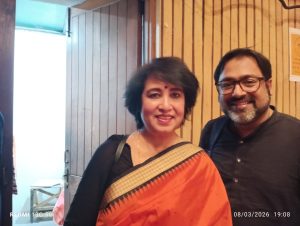
International Women’s Day provided a fitting occasion to celebrate the strength, resilience, and voices of women, highlighting what better way to do so than through the powerful words of Taslima Nasrin, the Bangladeshi-Swedish writer and feminist activist whose work has long challenged patriarchal norms.
Nasrin’s poetry and prose stand as a testament to her unwavering commitment to women’s rights and empowerment. Her books, including Lajja and All About Women, have received wide recognition for their bold and uncompromising portrayal of women’s lives in patriarchal societies. Through literature, she has consistently raised questions about gender inequality, social restrictions, and the struggle for autonomy.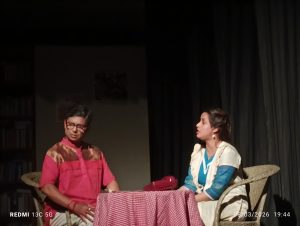
To mark the day, an evening of feminist poetry, songs, and theatrical expression was held at the Muktodhara Auditorium, Delhi, on Sunday, March 8, 2026. The programme was organised by Japonchitro Natya Goshthi, a prominent theatre group in the capital known for staging socially conscious and thought-provoking productions.
The event brought together writers, performers, and audiences in a celebration of women’s voices through literature and music. Nasrin herself attended the programme and recited several of her thought-provoking poems, drawing warm applause from the audience. Accompanying her were musical and poetic performances by Mousumi Hussain, who presented recitations and songs reflecting women’s experiences and identity. To mention, Mousumi Hussain is a well-known singer and composer based on modern Bengali poems. Hussain’s performances echoed the central message of the programme—women’s resilience and the ongoing fight for equality.
On the occassion Taslima Nasrin remarked, “This is not a day of mercy, but a day of claiming rights. Women’s struggle has brought us this day—International Women’s Day.” এটা কোনো দয়ার দিন নয়, বরং অধিকার ছিনিয়ে নেওয়ার দিন। নারীদের সংগ্রামের এই দিন। It is a powerful statement, shifting the focus from charity or pity to rightful recognition and empowerment.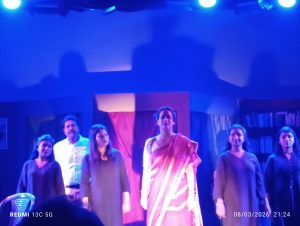
Their performance was not merely a recital; it was an intimate conversation with the audience about the many shades of womanhood.
Taslima Nasrin’s presentations included special pieces such as “Maa Er Kachhy Chiti,” “Mrittuhin Maye,” “Uddyan er Nari,” and “O Maye Sono,” etc. Mousumi Hussain’s presentations also included soulful musical renditions that complemented the poetic themes of the evening.
Taslima’s voice flows like a soft breeze—gentle, controlled, yet firm in conviction. It reflects the quiet strength, resilience, and emotional depth that shape women’s journeys, reminding us that true power often speaks in a calm and steady tone.
What further enriched the experience was Mousumi’s soulful rendition of the songs, seamlessly woven into the thematic narrative. Her voice carried a sense of nostalgia and warmth that resonated deeply with the audience, beautifully complemented by the exquisite musical arrangement of Saurasanta Biswas, which added an emotive dimension to the evening’s poetic performances.
The evening’s main attraction was a stage play, Shodh – Revenge, a theatrical adaptation of Taslima Nasrin’s novel Shodh. Staged after the poetry recitations, the performance carried special significance for International Women’s Day, made even more meaningful by the presence of the celebrated writer herself.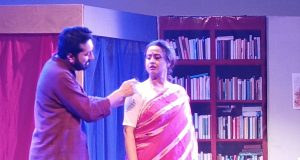
Over the years, Japonchitro Natya Goshthi has staged numerous productions across genres and earned widespread recognition for its artistic excellence. On this occasion, the group presented a full-length adaptation of Shodh, written and directed by renowned stage artist Shuan Bose.
The play explores the realities of a patriarchal culture in which women are often expected to remain obedient and self-sacrificing. Through its central character, the narrative examines questions of identity, autonomy, and the emotional consequences of living under such expectations.
The story follows the protagonist’s personal struggle as she navigates difficult choices about her future. She wrestles with questions surrounding relationships, motherhood, and the meaning of partnership, torn between following a conventional path of family life and pursuing independence and self-discovery.
At the same time, she confronts powerful social pressures that attempt to define how a woman should behave, what choices she should make, and how love, success, and family should be understood. These expectations shape the conflicts she faces and influence the decisions that ultimately determine her path.
Although rooted in a specific cultural context, the play resonates universally. It reflects the experience of many women who struggle to balance personal identity with the demands and expectations imposed by society and relationships.
Ultimately, Revenge offers a poignant commentary on societies where women continue to fight for equality, highlighting the challenges faced by those seeking independence within deeply entrenched patriarchal systems.
The programme concluded with a collective celebration through poetry, music, and theatre, emphasising women’s struggles and rights. As the director noted, the International Women’s Day programme stood as a powerful artistic expression of resistance against oppression and discrimination. Participants and audience members alike experienced the evening as a celebration of solidarity and creativity, reflecting a shared commitment to the ongoing fight for women’s dignity, equality, and freedom