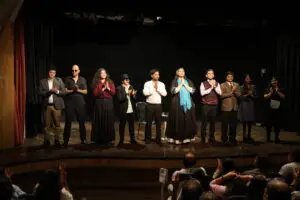
Dilip Guha, Sasraya News Desk ★ New Delhi : The Muktadhara Auditorium in the Capital witnessed an evocative evening of theatre as Articoll Theatre & Pictures presented Zindagi by Chekhov, a production inspired by two short stories of the legendary Russian writer Anton Chekhov—Dukh (Grief) and Nindak (The Slanderer)- on August 22, 2026.
Directed by theatre practitioner Janani Ray and performed by her alongside students from her theatre collective, the production blended humour, poignancy and introspection to explore the complexities of ordinary human life. Through two contrasting stories, the performance offered audiences a glimpse into the timeless humanism of one of Russia’s most celebrated literary figures.
Bringing Chekhov’s Humanism to the Stage
Anton Chekhov (1860–1904), celebrated as both a playwright and short-story writer, remains renowned for his subtle portrayal of everyday life. His writing is distinguished by irony, compassion and an acute understanding of human contradictions. Rather than depending on dramatic plots, Chekhov found extraordinary depth in ordinary people and situations, revealing universal truths about vulnerability, resilience, loneliness and the search for meaning.
Zindagi by Chekhov sought to bring this distinctive spirit to contemporary Indian audiences through the voices and interpretations of emerging theatre artists.
Articoll Theatre & Pictures, a branch of the All India Centre for Urban & Rural Development (AICURD), has been working to make theatre learning and production-oriented training accessible to theatre enthusiasts free of cost. Guided by its philosophy of “Theatre as Therapy,” the initiative uses theatre exercises, creative activities and innovative theatre games as tools for artistic as well as personality development.
The training eventually culminates in full-fledged productions, allowing students to translate their learning into performance before a live audience. Zindagi by Chekhov was one such culmination of sustained training, rehearsals and creative exploration.
AICURD, an NGO established in 1985, has been working to improve the quality of life of marginalised communities through community-based programmes focused on poverty alleviation and socio-economic empowerment, with particular emphasis on elementary education, health and income-generating skills.
Two Stories, Two Shades of Life
The production brought together two markedly different yet deeply human stories.
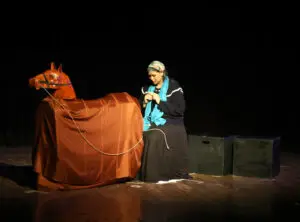
The first, Dukh (Grief), offered an introspective exploration of sorrow, loneliness and endurance. At its heart was the quiet struggle of an individual confronting loss and seeking something profoundly simple—a willing listener.
Also Read : Bharat Tex 2026 -Where India’s Textile Vision Meets the World’s Trade Ambition
Janani Ray, who portrayed the central character herself, delivered a restrained yet emotionally intense performance. Without resorting to melodrama, she allowed the silence, vulnerability and weight of grief to speak for themselves. The audience remained absorbed in the unfolding emotional journey before responding with heartfelt applause.
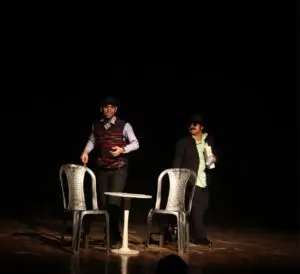
Nindak (The Slanderer), by contrast, took a satirical route to examine vanity, criticism and insecurity. Through wit and comic situations, the story exposed the contradictions of people who are quick to judge others while often remaining vulnerable to the same fears and shortcomings themselves.
Comic timing, exaggerated gestures and lively exchanges brought laughter to the auditorium, while beneath the humour lay a more reflective question: why are people so quick to judge, and what drives the human tendency to seek validation through the opinions of others?

Together, the two plays struck a delicate balance between emotion and satire, reflecting Chekhov’s remarkable ability to uncover humour, empathy and profound human truths within the complexities of everyday life.
Young Performers, Fresh Energy
The student ensemble brought freshness, sincerity and youthful energy to the stage. Their collaborative approach helped create smooth transitions between the contrasting emotional worlds of Dukh and Nindak.
The performers in Nindak: Kunal Gupta, Ajit Koli, Yashasvi Jaiswal, Anjali Marandi, Vijay Vastvik, Srishti Nair, Ritika Kumari, Sneh Charan, and Minora Nair, contributed considerable comic energy and texture to the satire, while the ensemble in Dukh created a restrained theatrical atmosphere that allowed the protagonist’s emotional journey to remain at the centre.
Director Janani Ray effectively brought the two contrasting pieces together while giving the young performers space to express their individual strengths. Her understated directorial approach, complemented by minimalist staging, kept the focus on the actors, their expressions and the narratives, allowing the emotional depth of the stories to emerge without relying on elaborate sets or theatrical embellishments.
More importantly, the staging represented the culmination of an intensive learning process. For the students, the production was an opportunity to transform months of theatre exercises, games, training and rehearsals into a shared live experience.
The production was supported by a dedicated creative and technical team. Amit Bansal served as the Production Manager, with Ranjan Basu handling Light Design and Sudip Biswas taking care of Make-up and Set-up. The distinctive props, including the horse and fish featured in Bar-be-Cue, were designed by Articoll student Vijay Vastvik. Minora Nair and Janani Ray contributed the music, while Vipul Rajguru took charge of anchoring.
Despite a few minor technical and coordination glitches typical of live theatre, the performers maintained their composure and carried the production forward with energy and sincerity.
A Resonant Evening of Theatre
By bringing Chekhov’s stories to the stage through the voices of emerging theatre artists, Zindagi by Chekhov reaffirmed the continuing relevance of his observations on human nature.
The production demonstrated how stories written more than a century ago can still speak directly to contemporary audiences—about grief that often remains unspoken, the need for empathy, the tendency to judge, and the contradictions that shape everyday relationships.
For the young performers, the evening represented more than a stage appearance. It was the culmination of a learning journey and an opportunity to experience the transformative power of theatre firsthand.
With its blend of laughter, emotion, introspection and empathy, Zindagi by Chekhov became more than a theatrical presentation. It emerged as a celebration of literature, a platform for emerging talent and a reaffirmation of theatre’s enduring ability to bring people closer to themselves—and to one another.
“Kindness and Empathy” at the Heart of Zindagi
Speaking about the production, director Janani Ray said:
“Zindagi by Chekhov is special to me because it portrays the underlying complexities of everyday life that on the surface appear to be normal. We don’t always choose to hide our pain; sometimes we are compelled to do so and suffer in isolation because everyone else is engrossed in their own struggles. No one is spared from it. However, perhaps if we try sharing our pain, if someone finds merely a sympathetic ear when one really needs it, to get the pain off one’s chest, maybe just maybe, things will be better. All it takes is a little empathy, probably even to make the entire world a better place. Kindness and empathy.”
Reflecting on the judgmental nature of society, she added:
“Another aspect is the judgmental side of society: why do we judge so much? Why can’t we live and let live? The classic fear of ‘log kyakahenge’ sometimes is precisely how we give people a chance to talk in the first place. The beauty of Chekhov lies in these small yet profoundly significant insights into human complexity and psychology. The layers he unfolds, the subtle undertones beneath seemingly simple situations, are what make Chekhov so intriguing and meaningful.”
Ray said Chekhov’s enduring appeal also lies in the ability of contemporary audiences to recognise themselves in his characters.
“How timelessly individuals can relate to his characters is uniquely interesting. Simple stories that convey such deep and powerful messages—that is what Chekhov is for me: absolutely beautiful, even in its pain & darkness!”
Theatre’s Biggest Challenge: Sustaining the Art
While the production celebrated the power of theatre, Ray also spoke candidly about one of the biggest challenges facing theatre practitioners—funding.
Quoting John Steinbeck, she observed:
“Theatre is a magical art form. There is a quote by John Steinbeck: ‘The theatre is the only institution in the world which has been dying for four thousand years and has never succumbed. It requires tough and devoted people to keep it alive.’ It makes me sad how such a life-changing art form is struggling to just exist, and that too, this has been the state for so many years now.”
For Ray, the challenge is particularly significant because she has been teaching theatre free of cost for nearly eight years while trying to provide students with opportunities to participate in professional productions.
“Our real challenge as theatre workers is always funds. I have been teaching theatre for free to everyone willing to learn for about eight years now, always trying hard to create a platform for students to finally showcase their talent in a full-fledged production, but I always struggle to collect enough funds to stage a production qualitatively.”
She also spoke about her efforts to secure institutional support.
“I have been applying for government grants for the last five years unsuccessfully; it is something that will be immensely helpful to us to keep working towards our cause. It is purely on willpower that we are pushing forward, as had it been for the circumstances, I should have quit long ago.”
Ray expressed hope for a more sustainable support system for theatre practitioners and organisations working at the grassroots.
“I really wish we could find a systematic way to gather enough funds when it is required, to keep the ball rolling, keep working towards taking the magic of theatre to people, and work in this field without any insecurities regarding our survival.”
She credited AICURD and her family for supporting her theatre journey:
“My NGO, All India Centre for Urban & Rural Development (AICURD), has been my only support system for all the years that I have spent pursuing my passion for theatre. Without the support of my AICURD family, my father and my sister, I don’t think I would have come so far. I am forever grateful to them.”
A Message to the Digital Generation
One of the most significant reflections to emerge from Janani Ray’s conversation was her emphasis on the continuing relevance of theatre in an increasingly digital and AI-driven world. For her, theatre offers something technology cannot easily replicate—the immediacy of human presence, emotional exchange and genuine connection.
Ray believes today’s youth possess two qualities that can become powerful foundations for leadership—curiosity and zeal. At the same time, she feels that young people need spaces that help them remain connected to their creative and emotional selves amid the overwhelming influence of the digital world.
Speaking about her message to the younger generation, she said:
“The youth today is curious and driven; these are two very strong qualities to build leaders. In this digital age, I would like them to learn about the beauty and magic of theatre. I feel theatre is a field that probably will never face a major threat from something like AI. Theatre is live; it is the human connection that makes it so effective and relevant. Nurturing your artistic side through theatre can keep one connected to their core because the digital life can get a bit confusing and even a bit misleading sometimes.”
Her observation underlines what she sees as theatre’s greatest strength: its irreducibly human character. Unlike digital experiences, theatre unfolds in real time, between real people, creating a shared emotional space that cannot be completely replicated by technology or artificial intelligence.
For Ray, therefore, theatre is not merely an art form or a means of entertainment. It is a way of building confidence, nurturing creativity, understanding emotions and strengthening human relationships. In a world increasingly shaped by screens, algorithms and virtual interactions, she sees theatre as an important space where young people can pause, engage with others, explore their own artistic instincts and reconnect with their core.
This philosophy also lies at the heart of Articoll Theatre & Pictures’ work—using theatre not only to train performers, but to encourage self-discovery, empathy, creative expression and meaningful human connection. In that sense, Zindagi by Chekhov was not simply a production by young theatre enthusiasts; it was also a reminder of why the live arts continue to matter in the digital age.
Also Read : Teej Festival Organized at Dilli Haat INA and Pitampura