Dilip Guha, New Delhi : The Indraprastha Cultural Festival (ICF) 2026 concluded on April 5 at the India Habitat Centre, Lodhi Road, marking the culmination of a three-day celebration that blended art, intellect, and cultural introspection. Organised by the Delhi Government in collaboration with Sarayu Trust and Garuda Prakashan, the festival emerged as a significant platform to rediscover the capital’s layered identity through the theme of “Delhi Unseen.”
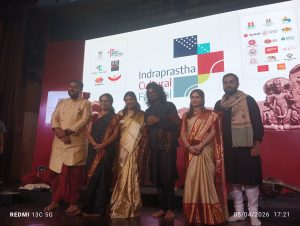
More than a conventional cultural gathering, ICF positioned itself as a movement to uncover forgotten histories, revive overlooked traditions, and amplify lesser-known artistic voices. As an organising partner, Sarayu Trust played a central role in shaping this vision, reinforcing its long-standing commitment to cultural preservation and community empowerment. Established in 2007, the Trust has supported grassroots initiatives in education while also contributing to broader conversations on Indian civilisation and heritage.
Read : IFFD 2026 Launches Nationwide AI Filmmaking Hackathon to Redefine Storytelling
Through its initiatives, the Sarayu Foundation Trust has emerged as a significant voice inspiring a paradigm shift in how ordinary Indians perceive their heritage. Envisioning Bharat as a nation-state that safeguards, nurtures, and celebrates indigenous traditions, cultures, and values, the Trust is dedicated to serving underprivileged and marginalised communities, revitalising Indian Knowledge Systems, and promoting Bhartiya culture. Guided by this vision, its mission is to help Indian society regain its excellence and glory by fostering cultural pride, encouraging informed dialogue, and enabling inclusive empowerment.
Garuda Prakashan, a rapidly growing Indic publishing house with over 300 titles, complemented this vision by fostering intellectual engagement rooted in rigorous scholarship. Together, the collaborators curated a festival that seamlessly bridged heritage with contemporary discourse.
The opening day set an immersive tone with performances, exhibitions, and interactive sessions that celebrated Delhi’s cultural depth. Addressing the inaugural gathering, Sarayu Trust Founder Rahul Dewan highlighted the city’s underexplored heritage, noting that Delhi is often reduced to a “makbara town,” despite its vast and diverse cultural landscape. He emphasised that the festival sought to reintroduce Delhi as a living, evolving cultural entity.
Read : Priyanka Mohan Walks the Red Carpet at IFFD 2026; Made In Korea Garners Global Acclaim
Echoing the importance of narrative ownership, Garuda Prakashan Founder Sankrant Sanu underlined that a civilisation must tell its own stories to sustain itself. He described ICF as both a literary and cultural revival initiative aimed at reclaiming indigenous perspectives.
Inaugurating the festival, Delhi’s Minister for Art, Culture & Languages and Tourism, Kapil Mishra, framed ICF as part of a broader effort to challenge entrenched narratives through fact-based discourse. He described the festival as a step toward a cultural renaissance, emphasising Delhi’s identity as a “Mini India” where traditions from across the country converge and flourish.
A highlight of the opening day was the screening of the documentary Delhi Unseen, featuring renowned actor Rakesh Bedi alongside historians and experts. The film explored lesser-known facets of the city—from the ancient Aravalli range to sites like Khooni Jheel and Purana Qila—blending research with accessible storytelling.
The festival’s intellectual depth was further reflected in sessions featuring prominent voices. Sanjeev Sanyal shared insights into the INSV-Kaundinya stitched-ship project, while J. Sai Deepak raised critical questions about legal frameworks and the interpretation of secularism in India.
Day two shifted focus to contemporary challenges, particularly technology and sovereignty. In a keynote on “Technology & Swarajya,” Rajiv Malhotra stressed the urgent need for India to achieve technological independence, especially in artificial intelligence. He cautioned that reliance on foreign systems could undermine long-term sovereignty, arguing that soft power must be supported by tangible strength and innovation.
The day also saw the launch of Sanu’s book The Third Republic: Re-imagining the Indian State, which called for a national dialogue on India’s governance framework. Complementing the intellectual sessions, a YouTubers’ Conference led by RJ Raunac offered practical insights into digital storytelling, reflecting the festival’s engagement with new-age media.
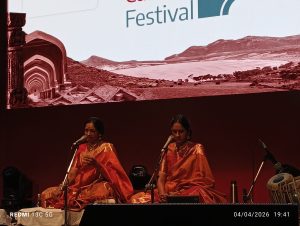
Cultural performances remained integral throughout. From Parvathy Baul’s spiritually resonant exploration of chakras and Shakti to the acclaimed Carnatic duo Ranjani and Gayatri’s evocative musical presentation, the festival celebrated India’s artistic diversity.
As leading exponents of Indian classical music, Ranjani and Gayatri have performed in multiple roles—soloists, violin duos, accompanists, vocalists, composers, educators, and ambassadors of Carnatic tradition. They are celebrated not only for preserving the unique beauty of their genre but also for innovating within it, ensuring its relevance for contemporary audiences.
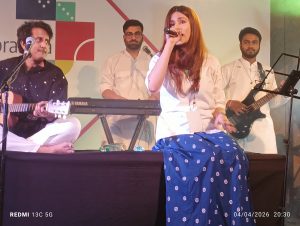
Contemporary expressions also found space, with bands like Night Delhi blending devotional themes with modern soundscapes. Their performances transport audiences into a world of colour, beauty, and transcendental bliss, leaving a lasting impact on music lovers and inspiring younger musicians to follow their style. Beyond the stage, they devote significant time to teaching and mentoring students, many of whom have themselves become concert performers, carrying forward the glorious legacy of Indian classical music.
The final day brought the festival to a powerful close, combining thought-provoking discussions with artistic excellence. Sessions on artificial intelligence, statecraft, and regional issues underscored the festival’s commitment to addressing both historical and contemporary concerns. Speakers such as Nitin Seth reflected on the disruptive potential of AI, while Smriti Irani highlighted the nuanced role of culture in shaping statecraft.
Performances like Pavithra Srinivasan’s Gita Natyam and presentations by children from the School of Happiness showcased the festival’s inclusive spirit. An MoU between Sangam Talks and Banasthali Vidyapeeth further underscored its focus on education and empowerment.
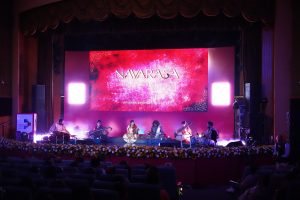
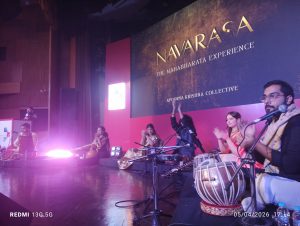
The grand finale, Navarasa: The Mahabharata Experience by the Apoorva Krishna Collective, encapsulated the festival’s essence. Blending Hindustani and Carnatic traditions with visual storytelling, the production explored the nine emotional states through episodes from the Mahabharata, creating an immersive and deeply evocative experience. The show involved musical recitals bringing out the navaras, while the scenes from the war played in the background.
An immersive musical odyssey curated by violinist Apoorva Krishna was staged. The production blended Hindustani and Carnatic traditions to explore the nine fundamental human emotions—love, joy, sorrow, anger, courage, fear, disgust, wonder, and peace—through stories drawn from the epic Mahabharata.
Directed by Krishna, the ensemble featured leading musicians including Momin Khan (Sarangi), Malvica Chopra (Sitar), Rakshita Ramesh (Veena), Vinod Shyam (Mridangam), and Roopak Kallurkar (Tabla). Together, they created a unified sonic landscape of melodic depth and rhythmic interplay. Original atmospheric visuals, conceptualised by Krishna, complemented the live performance, serving not as literal depictions but as extensions of each rasa, allowing music, imagery, and silence to merge into one immersive journey.
Described as “nine emotions, one epic, a meeting of traditions,” the production invited audiences not just to witness the Mahabharata but to feel its emotional essence. Each rasa became a doorway into the complexity of human experience, reaffirming the timeless relevance of India’s civilizational heritage.
As ICF 2026 drew to a close, it left behind more than memories of performances and discussions. It reaffirmed Delhi’s position as a dynamic cultural hub—one that not only preserves tradition but also engages in meaningful dialogue about identity, history, and the future.
Read : Bharat Gaurav Ratna Shri Samman Celebrates Excellence and Social Impact Across India