Dilip Guha, Sasraya News ★ New Delhi: Some stories refuse to disappear. They survive not only in books and manuscripts, but in songs, voices, rivers, memories and performances passed from one generation to the next. Mahua Sundari is one such story— a timeless folk ballad that continues to resonate with the emotional and cultural memory of Bengal.
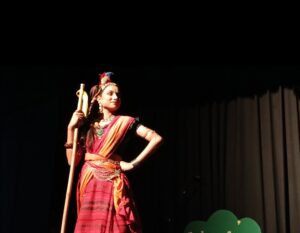
Following the success of its earlier productions, Nakshi Kanthar Math and Priyobondhu, which received immense love and appreciation from audiences, Delhi-based cultural group Ichchhe Bitan returned to the stage with Mahua Sundari Pala. The latest production was staged on 1 August 2026 at B.C. Pal Auditorium, New Delhi, once again delighting theatre lovers with a work deeply rooted in Bengal’s folk tradition.
The play transported audiences into a world of myth, memory and cultural heritage, evoking a Bengal of generations past.
Among the great treasures of Bengali folk literature, the Mymensingh Geetika occupies a special place. Collected from the villages of Eastern Bengal and later compiled by eminent scholar Dinesh Chandra Sen, these ballads have continued to captivate readers and audiences across generations.
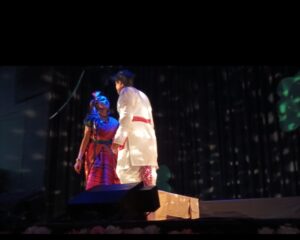
Mahua Sundari—a tale of passionate love, sacrifice, separation, courage and the eternal human quest for freedom—has lived in the hearts of Bengalis for generations. Ichchhe Bitan’s fresh theatrical adaptation brings this immortal folk epic to the stage through a compelling blend of music, drama and cultural symbolism.
The play “Mahua Sundari Pala”, directed by Nabanita Chatterjee, brings one of the great folk narratives of undivided Bengal to the contemporary stage. Adapted from the celebrated Mymensingh Geetika, the production explores love, power, social identity, separation, loss and destiny through Bengal’s traditional pala storytelling form.
The production does more than revive a legendary ballad. It also underscores the story’s enduring relevance in contemporary society, reminding audiences that love, resilience and the desire for freedom remain timeless human concerns.
The Story: Love, Power and Tragedy
At the centre of the narrative is Mahua, a young woman whose life is shaped by forces beyond her control. Her journey takes audiences into a world of travelling communities, river routes, village life and social hierarchies deeply rooted in Bengal’s folk imagination.
Mahua’s life becomes intertwined with Humra Baidya, a powerful and proud figure. As relationships develop, love comes into conflict with social conventions, power, pride and circumstance. The river and the boat become recurring symbols of movement, uncertainty and the ever-changing course of human destiny.
As Mahua and Noder Chand’s relationship deepens, the story moves towards tragedy. Humra’s transformation—from an authoritative man to someone overwhelmed by grief—provides much of the narrative’s emotional force. Ultimately, Mahua Sundari emerges as a profound folk tragedy about love, power, loss, and irreversible choices.
Mahua’s life becomes intertwined with Humra Baidya, a powerful and proud figure. As relationships develop, love comes into conflict with social conventions, power, pride, and circumstance. The river and boat become symbols of movement, uncertainty, and changing human destiny.
As Mahua and Nader Chand’s relationship deepens, the story moves towards tragedy. Humra’s transformation—from an authoritative man to someone overwhelmed by grief—gives the narrative its emotional force. Mahua Sundari ultimately becomes a folk tragedy about love, power, loss, and irreversible choices.
In terms of performances, Geetika Das, as Mahua, provides the emotional centre of the production, balancing vulnerability with inner strength.
Siddhartha Bhadury’s portrayal of Humra Baidya is among the production’s strongest performances. His transition from pride and authority to devastating grief gives the character considerable dramatic weight and emotional depth.
Also Read : Ichchhebitan and Dohar Weave Magic: A Cultural Showcase of Bengali Identity at Mango Mela
Sharmistha Bhattacharya, as Noder Chand’s Mother, makes a strong impression despite comparatively limited stage time. Her performance demonstrates an important quality of folk theatre: a character does not need extensive dialogue or prolonged stage presence to become memorable.
Siddharth Chatterjee, as Noder Chand, effectively portrays the privileged yet simple son of a zamindar.
The supporting ensemble includes Shatakshi Chowdhury as child Mahua; Nabangshu Deb in dual roles; Ushnish Chattopadhyay as the mischievous sanyasi; Promita Das as Palak; and Vedic Saha as Sujan Baidya.
Also contributing are Srija Chanda, Indranil Chakraborty, Samiran Chakraborty, Mrityunjoy Guha, Debapriya Dutta, Mukul Mitra, Raja Das, Mousumi Acharya and Abir Chaudhuri. Suchismita Chowdhury Sinha, Debashree Patra, Jayeeta Saha, Ranjana Bhowmik, Sanjana Manna and Tanisha Sharma enrich the production through their contributions to dance and acting.
Music: The Soul of the Pala
Music forms the emotional backbone of Mahua Sundari Pala. Music director Debabrata Bhattacharya shaped the production’s musical identity through training, composition, and arrangement. Sudeep on dotara and Abhijit on flute further strengthen its distinctly folk character.
The musical presentation is enriched by Anindita Mukherjee, Shyamal Majhi, Chandan Panda, Srabani Ghosh Deb, Sonali Roy, Prativa Das, and Pankaj Sen Gupta. Together, the voices and instruments create a distinctive soundscape of rural Bengal. In a production rooted in Mymensingh Geetika, music is not merely an accompaniment—it is an essential part of the storytelling itself, carrying atmosphere, emotion and cultural memory.
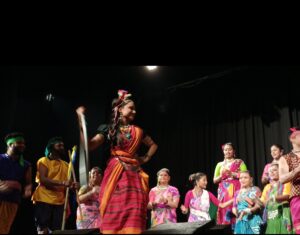
Set, Costume and Make-up
Shuddha Banerjee’s set design, particularly the symbolic boat, establishes the geographical and cultural environment with remarkable simplicity. Sarmistha Bhattacharya’s costumes add vibrant colour to the production, while Ratna Basu’s make-up strengthens the authenticity of the characters.
Direction and Cultural Authenticity
For Nabanita Chatterjee, authenticity lies at the heart of the production.
“When we decided to work on Mohua Sundari from Mymensingh Geetika, the commitment was simple—to bring rural Bengal’s folk literature alive for today’s audience. This is not just a play; it is our responsibility to our roots.”
Boats, bird cages, river journeys and rural surroundings recreate the disappearing world of the Baidya community. The boat, in particular, becomes a recurring symbol of travel, livelihood, uncertainty and movement—an object that carries both people and the story itself through an unpredictable landscape.
One of the production’s strengths is the opportunity it provides to emerging performers. Chatterjee’s philosophy appears to place commitment above reputation. “Dedication matters more than fame,” she said. There are occasional imperfections, but the ensemble performs with unmistakable sincerity. The audience’s continued engagement suggests that the production succeeds in establishing a genuine emotional connection, allowing the story and its performers to communicate beyond technical limitations.
Dialect and Cultural Identity
The Mymensingh dialect is an important part of the production’s identity. Since the story comes from the folk tradition of Mymensingh, language becomes an essential element of cultural authenticity.
Chatterjee acknowledges that consistency in the dialect can be developed further. Future performances may therefore provide the cast with an opportunity to deepen their understanding of the dialect and refine its delivery, further strengthening the cultural texture of the production.
A Tribute to Mymensingh and Undivided Bengal
The significance of Mahua Sundari Pala extends beyond the stage. Mymensingh Gitika represents an important folk-literary heritage associated with Mymensingh and undivided Bengal.
For Chatterjee, staging Mahua Sundari is an act of respect towards that legacy. Mahua Sundari is Our Tribute to Bengal’s Living Folk Heritage. To stage Mohua Sundari is to bow before that tradition,” she said.
By bringing Mahua Sundari before contemporary audiences, Ichchhe Bitan seeks to reconnect younger generations with a tradition carried through folk songs, oral narratives, dialects, travelling performers, rivers, boats and stories passed from one generation to another.
Ultimately, Mahua Sundari Pala is more than a theatrical production. It is an attempt to keep a living folk tradition alive—to bring an old story, along with its music, language, emotional power and cultural memory, before a new generation.
And perhaps that is the greatest achievement of this production. In an age when cultural memories can easily fade beneath the weight of modernity, Mahua Sundari reminds us that heritage is not something preserved only behind glass or within the pages of old books. It lives when it is spoken, sung, performed and remembered.
On the stage of the Auditorium, an old river seemed to flow again, carrying with it the voices, dreams and sorrows of a Bengal that may have changed with time, but has not disappeared from memory
Also Read : Teej Festival Organized at Dilli Haat INA and Pitampura