Dilip Guha, Sasraya News ★ New Delhi : The Khadi and Village Industries Commission (KVIC), operating under the Ministry of Micro, Small & Medium Enterprises (MSME), presented a diverse and captivating collection of Khadi and village‐industry products—symbolising the spirit of “New Khadi for New India” — at the 44th India International Trade Fair (IITF) 2025, held at Bharat Mandapam, Pragati Maidan, New Delhi.
At the pavilion, visitors explore innovative and contemporary Khadi creations that highlight its transformation into a global brand nurtured under the leadership of Prime Minister Shri Narendra Modi.
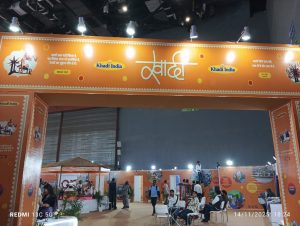
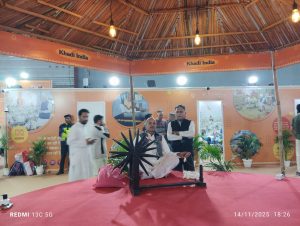
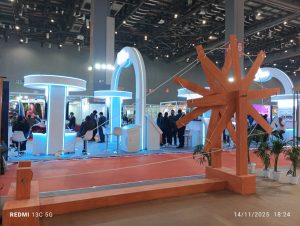
KVIC has showcased a wide range of products from the “New Khadi of New India” in Hall No. 6. Chairman of KVIC, Shri Manoj Kumar, visited the Khadi India Pavilion. While interacting with Khadi artisans from various states, entrepreneurs associated with the Prime Minister’s Employment Generation Programme (PMEGP), and representatives from SFURTI clusters, he learned about their products, work experiences, and innovations, and encouraged them to join the Government of India’s “Aatmanirbhar Bharat” and “Vocal for Local” campaigns. Speaking on the occasion, he said that the Khadi India Pavilion had been thoughtfully designed in alignment with Prime Minister Shri Narendra Modi’s vision of “Har Ghar Swadeshi, Ghar-Ghar Swadeshi” and “Ek Bharat, Shreshtha Bharat.”
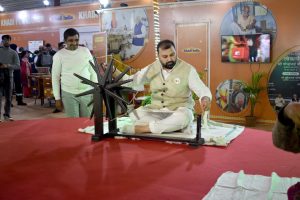
He further stated that under the Prime Minister’s leadership, the “Khadi Kranti” has grown the Khadi and Village Industries business to over ₹1.70 lakh in the last 11 years, while employing approximately two crore people. KVIC Chairman Shri Manoj Kumar appealed to all visitors to buy Swadeshi products so that lakhs of artisans associated with KVIC in rural areas can get livelihood opportunities and strengthen the rural economy.
A total of 150 stalls have been set up at the Khadi India Pavilion, hosting artisans from Khadi institutions, PMEGP units, and SFURTI clusters from across the nation. These stalls display a rich array of handicrafts, Khadi fabrics, and village‐industry products, along with live demonstrations of traditional spinning using the indigenous charkha and peti charkha, the operation of an electric pottery wheel, and the age-old process of extracting crude oil from a ghani, blending heritage with innovation.
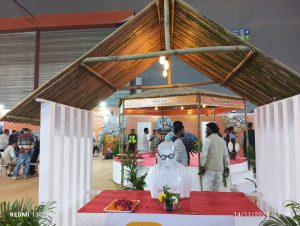
One of the pavilion’s standout attractions is the newly introduced podcast studio, “Baat Khadi Ki,” a first-of-its-kind initiative at this year’s IITF. In this space, artisans recount their personal journeys—their struggles, achievements, and deep connection with traditional arts—in their own voices. This platform elevates Khadi beyond commercial value, presenting it as an idea, a spirit, and a living legacy. “Baat Khadi Ki” not only reveals Khadi’s true identity but also beautifully marries modern technology with traditional craftsmanship. The initiative aligns with the Prime Minister’s vision by bridging Khadi with India’s youth.
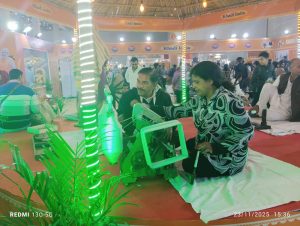
The pavilion also features a diverse range of products, including textiles, cosmetics, rural foods, bamboo and cane crafts, and specialities from Jammu & Kashmir, Rajasthan, Bihar, Uttar Pradesh, and the North East. Several PMEGP and SFURTI entrepreneurs are showcasing their success, reflecting the growing strength of Khadi and village industries.
Visitors are particularly drawn to a wide variety of items: textiles, rural foods, natural beauty products, handcrafted home décor, bamboo and cane goods, and intricately carved artefacts. Highlights include Pashmina shawls and Kashmiri garments from Jammu & Kashmir; traditional sweets, pickles, and food items from Rajasthan, Bihar, and Uttar Pradesh; Kanchipuram silk sarees from the South; wooden carvings from Andhra Pradesh; natural skincare lines from Jharkhand; and handloom Khadi fashion from Delhi, Haryana, and Punjab. Modern, eco-conscious products such as natural honey, organic herbal teas, Ayurvedic cosmetics, and traditional perfumes also affirm Khadi’s relevance in today’s world.
The representation of North Eastern states adds another dimension of diversity—eco-friendly bamboo and cane products such as water bottles, temple lamps, pen-stands, bags, and mats have especially captured visitor interest. Many young entrepreneurs participating here have set up their units under the PMEGP scheme; some now report annual turnovers ranging from lakhs to crores, and such success stories strongly validate the commission’s policies, reinforcing the role of rural entrepreneurship in driving self-reliance.
Khadi has evolved into a brand trusted across India. The pavilion is linked to broader national initiatives—“Har Ghar Swadeshi,” “Vocal for Local,” and “Aatmanirbhar Bharat.” Notably, over 40% of the stalls are dedicated to Khadi production institutions, while the rest showcase village industries, PMEGP, and SFURTI units. By offering a centralised platform for artisans, the Khadi India Pavilion aims to promote the skill and creativity of artisans nationwide while advancing the vision of supporting local, Swadeshi products.
Read More :