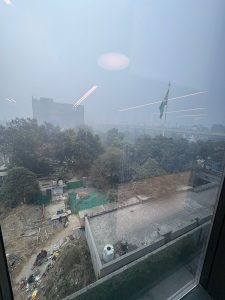
Dilip Guha, Sasraya News, New Delhi : A thin layer of smog engulfed several parts of the national capital as air quality in the city remained in the poor category on Friday in New Delhi.
Delhi remained under a thick blanket of smog as the Air Quality Index (AQI) stood at 387, while dense fog reduced visibility, forcing the cancellation of over 150 flights at the city’s airport.
The national capital continued to reel under toxic smog on Friday as air quality stayed in the ‘very poor’ category and dense fog sharply reduced visibility, severely disrupting flight operations. Delhi-NCR is facing a harsh winter spell, with dense fog, biting cold, and hazardous air pollution gripping the region. With visibility plunging and AQI levels turning toxic, daily life has been badly affected.
Air quality in Delhi has deteriorated sharply, with AQI readings ranging between 400 and 500, placing it in the ‘severe’ category. Neighbouring cities such as Noida and Ghaziabad are also enveloped in thick smog. Low wind speeds are trapping pollutants, leading to breathing discomfort, eye irritation, and heightened health risks.
The air quality in India’s capital and adjoining regions has remained hazardous for several days, even as a layer of haze continues to engulf the city.
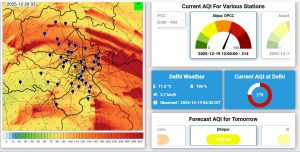
The AQI stood at 387 at 7:05 am, worsening from Thursday’s rolling average of 373, according to data from the Central Pollution Control Board (CPCB).
The India Meteorological Department (IMD) said very dense fog covered large parts of the national capital during the early morning hours. Visibility dropped to zero at Safdarjung and fell to around 50 metres at Palam airport.
IMD officials said visibility began declining from Thursday afternoon. While it was around 800 metres at about 3 pm under clear conditions, it steadily worsened through the evening and night, dropping to 50 metres by 2:30 am on Friday.
At 5:30 am, the weather department forecasted very dense fog across all districts of Delhi for the next two to three hours.
On Thursday morning, the city’s overall AQI—which measures PM2.5, fine particulate matter that can clog lungs, along with other pollutants—was recorded at 376, more than 25 times the limit recommended by the World Health Organisation.
Exposure to such high pollution levels can cause serious health problems, especially among children and the elderly.
On Wednesday, the Delhi government made it mandatory for all government and private institutions to implement work-from-home arrangements for 50% of their employees.
Several pollution-control measures have also been enforced, including a ban on old diesel vehicles, restrictions on construction activities, hybrid classes in schools, and a no-entry policy for older vehicles not meeting fuel efficiency and pollution control standards.
Schools in Delhi will remain closed for younger students as air pollution levels once again touched the ‘severe’ category. With AQI worsening across Delhi and adjoining NCR areas, the Delhi government has enforced Graded Response Action Plan (GRAP) Stage 4 restrictions to limit public exposure to hazardous air.
Experts warned that air pollution has moved far beyond being merely an environmental issue and is now undermining India’s economic progress while fuelling a rise in severe health problems such as strokes, cardiovascular diseases, respiratory ailments, and neurological disorders. These concerns dominated discussions at the Illness to Wellness Conference on the Impact of Air Pollution on Health and Preventive Measures, hosted by the Illness to Wellness Foundation (ITWF) on Thursday. Specialists emphasised that prolonged exposure to toxic air is shortening productive life years, increasing disability rates, and placing immense pressure on healthcare systems—ultimately threatening India’s long-term development.
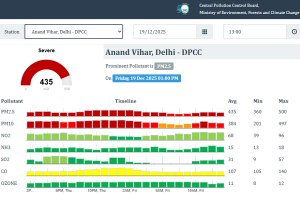
Pollution in Delhi Today
Several areas reported extremely high pollution levels. Of the 40 active air quality monitoring stations in Delhi, 17 recorded ‘severe’ air quality on Friday morning, while several others remained close to the 400 mark.
R.K. Puram, a residential area known for high pollution levels, was among the worst affected, recording an AQI of 441—nearing the CPCB’s ‘severe plus’ category.
According to CPCB standards, AQI levels between 301 and 400 fall under the ‘very poor’ category, while readings above 400 are classified as ‘severe’. Such levels can affect even healthy individuals and pose serious risks to those with respiratory or heart-related conditions.
Experts attributed the worsening conditions to calm westerly winds of 4–6 kmph, combined with low temperatures and moisture, which contributed to the build-up of pollutants and reduced visibility.
Delhi also witnessed a sharp drop in temperatures on Thursday. As per IMD data, the maximum temperature fell by 4–6°C over the past 24 hours to settle at 20.1°C, more than 2°C below normal. The minimum temperature stood at 9°C, close to the seasonal average.
Meanwhile, flight operations at Delhi’s Indira Gandhi International Airport were severely impacted on Friday, with more than 150 flights cancelled due to dense fog.
Visibility has remained poor since late Thursday night, forcing airlines to slow arrivals and departures. Airport authorities said flight movements are being managed under CAT III conditions to ensure safe operations in low visibility.
Officials confirmed that dense fog continues to disrupt schedules, with delays and cancellations reported for both arrivals and departures.
Read : Dense Smog and Severe Pollution Grip Delhi-NCR on December 18