Dilip Guha ★ NewDelhi : This year, on the occasion of the 165th Birth Anniversary of Rabindranath Tagore, Saanjhbaati Foundation, in collaboration with Swarchhanda, presented an evocative and immersive evening that brought together literature, music, and theatre in a deeply engaging artistic experience.
Programme titled Beyond Silence: Tagore’s Women — an evening dedicated to the unforgettable women who lived in his stories, poems, and songs. The event was held at the LTG Auditorium, New Delhi, on Saturday, 9th May 2026.
Tagore’s women were not just characters. They embodied Binodini’s fierce agency, Charulata’s quiet yearning, Mrinal’s bold defiance, and Bimala’s awakening. Through literature, music, and performance, this special presentation traced their strength, dignity, and subtle acts of resistance — voices that broke the silence in their time and still speak to us today.
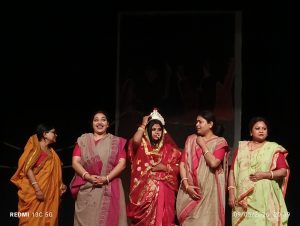
In a world still negotiating questions of identity, freedom, and choice, Tagore’s women felt remarkably contemporary. Their journeys reminded us that resilience did not always roar. Sometimes, it whispered.
Swarchhanda is a distinguished musical ensemble renowned for its artistic expression and choral excellence. The group unites voices that resonate with harmony and emotion, creating performances that are truly experienced as musical storytelling. With a diverse repertoire spanning classical, semi-classical, Rabindra Sangeet, Nazrul Geeti, and Hindi compositions, Swarchhanda embodies a vibrant musical legacy that is both culturally rooted and accessible. At the helm of Swarchhanda is Subrangshu Chakravarty, whose vision and musical sensibility have shaped the group into a cohesive and expressive artistic unit.
Read : Purbo Diganta Foundation Celebrates 7th Annual Day and Founder’s Day with Cultural Extravaganza
Founded in 2007, Saanjhbaati Foundation is a Delhi-based theatre collective rooted in the rich traditions of Bengali theatre while embracing a bold, multilingual identity. For nearly two decades, the group has remained committed to creating theatre that is meaningful, introspective, and socially relevant. Rather than following trends, the foundation has consistently chosen depth over convenience, crafting performances that engage with human emotions and literary richness.
The group’s Hindi productions have been showcased at prestigious platforms, including Bharat Rang Mahotsav, Bharatendu Utsav, and Bharat Muni Utsav, earning critical and audience appreciation.
The foundation is led by Nandini Banerjee, Shuddho Banerjee, and Neil Banerjee, along with a dedicated ensemble. Saanjhbaati continues to be a space where performance is not just art, but purpose.
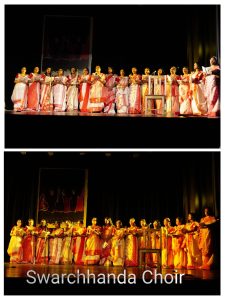
Beyond Silence: Tagore’s Women Celebrated Through Music and Expression
Beyond Silence: Tagore’s Women was conceived as a multilingual and multidimensional presentation that sought to reintroduce Tagore’s timeless ideas to a wider, non-Bengali-speaking audience. Through a carefully curated blend of songs, narration, and dramatic performance, the production explored the emotional and intellectual depth of Tagore’s writing. At its core lay Tagore’s profound understanding of women—not as silent figures within society, but as thinking, feeling individuals navigating identity, freedom, and resistance. His women questioned norms, challenged expectations, and asserted their presence in a world that often attempted to confine them.
Through this production, these voices were brought to life—not as relics of the past, but as living, breathing ideas that continue to resonate today.
A soulful musical presentation titled Beyond Silence: Tagore’s Women brought alive the emotional depth, resilience, and inner voices of women envisioned in the literary and musical world of Rabindranath Tagore. The programme was conceptualised and mentored by Subrangshu Chakravarty.
Subrangshu explained, “This initiative was actually to project Tagore beyond just being a lyricist or a poet. It was about bringing to light a different side of Tagore — as a revolutionary. And by ‘revolutionary,’ I don’t necessarily mean rebellion, but someone who worked toward social reform, who stood up against certain norms of society through his work.
“So, these five pieces that we have chosen today — in each one, he has actually brought about a social revolution through these characters, and that was the aim.”
He further explained, “And when we talk of revolution, it doesn’t come on day one. It comes with an awakening; it comes with a realisation that something is not right. So, the Jagaran Sangeet that we had first, and then the revolutionary song that followed it, traced the complete journey of that character — starting from how the person realised that something was wrong to how the person revolted against it.”

So that was the theme: to bring to light that Tagore is more than just a romantic poet and more than just somebody who wrote ‘Jana Gana Mana’ or ‘Ekla Chalo.’ There is a lot more to Tagore, a lot more that we need to explore in Tagore, and that was the complete theme based on which we did this production,” he added.
Regarding doing this program in Hindi, he said, “The reason was that we wanted to showcase it beyond Bengal. Bengalis have probably read these works in some form or shape at some point, but the audience here had not experienced them. Just now, I was talking to a few people, and they were so interested — they wanted to learn and know more about Tagore. That was exactly the intent, and I felt it was successful because they came up and wanted to know more about Tagore. So that was the idea behind doing it in Hindi,” he added.
The evening featured evocative renditions of Rabindra Sangeet by the Swarchhanda group, whose performances reflected the many shades of womanhood portrayed in Tagore’s works — from strength and sacrifice to longing and liberation.
The vocal ensemble included Dhriti Dam, Prantika Chowdhury, Rupanjana Chakravarty, Moushumi Chowdhury, Rama Chatterjee, Putul Chakraborty, Indrani Dam, Shayanti Arora, Tanusree Samanta, Madhumita Pal, Shrabani Ghosh Deb, Sonali Roy, Ayona Kar Dutta, Sumita Nag and Debashmita Aich. Guest vocal artist Rumpa Das added a special dimension to the presentation with her expressive performance.
The musical accompaniment enriched the programme, with Mihir Basu on keyboard, Dipankar Das on tabla and Amaresh Chakravorty on octapad.
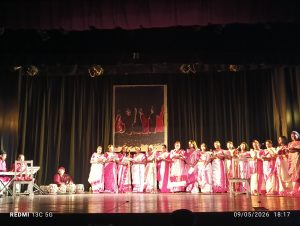
The programme unfolded with the inspiring rendition of Mana Jago Mangaloke, setting the tone for a reflective and emotionally layered musical journey. It evolved into a powerful evening of solo performances, with each artist bringing to life one of Gurudev Rabindranath Tagore’s unforgettable feminine characters. Narration linking the characters was presented by Neil Banerjee in the role of Tagore. Conceived as a multilingual and multidimensional presentation, the production sought to reintroduce Tagore’s timeless ideas to a wider audience.
Kritika Bhatia opened the evening with her portrayal of Soudamini from Badnaam. Her restrained yet poignant performance captured the crushing weight of social stigma, highlighting Tagore’s critique of gossip and prejudice.
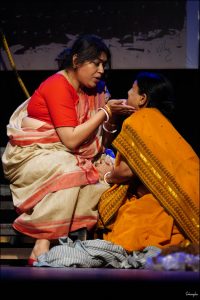
Aranya Singh followed with Giribala from Manbhonjon, delivering a nuanced act that balanced vulnerability with quiet resistance. Singh’s interpretation revealed the emotional depth of a woman negotiating between duty and desire, making Giribala’s struggle resonate as both personal and universal.
Naiswargika Das Haldar’s solo on Manjulika from Nishkriti was intense and haunting. Through piercing clarity and controlled silence, she conveyed the suffocation of domestic confinement, reminding audiences of the invisible battle women fought within family structures.
Sangita Sanyal’s performance as Anandamayee from Gora radiated wisdom and compassion. Calm yet commanding, she embodied the maternal force that transcends boundaries of religion and identity, reflecting Tagore’s vision of women as carriers of moral clarity and universal love.
This part concluded with Tasmiah Hossain’s powerful portrayal of Nirupama from Dena Paona. Her act was piercing in its simplicity, capturing the devastating impact of dowry and patriarchal oppression. With dignity even in despair, Hossain made Nirupama’s tragedy feel urgent and contemporary.
Together, these solo performances, Rabindra sangeet, and narratives created a tapestry of resilience and resistance. The artists did not merely enact roles; they embodied voices that refused silence. Beyond Silence thus became not only a tribute to Tagore’s women but also a dialogue across time, reminding audiences that their struggles and strength continue to echo in the present.
The presentation featured a rich repertoire of Rabindra Sangeet, including Aaji Pronomi, Daake Bar Bar Daake, Amaar Matha Noto Kore Dao, Haroshe Jaago Aaji, Ei Lobhinu Shongo Tobo, Bhango Baadh Bhenge Dao, Shono Taaro Sudhabani, Aamare Koro Jibonodan, Bhubon Hoite Bhubonbashi and By Aaloker Ei Jharnadharaye, which concluded on a stirring note with the iconic song Jodi Tor Daak Shune Keu Na Ashe, leaving the audience with a message of courage, individuality and hope.
The second presentation of the evening was a play, “Aapki Mrinal” — A Voice That Refuses Silence.
Saanjhbaati’s presentation, Aapki Mrinal, was a Hindi adaptation of Tagore’s iconic short story Streer Patra (The Wife’s Letter, 1914), and it celebrated its 20th anniversary by powerfully portraying Tagore’s central female characters.
Scripted by Shuddho Banerjee and translated and directed by Nandini Banerjee, this powerful narrative traces the emotional journey of a woman who, after years of silent endurance within a rigid patriarchal structure, chose to reclaim her identity and assert her independence. Minimal yet intense, poetic yet piercing, Aapki Mrinal was not merely a performance—it was a statement. It reflected a voice that refused to be suppressed and spoke with clarity, dignity, and strength.
Mrinal is a sharp, observant woman, known in the family as “Mejobou,” who finds her voice through this final letter. It is considered one of Tagore’s most profound feminist texts. The central theme of the story focuses on women’s identity, liberation, and the quest for self-respect. It follows Mrinal’s realisation of her own autonomy after her sister-in-law’s friend, Bindu, commits suicide, leading Mrinal to abandon her traditional home and refuse to return. The storyline, written as a letter from Mrinal, the protagonist, to her husband, serves as a scathing critique of a patriarchal family structure that reduces women to subordinate roles.
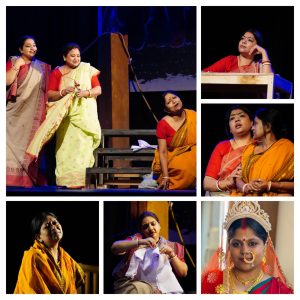
The play Aapki Mrinal opened with Mejo Bou, Mrinal, writing a letter in which she firmly declares that she will never return home. Set against the backdrop of a pilgrimage to Puri, the narrative follows her emotional and intellectual journey toward freedom, culminating in a powerful assertion of her independence, dignity, and self-respect. Deeply affected by the harsh realities surrounding her, Mrinal gradually becomes aware of the injustice, oppression, and emotional emptiness that define her married life. Her final decision to break free emerges as a profound act of courage, awakening, and self-realisation.
The play is structured uniquely, featuring three principal performers supported by two assistant characters. The stage performance hinges on the interplay between Mrinal and Bindu. The three lead actors collectively embody Mrinal, shifting between her voice and the characters in her memory with fluid precision. This layered delivery captures Tagore’s intent: Mrinal is not a single persona but a voice for countless women silenced by rigid patriarchal structures. Her final letter emerges as both personal defiance and a broader assertion of freedom that Tagore envisioned in the story “Streer Patra”.
Through nuanced acting and restrained musical cues, the production translates Tagore’s ideas into a visceral theatrical experience. The performance makes clear that for Tagore, women’s resistance often began in silence and culminated in quiet, unshakeable resolve. In this interpretation, Mrinal and Bindu ceased to be literary figures and became living echoes of that thought.
In terms of performance, the character role of Mrinal was portrayed by Nandini Banerjee, Kritika Bhatia, and Tapasya Banerjee, who fluidly shift between her voice and the characters from her past, showing how her identity is shaped by memory. Bindu, played as the pivotal figure who opens a new window in Mrinal’s life, becomes the catalyst for her awakening. With Paramita Ghosh’s evocative vocals underscoring the narrative and Tithi appearing as the bride, the performances make Tagore’s vision of quiet defiance feel immediate and collective.
The music, costumes, and direction were by Nandini Banerjee; lighting was by Ranjan Basu. Off-stage contributions include Diptesh Das, Shuddho Banerjee, Niladree Deb Chowdhury, Sanya Roy, Archana Singh, Sugato Bhattacharya, Debashish Chakrabarty, Tonmoy Chaudhuri, Ekpornika Banerjee, and Jyotshna Chakrabarty.
Director of play said, “Aap Ki Mrinal is not just a retelling of Tagore’s vision, but as a reflection of the silences, power structures, and quiet resistance that continue to shape our society, Mrinal’s voice becomes more than an individual monologue—it transforms into the collective echo of countless unheard voices, making this production both a tribute to Tagore and a deeply relevant statement for our times.”
A Dialogue Across Time
This collaboration between Swarchhanda and Saanjhbaati Foundation in Beyond Silence: Tagore’s Women adds a profound sonic dimension to the production, elevating the theatrical experience into an immersive confluence of music, literature, and performance.
This production was not just a tribute—it was a conversation between eras. It bridged the past and the present, literature and performance, silence and expression.
By revisiting Tagore’s work through a contemporary lens, Beyond Silence created a space where audiences were invited not only to witness but to reflect, question, and connect. It reminded the audience that the questions Tagore asked then remain relevant today, and the voices he created still seek to be heard.
Photo Courtesy : Shri Shubrangshu Chakravarty
Read : Housefull Screens, Star Power, and a City in Sync: IFFD 2026 Makes a Landmark Debut