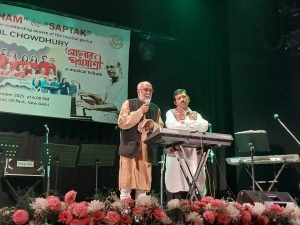
Dilip Guha, New Delhi, December 13, 2025: Music lovers in the capital were treated to an evocative journey through melody, meaning, and memory as two cultural collectives — PARCHAM and SAPTAK — came together to present ও আলোর পথযাত্রী (O Alor Pathojatri), a soulful musical tribute to the legendary composer Salil Chowdhury on his 100th birth anniversary. The programme was held on Saturday evening at the Bipin Chandra Pal Auditorium, CR Park, New Delhi, and drew an audience deeply immersed in the maestro’s rich and socially conscious oeuvre.
Salil Chowdhury, whose music seamlessly bridged Indian classical traditions, folk roots, and Western harmonics, was remembered not merely as a composer but as a visionary whose songs spoke of humanity, struggle, hope, and light. He had been a non-conformist and a true visionary whose music had transcended boundaries of language and genre.
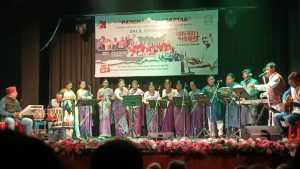
The event, aptly titled “O Alor Pathojatri,” a song penned by Salil Chowdhury, had been released in 1949 and had first been performed by Priti Sarkar and Debabrata Biswas on behalf of the Indian People’s Theatre Association (IPTA). The title of the evening — Wayfarer on the Path of Light (O Alor Pathojatri) captured the spirit of his creative legacy. Embedded in the song was a powerful and enduring message of hope, perseverance, and social justice in the face of adversity and darkness. He had once said, “I want to create a style which shall transcend borders—a genre which is emphatic and polished, but never predictable.”
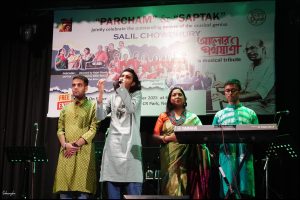
Through a series of musical performances by talented artists of Antarik, Saptak, and Pracham, audiences had been taken on a journey through Salilda’s illustrious career. That evening had been a heartfelt tribute to the maestro whose art had been rooted in truth, compassion, and social
consciousness. Salil Chowdhury had not just been a composer; he had been a poet, a writer, a multi-instrumentalist proficient in the flute, piano, and esraj, and a master arranger whose compositions had been a unique blend of Western classical symphony and Indian folk rhythms.
The evening opened on a solemn and uplifting note with the inaugural song, “বিশ্বপিতা তুমি হে প্রভু”, rendered collectively by all participants. This soulful prayer to the “Father of the Universe,” famously featured in the 1977 film Sister, sung by Sabita Chaudhary
The chorus presentation set a tone of unity and reverence, echoing Salil Chowdhury’s belief in collective voice and universal human values.
One of the most moving segments of the programme was the performance by ANTARIK, a group of specially-abled children, whose participation underlined the inclusive spirit of the event. Coordinated by Jhuma Roy Chowdhury, the young performers — Pratyaksh Kayala, Bhavya Khosla, and Shreyan Chakraborty — accompanied on the keyboard, won heartfelt appreciation for their confidence, musical sensitivity, and expressive delivery.
They presented two compositions that showcased both technical finesse and emotional depth:
“Ni sa ga ma pa ni sa re ga”
“Maujon Ki Doli Chali Re.”
Their performance stood out as a reminder that music, much like Salil
Chowdhury envisioned, transcends physical limitations and becomes a shared language of joy and resilience. The group of these exceptionally talented, specially-abled children who are breaking barriers and redefining music through their passion, creativity, and resilience. These young performers have had the privilege of showcasing their talent at several prestigious platforms, including events hosted by the Lt. Governor, India International Centre (IIC), NTPC, Bangla Sangeet Mela (Dakshin Delhi Kali Bari), Indian Oil Corporation, Purbo Diganta Foundation, where they received overwhelming appreciation.
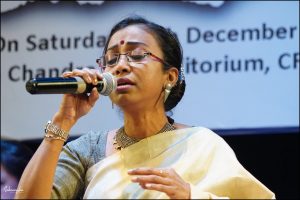
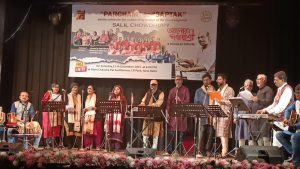
Saptak, with their ensemble talent, showcased the spectrum of Salilda’s mesmerising blend of East and West, Folk and Classical. The organisation has been nurturing local talents through workshops & training programs for upcoming singers.
The Bose Duo, Mihir & Bishakha, are its Mentors. The mentor’s love for music and unique ability to tap talent, Saptak has provided a platform for music enthusiasts to both learn and perform. Saptak has kept alive the Bengali Culture through varied forms of Bengali Music, especially folk through regular performances and concerts especially folk music. Many forms of folk music that had gone into oblivion have been resurrected by the group. Saptam, over the years, has endeavoured to be a bridge, spanning all Bengali musical groups of Delhi NCR by conducting concerts jointly under the banner of Saptak. This initiative of Saptak has created a larger community bound by music across Delhi NCR, which has not only brought about social integration but has also provided a forum for learning from each other. Saptak remains an example and symbol of integration through art and portrays that music is a great leveller.
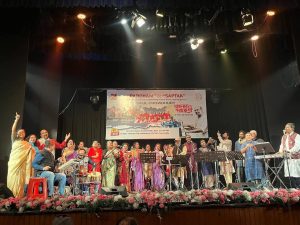
Mihir Bose, a Sangeet Visharad & Sangeet Shree, as an A-Grade Artist of All India Radio & Doordarshan, and a regular performer of Akashvani and DD as an empanelled artist of the Indian Council for Cultural Relations (ICCR), has represented India in various International Music Festivals. As a Composer and Music Director, he has over 400 songs sung by reputed artists with his composed music and 8 albums of songs composed and sung by him. He has been the music director of movies and serials.
Bishakha Bose Sangeet Bhusan, a Postgraduate of Music from Rabindra Bharati University, was later mentored by Maya Sen & Pdt Jayanta Bose. She was associated with a Folk Bangla Band “Madol” in Kolkata. As an empanelled artist of the ICCR represented India at the “Nanning International Folk Songs and Art Festival in China. She has Two Musical Albums to her credit. Both have been widely acclaimed and awarded by a large number of Governmental and non-governmental organisations of Kolkata and Delhi.
Facets of Salil Chowdhury Songs, presented by SAPTAK group and directed by Bishakha Basu and Mihir Basu, was a thoughtfully curated musical evening that paid rich tribute to the timeless genius of Salil Chowdhury. The programme unfolded as a seamless journey through the many emotional, philosophical, and socio-political layers of his songs, reflecting his unparalleled ability to blend melody with meaning. The ensemble of performers—Amrita Banerjee, Parna Moitra, Rupa Roy Burman, Antara Ganguly, Soma Mandal, Debolina Majumdar, Chandrika Dutta, Sunetra Chakraborty, Jaya Roy Chowdhury, Samriddhi Chakrabarty, Sameek Bhattacharya, Tridiv Chakrabarty, Tonmoy Mukherjee, Sunandan Banerjee, along with Mihir Basu, Bishakha Basu, and Sutapa Ghosh Dastidar—brought collective strength and individual sensitivity to the stage.
The selection of songs beautifully highlighted Salil Chowdhury’s wide creative canvas. Numbers like “এই সারাটা দেশ জুড়ে আমার ঘরবাড়ি” (All across this country, everywhere is my home) and “আমায় প্রশ্ন করে / কাহি দূর জব দিন চল্ যায়” (They ask me, “How far must I go as the days keep passing?”) resonated deeply with themes of identity, journey, and social consciousness. Folk-rooted expressions such as “ইচ্ছে করে পরানটারে গামছা দিয়া বান্ধি” revealed an intimate longing of the human heart, while lighter yet evocative pieces like “সেই মেয়ে” and “রানার” added emotional contrast. The philosophical depth of “এই রোকো পৃথিবীর গাড়িটা থামাও” (Stop this world’s vehicle right now) and the lyrical beauty of “দে দে রে সখী চোখে নীলাঞ্জন” enriched the evening further. Comic warmth flowed through “নন্দলাল দেবদুলাল”, and nostalgia lingered poignantly in “সেদিন আর কত দূরে” (How far away is that day now).
Overall, their performance stood out not merely as a concert but as a reflective homage to Salil Chowdhury’s enduring relevance. The sensitive direction, disciplined group presentation, and heartfelt performances ensured that the audience experienced both the musical brilliance and the timeless humanism embedded in his composition.
During Salil Chowdhury’s university years, his political ideas were fast maturing along with his musical ideas. Living through the Second World War, the Bengal famine, and the hopeless political situation of the ’40s, he became acutely aware of his social responsibilities. This is when he joined IPTA (Indian People’s Theatre Association) and became a member of the communist party. IPTA, which went on to become one of the most dynamic performing art movements in India in the 1940s, became like a magnet for the young and radical artists, actors, musicians, and dancers of the period. During this period, Salil wrote numerous songs and, with IPTA comrades, took his songs to the masses. They travelled through the villages and the cities, and his songs became the voice of the masses.
Parcham group presented this facet of Salil Chowdhury. Parcham, the people’s song squad, was founded in the early 1980s to carry forward the legacy of the Indian People’s Theatre Association (IPTA). It has participated in theatre directed by renowned directors, such as Habib Tanvir, as well as in films. Its repertoire includes not just old IPTA songs, but a variety of others that the group, led by Kajal Ghosh, has itself set to music or translated. The song squad intends to continue its tradition of raising the voice of the people through music. Kajal Ghosh inherited his musical skills from his parents, who were both accomplished singers associated with IPTA trained in Hindustani vocal music under the late Acharya K. C. D. Brahaspati and later under Sulochana Brahaspati. He also learnt popular and folk music from legendary singers and composers such as Jyotirindranath Moitra, Hemanga Biswas, and Salil Choudhury.
Beginning in 1971, Kajal Ghosh started composing music for plays and went on to create music for numerous productions of the National School of Drama, NSD Repertory, Shri Ram Centre Repertory, Jan Natya Manch, and others.
IPTA Songs by PARCHAM Captivate Audience with Spirit of Protest and Hope, directed by noted cultural activist Kajal Ghosh, the evening stood as a vibrant reminder of music’s role in social awakening, resistance, and collective hope, drawing an attentive and emotionally engaged audience.
The programme featured compelling performances by Shankar Raghuraman, Suranjan Banerjee, Kshitij, Naman Jain, Amitabha Roychowdhury, Rekha Ghosh, Aditi Nigam, Vijaya Venkataraman, Ruchira, and Kajal Ghosh himself. Each artist brought distinct vocal strength and interpretative depth to songs rooted in protest, patriotism, and human resilience. The repertoire included evocative numbers such as “ও আলোর পথযাত্রী”, “ধন্য আমি জন্মেছি মা”, “Ab Machal Utha Hai Dariya”, “ঢেউ উঠছে”, “হেই সামাল ধান হো”, “Jaanewaale sipahi se poochho”, “পথে এবার নাম সাথী”, “আমার প্রতিবাদের ভাষা”, and “Tu Zinda Hai”, collectively reflecting IPTA’s enduring commitment to social justice and people-centric art.
The musical arrangements were enhanced by accomplished instrumental support—Nilanjan Sengupta on tabla, Amaresh Chakrabarty on octapad, Mintal Gazi on guitar, and Mihir Basu on keyboard—whose sensitive accompaniment added depth and dynamism to the performances without overshadowing the lyrical message.
Overall, IPTA Songs by PARCHAM emerged as a stirring musical experience that reaffirmed the transformative power of music as a voice of the people, resonating strongly with the ideals of unity, resistance, and hope.
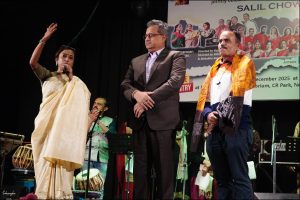
The evening was eloquently anchored by Dr Sameek Bhattacharya, whose contextual introductions helped the audience connect the songs to their historical and contemporary relevance. The programme concluded on an energetic and unifying note with the iconic “ধিতাং ধিতাং বোলে”, performed collectively by all participants, leaving the audience uplifted and inspired.
Throughout the evening, the collaborative effort of SAPTAK and PARCHAM reflected meticulous planning and deep respect for the composer’s legacy. The programme unfolded as more than a concert — it was a celebration of ideas, inclusivity, and the enduring relevance of Salil Chowdhury’s music in contemporary times.
As the notes lingered in the auditorium and the audience responded with warm applause, ও আলোর পথযাত্রী emerged as a luminous homage — reaffirming that Salil Chowdhury’s melodies continue to guide generations along the path of light.