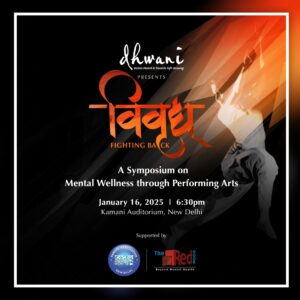
Dilip Guha ★ New Delhi : In a heartfelt and transformative evening, Dhwani Dance and Music Academy hosted “Vivridh: A Symposium on Mental Health and the Performing Arts”, an initiative aimed at fostering conversations around mental health through the universal language of art at Kamani Auditorium on Thursday 16th Jan2025.

Organized with the support of The Red Door and The Bengal Association of Delhi, the event brought together poignant performances and insightful discussions to address the pressing need for inclusivity and empathy in the discourse on mental well-being.
Young people today are navigating a complex world filled with opportunities and unique pressures—from academic stress and societal expectations to the pervasive influence of social media. The Seminar is a much-needed conversation on equipping one selves and communities to provide better support, foster resilience, and create environments where young minds can thrive.
A diverse panel of speakers offered insights from multiple perspectives, ensuring a comprehensive understanding of the issues at hand with meaningful dialogue, challenging traditional narratives, and taking actionable steps to ensure that the next generation feels seen, heard, and empowered.
It explored critical themes such as the role of societal pressures in shaping mental health, the potential pitfalls of overdiagnosis or excessive medication, and the value of a holistic conversation on care.
Dhwani is well-known for its exquisite choreographies and has been recognized for its significant contributions to the country’s rich cultural heritage. Founded in 1984 by Smt. Vaswati Misra, the organization is led by the daughter-in-law of Kathak Guru Pandit Shambhu Maharaj, a recipient of the Padma Shri award for his pivotal role in bringing recognition to the dance form.

The evening began with a soul-stirring piano recital by Gauri Mishra, a young prodigy whose music transcended words, touching the hearts of the audience and setting the tone for an introspective journey. Through her recital, Mishra demonstrated how art can serve as both expression and solace, providing a medium for emotional connection and healing. She was accompanied by Siddhartha Chakraborty on the table and by Shri Rajesh Jain on the guitar.
The recital was followed by a short audio-visual presentation on Rishika Chakraborty, a young and talented artist lost to the challenges of mental ill health. The short film highlighting her struggle with her demons, her deep desire for acceptance, and her passion and love for dance, where she found her solace and her safe place, left many in the audience teary-eyed.

Following this, a panel discussion featured leading practitioners from the fields of mental health, performing arts, and social advocacy. Panelists engaged in a candid dialogue about the intersection of emotional well-being and artistic expression, exploring how the performing arts can serve as a therapeutic outlet and a powerful tool to break the stigma surrounding mental health. The discussions left many pondering over the actual efficiency of the bio-medical model of mental health, in the absence of true empathy and a human-centric approach, as highlighted by Dr Amit Sen Psychiatrist, Dr Aditya Tiwary Homeopathic Psychiatrist, and Abdul Mabood Founder Snehi.
Pranami Tamuli, who serves as the Executive Director and Resilience Expert at The Red Door, along with Alee, an advocate of alternative mental health practices, and Ayurdhi Dhar, PhD, Visiting Faculty, Prescoll College, Arizona and Editor, MAD in South Asia recounted their personal stories and journeys.
“Vivridh is more than just an event; it is a movement to weave empathy and understanding into the fabric of our lives,” said Smt Vaswati Misra, Founder of Dhwani Dance and Music Academy. “By combining art and mental health advocacy, we hope to create a safe space for dialogue and inspire a deeper understanding of the struggles many face silently. Those of us who are not doctors, but want to help, want to know how we can do so.”
“Through teaching, I have observed that many intelligent and talented children suppress their emotions, taking months or years to express their feelings. The performing arts offer an outlet for these unspoken feelings. I believe a teacher’s role is to stand by the student in all circumstances, as beautifully articulated by poet Gabriel Mistry: ‘Let me be the mother rather than the mother herself in my love and defense of the child who is not the flesh of my flesh”.
“One of my students, Rishika, exhibited immense talent and empathy but battled with depression and borderline personality disorder. Dance provided her solace and a sense of peace, yet she was frequently drawn into darkness, ultimately taking her life on December 8, 2024. While the healing power of the arts benefits many children, those like Rishika need more comprehensive support. I urge the experts present to narrate their insights and experiences to further educate us, she passionately declared.”
Through Vivridh, Dhwani aimed to shine a spotlight on the transformative power of performing arts as a bridge between awareness and action, connecting minds and hearts to address the complexities of mental health.
Dr. Aditya Tiwary believes that Public Outreach Programs can be effectively implemented to address this issue. His approach includes:
Life Skills Training: Offering workshops that teach vital life skills and coping mechanisms.
Emotional Expression Workshops: Providing opportunities for individuals to express their emotions healthily and constructively.
Engaging Community Workshops: Developing engaging modules and conducting numerous free community workshops to attract and educate participants.
These initiatives are designed to provide comprehensive support and foster resilience in the community. He expressed the need to urge the government to enhance its efforts, but that progress can be slow. He emphasized the importance of community action in driving change.
Dr. Amit Sen echoed similar sentiments, emphasizing that addressing mental health necessitates a multifaceted approach encompassing community engagement, open discussions, and creative expression.
He stressed the importance of fostering environments where individuals feel safe to share and collaborate. Dr. Sen highlighted three key strategies:
Integration: Collaborate with other college clubs, such as those focused on music, theatre, and arts, to address mental health issues collectively.
Expression: Utilize various art forms to tell stories, tackle social, cultural, and political issues, and validate personal experiences.
Community Engagement: Encourage active participation in community activities to create a supportive network.
By implementing these strategies, we can begin to address the complex and multifaceted world of mental health more effectively.
Alee said the balance of body, mind, and breath can help us understand and overcome our challenges. We must connect with ourselves and find our center to navigate through life’s difficulties. This journey has been transformative for me, and I hope it can inspire others to find their path to healing.
Ayurdhi Dhar explained that in today’s society, we often blame young people for being addicted to social media or struggling with mental health issues. However, social media is designed to be addictive, and the pressures of the job market and academic demands create a challenging environment. When young people come to us with these issues, we often respond with diagnoses based on shaky science, as even the DSM (the Bible of psychiatry) has its limitations.
Diagnosis can be a helpful construct, but it can also lead to a person identifying too closely with their condition, making it difficult to move forward. We live in a system where we are expected to work long hours, leaving little time for activities that help us flourish as human beings, like spending time with loved ones.
The highlight of the evening was an evocative dance performance, “Cliff to the Riff”, a tribute to Rishika Chakraborty, by her soul sisters at the academy. Through their emotive choreography, the young girls conveyed the unspoken struggles, resilience, and beauty of the human spirit, leaving the audience deeply moved. It was especially poignant since the same dance had been performed by Rishika herself, in November 2024, as an expression of her struggles with her mental illness and her hopes.
This initiative was supported by The Red Door, a mental health advocacy platform that believes in an inclusive, diverse, and respectful approach to emotional and mental well-being, and The Bengal Association of Delhi, a cultural organization dedicated to promoting meaningful initiatives for community enrichment.