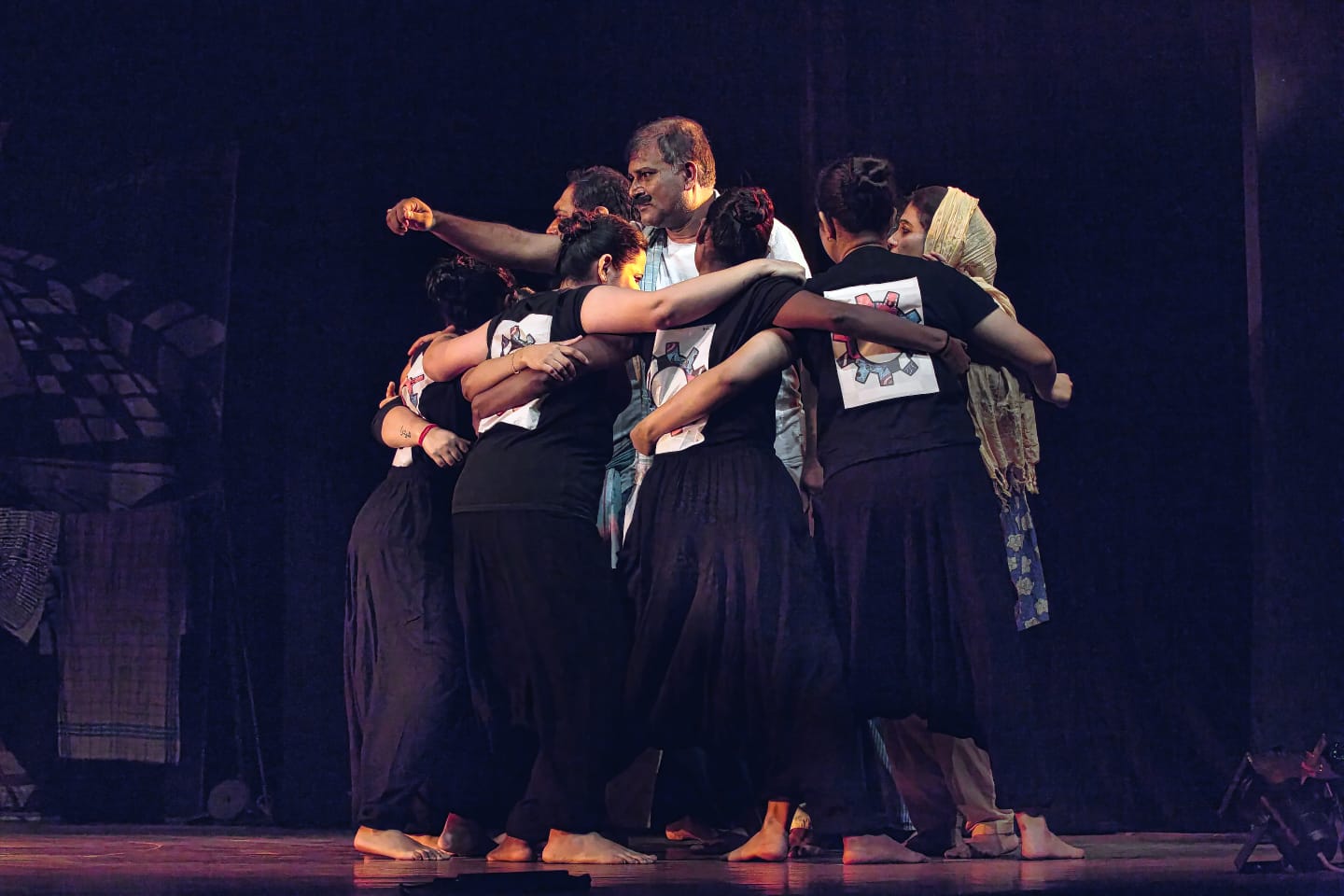
Dilip Guha ★ Sasraya News, New Delhi: Shapno Ekhon, a New Delhi-based socio-cultural organisation engaged in theatre and heritage education, recently staged Rabindranath Tagore’s iconic play Raktakarabi at the Capital’s Abhimanch Auditorium of the National School of Drama (NSD).
Designed and directed by Shomik Ray under the dramaturgical guidance of noted art and theatre scholar Samik Bandyopadhyay, the production revisited Tagore’s powerful exploration of authority, exploitation and human freedom through a contemporary social and political lens.
Shapno Ekhon has been practising socially relevant theatre in the Delhi-NCR region for the past 17 years. The organisation has a repertory of more than 50 productions in English, Hindi and Bengali and has received over 30 awards across various aspects of theatre practice at multiple forums in India. Its work also extends to heritage education and cultural engagement.
Also Read Delhi Mango Mela Concludes at Dilli Haat Janakpuri with Record Crowds, Competitions, and 400 Varieties on Display
A Century-Old Play with Contemporary Relevance
Written in 1923–24, shortly after the Non-Cooperation Movement, Raktakarabi, or Red Oleanders, emerged as Tagore’s artistic response to the structures of oppression and exploitation prevalent during colonial rule.
Set in the fictional land of Jokkhopuri, the play portrays an autocratic system built around gold mining, where human beings are reduced to instruments of production. Its portrayal of power and control would have evoked unmistakable parallels with the British Raj among audiences of Tagore’s time.
Yet, the play transcends its historical context. Its concerns extend to environmental degradation, mechanised dehumanisation and the continuing struggle between human dignity and oppressive systems.
Developed through 11 versions, the play offers a nuanced exploration of the relationship between the State and its subjects across different societies and historical periods. It has been staged in diverse forms and designs in several Indian languages, while continuing to engage audiences more than a century after its creation.
Reinterpreting Raktakarabi for Today
Speaking about the production, director Shomik Ray said the staging was the outcome of a year-long creative journey undertaken under the mentorship of Samik Bandyopadhyay.
“The current production is the outcome of a journey that we undertook a year ago under the mentorship of the noted art/theatre scholar, Sri Samik Bandyopadhyay. Our journey has been one of self-discovery and of personalising the text to our values, politics and the socio/political environment that we find ourselves in.”
The production sought to retain the integrity of Tagore’s original text while placing its characters and situations within a contemporary social and political framework.
Ray explained that the creative team imagined modern versions of the characters by drawing inspiration from familiar figures encountered in everyday life, newspapers and television.
“While developing this production, we imagined a contemporary version of each character. We selected people whom we see around us, in newspapers and on television, and placed them within the play. The acting, dialogues and presentation reflect today’s Raja, Sardar, Bishu and Nandini.”
He added that audiences, too, were invited to bring their own associations and experiences to the performance.
“The audience, too, must watch the play by placing their own familiar images within it. Only then will everyone’s Raktakarabi become truly their own—and perhaps more meaningful than ever.”
Also Read: Prarambh Theatre Brings Yasmina Reza’s ART to Delhi Stage with Two Houseful Performances
The production, titled Raktakarabi, also drew inspiration from the artistic expressions of prominent artists of Tagore’s era, while engaging with the social and global political realities of the present.
Ivy Sengupta, an experienced theatre practitioner who played the lead role of Nandini, spoke about her process of developing the character in collaboration with the director and the theatre group. She said that understanding Nandini required her to first understand the play in its entirety.
“When we decided to stage Raktakarabi, and I first read the character of Nandini, I realised that to truly understand her, I had to first understand the entire play. For nearly two years, we read and re-read the text together as a group, exploring and understanding every character. Gradually, each character took shape, and in the same way, Nandini began to evolve.
“I interpreted Nandini in my own way. We reflected deeply on every thought and feeling she might embody — whether she would be radiant or calm, serious or tender; what clothes she would wear, how she would walk, how she would speak, and how she would relate to each character. We discussed all of this extensively, and I shared my ideas with our director.
“Through this process, Nandini’s character was created step by step, and I slowly internalised her essence. She became not just a role to perform, but a living presence I carried within me.”
A Tale of Courage and Conscience
Set in the fictional land of Jokkhopuri, Raktakarabi follows Nandini, a radiant and free-spirited woman summoned to a palace ruled by an invisible autocrat. Though the land prospers through gold mining, its people remain trapped in a system of exploitation and dehumanisation.
The Sardars, agents of the ruler, enforce a regime that reduces miners to mere instruments of production. Nandini’s arrival marks a turning point in this oppressive world.
Her warmth, courage and defiance challenge the sterile corridors of power. Through her, Tagore presents a poetic form of resistance—one rooted not in violence, but in humanity, compassion and the possibility of transformation.
Also Read : Kisaanka Expands Footprint with Delhi Launch, Strengthening Farmer Empowerment
The King, initially detached and tyrannical, undergoes a profound change through his encounter with Nandini, opening the possibility of a fundamental shift in the established order.
Also Read : Murder, Mystery and Laughter: Play Bitongsho Brings Classic Comedy Alive
Minimalist Staging, Powerful Visual Language
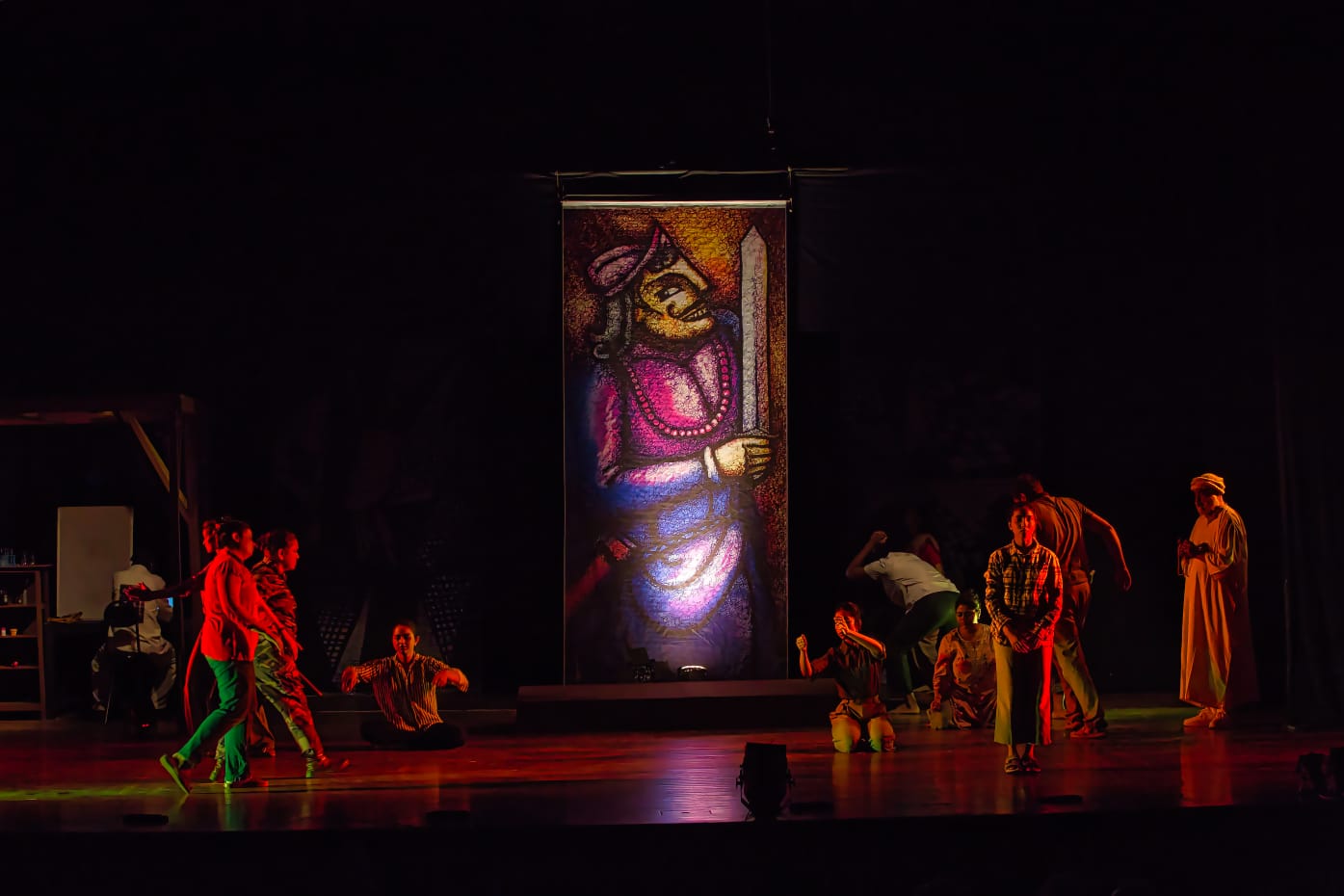
The production effectively evoked the atmosphere of a colonial-era industrial state through its visual treatment. Its minimalist staging allowed the emotional and philosophical weight of Tagore’s text to remain central.
The use of shadow play and symbolic props, particularly the recurring motif of red oleanders, added depth to the narrative and reinforced the play’s themes of beauty, resistance and human freedom.
The presentation brought together acting, music and movement to create a theatrical experience that engaged with Tagore’s complex ideas while making them accessible to contemporary audiences.
Also Read : IFFD 2026 to Celebrate Guru Dutt’s Birth Centenary with 4K ‘Pyaasa’ Screening
Cast and Performances
The ensemble delivered a compelling interpretation of Raktakarabi, combining emotional depth with contemporary theatrical expression.
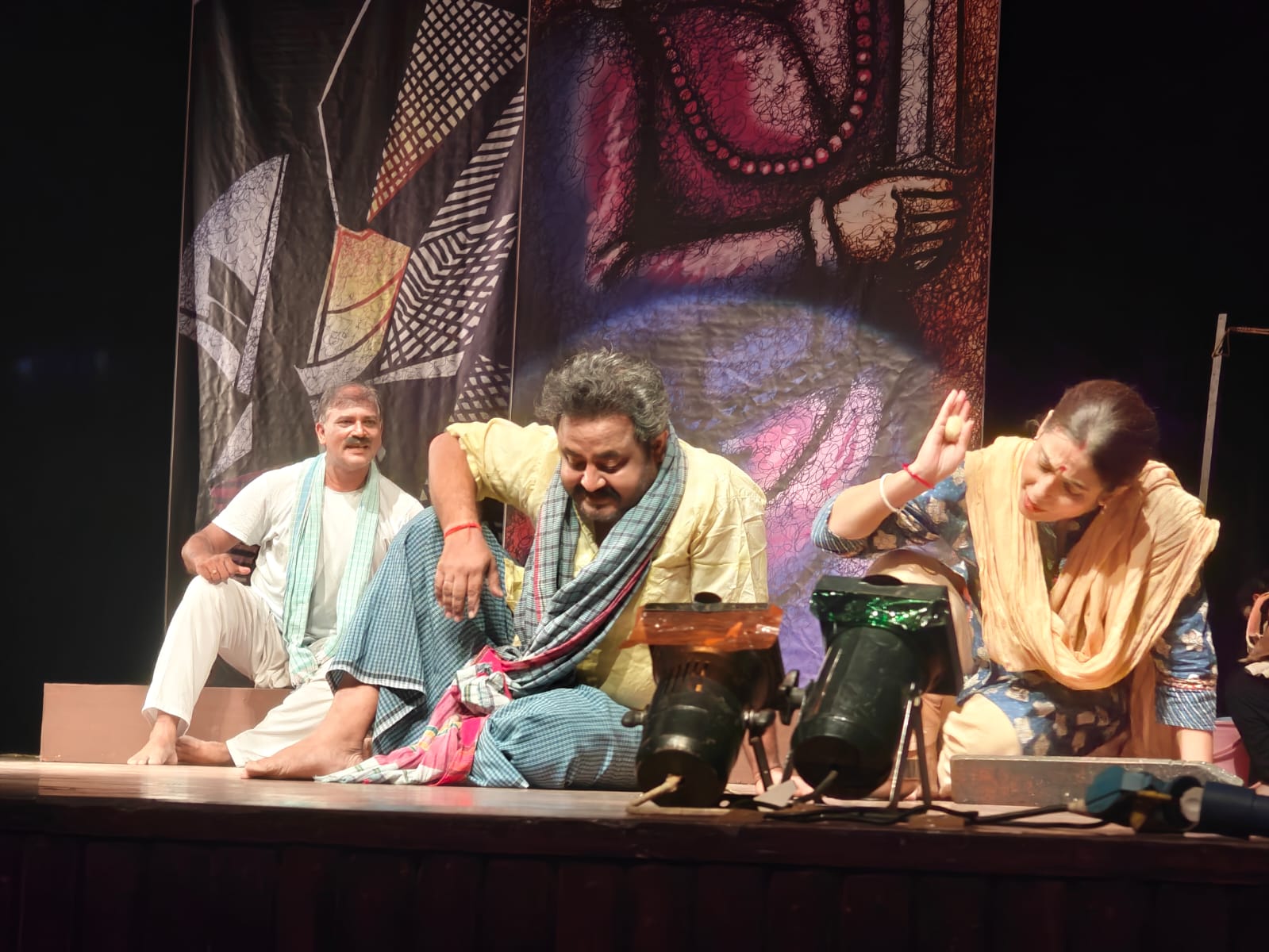
Ivy Sengupta, in the role of Nandini, gave a layered performance that balanced tenderness with quiet defiance. Her monologues held the audience in palpable silence before earning enthusiastic applause.
Director Shomik Ray, who also portrayed Raja, stood out with a nuanced performance that captured the complexities of a ruler caught between authority and transformation.
The supporting cast included Arindam Ghatak as Bishu, Siddhartha Bhadury as Fagulal, Susovan Saha as Gokul, Paromita Roy as Chandra, Surjavo Sengupta as Kishore, Partha Sarathi Bose as Paloan and Sudeep Dasgupta as Sardar.
Other roles were portrayed by Bhismabrata Bhattacharya as Odhyapok, Nirbhik Chatterjee as Puranbagish, Shahana Chakraborty as Mejo Sardar, Ashim Mishra as Morol and Amit Tagore as Gosain, helping the play roll.
The chorus featured Riddhi, Rubina, Rishika, Muskaan, Gayatri, Aakansha and Shreyjal, contributing to the collective energy of the production.
Creative and Technical Team
The production brought together a diverse team of theatre practitioners and artists.
Aniruddha Choudhury composed the background score, while Jayoti Ghosh served as vocal mentor. Stage creatives were handled by Suman Sen Gupta, with promotional creatives by Sourav Choudhury, Arya Ray and Surjavo Sengupta. Shubha Mitra designed the poster, while Brishti Mishra managed the sound board.
Lighting was designed by Ranjan Basu and Partha Nandi. Paromita Roy handled looks and costumes, while the crafts were created by Sanghamitra Ray and Paromita Roy.
Stagecraft was overseen by Dharam Singh Bisht of the National School of Drama, with Kalaripayattu training by Pratibha Verma.
Production assistance was provided by Shivangi Sain, Sridatri Bhattacharya, Suchitra Choudhury and Sanghamitra Ray.
Through its reinterpretation of Raktakarabi, Shapno Ekhon brought Tagore’s enduring questions about power, freedom and human dignity into dialogue with the realities of contemporary society.
The packed auditorium resonated with admiration. “Nandini’s quiet defiance held us breathless,” remarked one viewer. Another observed, “Tagore’s questions on dignity still demand answers.”
Also Read : The 80th birthday celebration of former Prime Minister of Bangladesh Sheikh Hasina