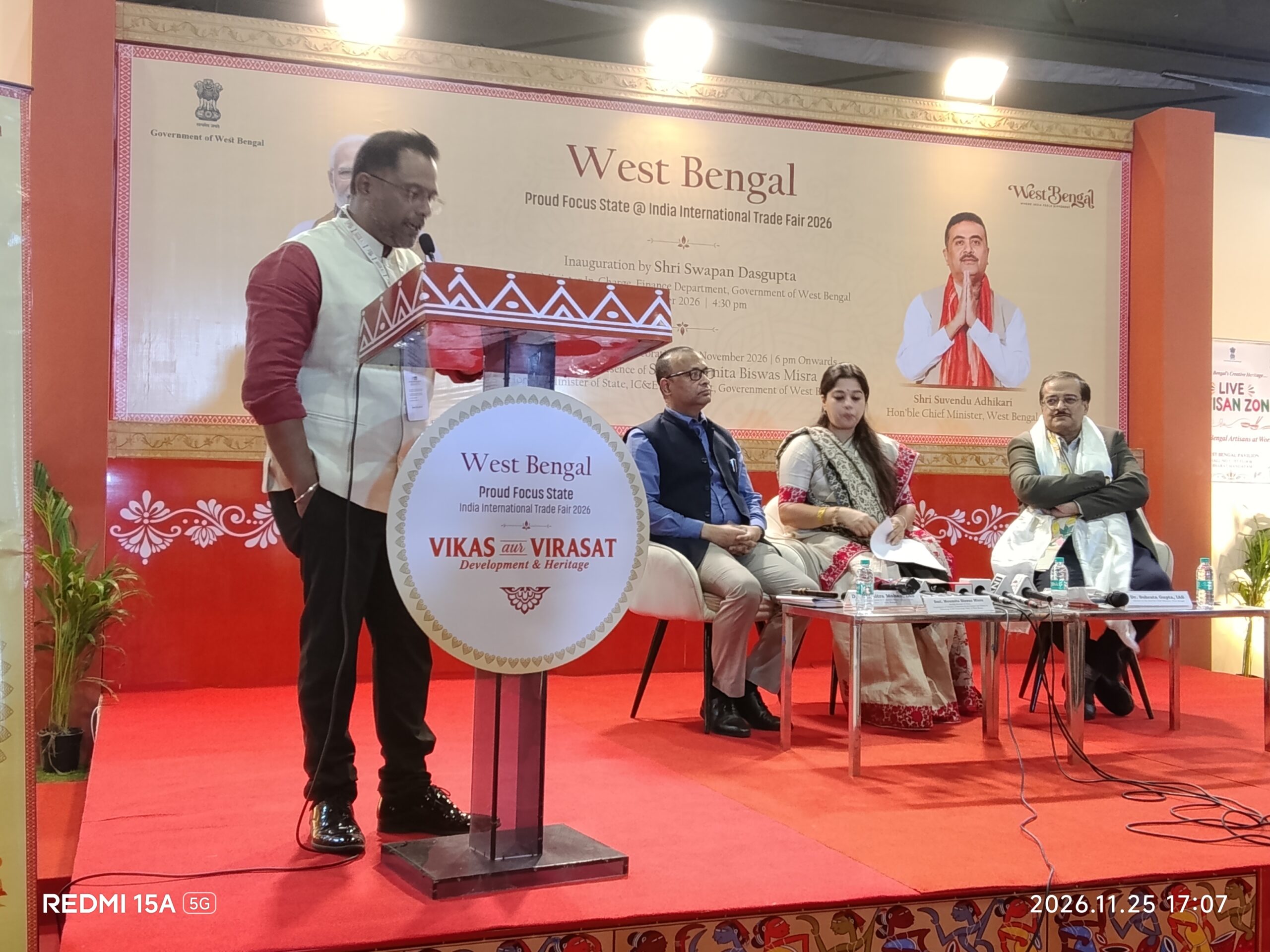
Dilip Guha, Sasraya News ★ New Delhi : The West Bengal Pavilion at the 45th India International Trade Fair (IITF) 2026 emerged as a vibrant showcase of the state’s rich cultural heritage, industrial potential and growing investment opportunities. Celebrating the theme “Vikas aur Virasat” – Development and Heritage, the pavilion brought together Bengal’s traditional strengths and its emerging economic aspirations.
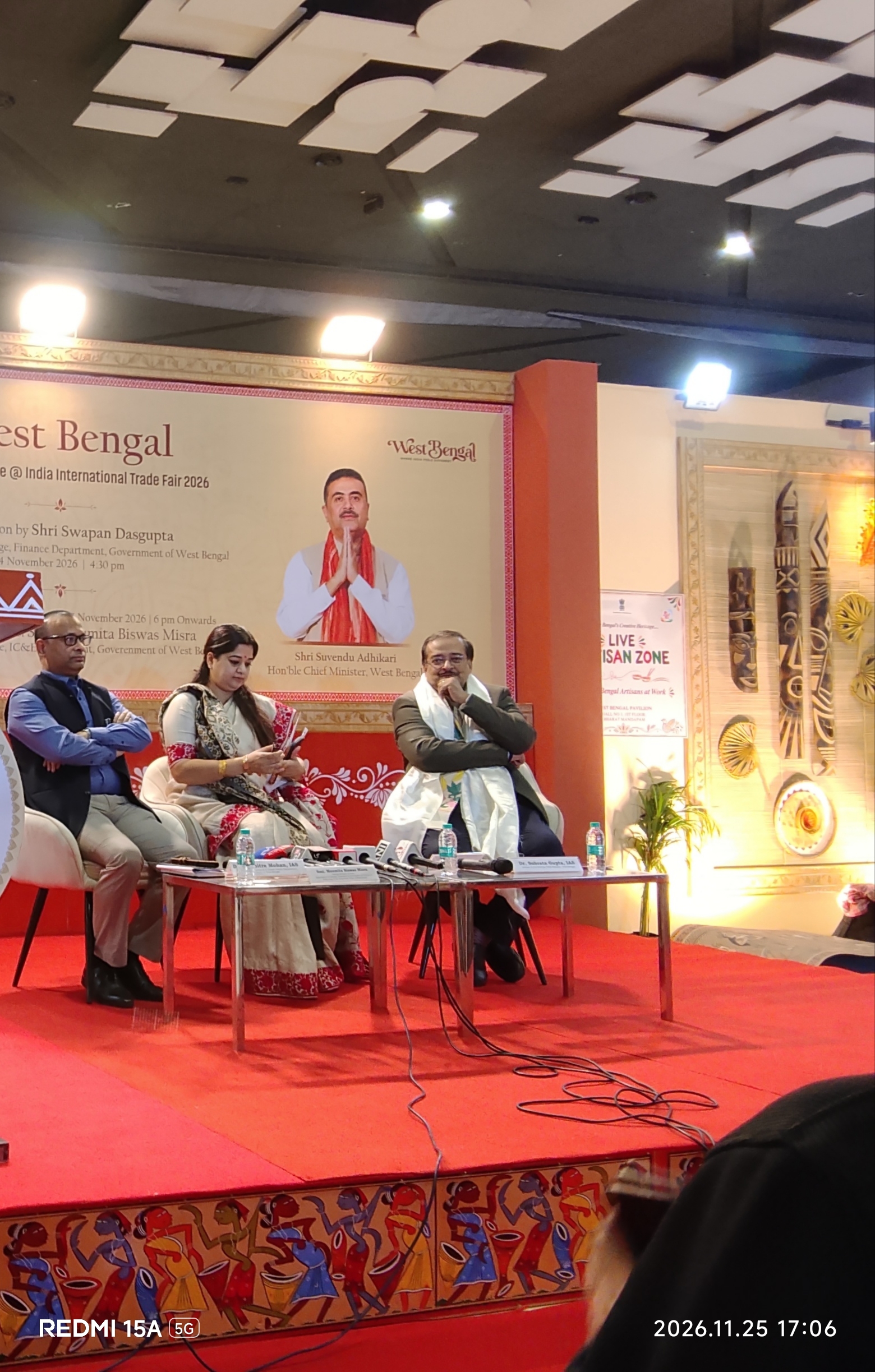
The West Bengal Day celebrations and press conference were held on November 25 at Bharat Mandapam and were addressed by Smt. Moumita Biswas Misra, Hon’ble Minister of State, Department of Industry, Commerce & Enterprises; Dr Subrata Gupta, IAS, Advisor to the Hon’ble Chief Minister of West Bengal; and Dr Saumitra Mohan, IAS, Secretary, Information & Cultural Affairs Department, Government of West Bengal.
The day featured development-focused discussions, interactions with the media and cultural celebrations, highlighting Bengal’s progress across industry, culture, handicrafts, handlooms and new-age entrepreneurship. The presentations underscored the state’s ambition to position itself not only as a destination of rich heritage but also as an emerging hub of investment and economic opportunities.
WEST BENGAL INVESTMENT PROMOTION POLICY 2026: A NEW ROADMAP FOR INDUSTRIAL GROWTH
The newly introduced West Bengal Investment Promotion Policy 2026 was the principal highlight of the press conference. The policy aims to attract fresh investments, generate employment, strengthen manufacturing and enhance the state’s position as a leading industrial destination in Eastern India.
Explaining the much-awaited policy, Smt. Moumita Biswas Misra said:
“I would like to explain that, as you have all been waiting for, the Government of West Bengal has introduced a new industrial policy, the West Bengal Investment Promotion Policy 2026, with a strong emphasis on employment generation, manufacturing, value addition and balanced regional development.”
The policy offers an attractive package of fiscal and non-fiscal incentives, including assistance linked to fixed capital investment, support for employment generation, technology upgradation, and research and development.
It places particular emphasis on strategic and emerging sectors, including semiconductors, electronics, electric vehicles (EVs), defence manufacturing, green energy, textiles, pharmaceuticals and food processing.
A significant feature is the creation of a dedicated, non-lapsable Assured Incentive Fund, intended to ensure that investment commitments are supported by financial provisions and policy continuity.
Reiterating the government’s commitment to building investor confidence, she said:
“The underlying message from the Government of West Bengal is very clear — West Bengal wants to build investor confidence through predictable policies and credible delivery,” she said.
“IF YOU HAVE NOT SEEN BENGAL, YOU HAVE MISSED SOMETHING IN LIFE”
Highlighting Bengal’s extraordinary geographical, cultural and artistic diversity, Dr Subrata Gupta, IAS, Advisor to the Chief Minister of West Bengal, welcomed members of the press and visitors to the pavilion with the remark:
“If you have not seen Bengal, you have missed something in life.”
He observed that the state’s vast diversity could not be adequately represented through a single exhibition, given its distinctive cuisine, languages, dialects, music, dance forms, historical landmarks, craftsmanship and cultural traditions.
“I think one such conference or one such exhibition is not enough to describe the variety that is West Bengal. West Bengal is geographically not a very large state, but if you look at the possibilities and the variety — whether it is the flavours of the state, its cuisine, the languages and dialects spoken from north to south, the music from the extreme north-east to the extreme south-west, the dance forms, cultural heritage, historical buildings, artefacts, craftsmanship, textiles and all the things that are unique to West Bengal — that entire canvas cannot be presented through a single exhibition.”
Appreciating the efforts of the Information and Cultural Affairs Department in bringing different aspects of Bengal to the national capital, he said:
“Yet, the Information and Cultural Affairs Department, my good friend Soumitro and his entire team, have worked very hard to present glimpses of different parts of West Bengal to people in Delhi and those visiting the India International Trade Fair — some flavours and some samples — so that we can showcase the state’s diversity.”
He emphasised that the exhibition was also intended to encourage visitors to explore Bengal’s investment opportunities, tourism destinations and cultural attractions.
“The idea is that, while talking about Bengal’s future and its investment possibilities, the objective of this fair and our exhibition is to encourage people from across the country to visit West Bengal and enjoy what it has to offer,” he added.
“In terms of tourism, tourist destinations, heritage, religious structures, architectural variety and the diversity of tribal cultures, West Bengal has so much to offer. People who have not visited West Bengal or experienced its diversity have missed something in life.”
A WINDOW INTO BENGAL
Describing the pavilion as a glimpse into the state’s immense diversity, Dr Gupta said:
“So, the objective of this exhibition, organised by the department under the guidance of the Hon’ble Chief Minister, is to provide a snapshot, a window into the state. My appeal to all of you, to all the visitors and to people across the country through our friends in the press, is to encourage them to come to Bengal and experience it,” he said.
NINE GOVERNMENT DEPARTMENTS, 31 STALLS: WEST BENGAL SHOWCASES ITS DIVERSE POTENTIAL AT IITF 2026
Bengal’s participation at IITF 2026 went beyond a conventional trade exhibition, presenting an integrated picture of its cultural identity, traditional craftsmanship, industrial ambitions and development initiatives.
Dr Saumitra Mohan, IAS, Secretary, Department of Information and Cultural Affairs, Government of West Bengal, highlighted the state’s objective of presenting its overall potential through the platform.
“You have already heard what the West Bengal Industry Policy offers and what this Trade Fair is all about. Following the change of government under the dynamic and visionary leadership of the Hon’ble Chief Minister Suvendu Adhikari, so many positive things are happening in the state. Through this platform — the Trade Fair — we are trying to showcase West Bengal’s entire potential.”
Giving an overview of the participation, he said:
“We have around 31 stalls here, with nine departments of the Government of West Bengal participating.”
The nine participating departments represented different facets of the state’s economy, traditional industries and development initiatives:
- MSME & Textiles Department: Showcasing West Bengal’s traditional handlooms and handicrafts.
- Self Help Groups & Self Employment Department: Highlighting traditional household skills, indigenous products and craftsmanship.
- Panchayat & Rural Development Department: Presenting rural traditions, entrepreneurship, infrastructure, livelihood opportunities, skill development, handicrafts and the state’s sustainable development model.
- Tribal Development Department: Showcasing indigenous art, tribal craftsmanship and traditional cultural identity.
- Tourism Department: Highlighting Bengal’s heritage, culture and remarkable tourism diversity.
- Animal Resource Development Department: Presenting livestock, animal husbandry, dairy and allied entrepreneurial opportunities.
- Agri-Marketing Department: Showcasing modern marketing infrastructure, processing facilities and market-oriented value chains.
- Industry, Commerce & Enterprises Department: Highlighting the state’s efforts to attract fresh investments across different economic sectors through its new industrial policy.
- Information & Cultural Affairs Department: Coordinating the cultural and heritage presentation.
Explaining the broader concept behind the pavilion, Dr. Mohan said:
“Our pavilion basically spans five to six themes,” he said.
ART, CRAFT AND CULTURE
The pavilion celebrated Bengal’s distinctive artistic traditions through terracotta, Dokra, Patachitra, Shola, Kantha, Madhurkathi, traditional textiles and GI-recognised products. Live demonstrations by artisans further highlighted the craftsmanship and skills passed down through generations.
CULTURAL, SPIRITUAL AND LEGENDARY PERSONALITIES
The presentation also celebrated the contributions of eminent personalities associated with Bengal, including Rabindranath Tagore, Swami Vivekananda, Netaji Subhas Chandra Bose, Raja Rammohan Roy and Satyajit Ray, alongside other social reformers and freedom fighters.
SPIRITUAL HERITAGE
Bengal’s spiritual traditions were represented through references to Chaitanya Mahaprabhu, Ramakrishna Paramahamsa, Belur Math, Kalighat and Gangasagar. The presentation also highlighted the state’s vibrant cultural traditions, including Durga Puja, Baul music and other musical genres.
TRADE, INDUSTRY AND INVESTMENT
The state’s industrial and investment potential was prominently highlighted through the newly introduced West Bengal Investment Promotion Policy 2026.
TOURISM AND REGIONAL IDENTITY
The pavilion also showcased Bengal’s tourism potential, regional diversity and distinctive cultural identity, with artisans demonstrating their traditional skills and craftsmanship.
Concluding his overview, Dr Mohan extended an invitation to visitors and the media to explore the state’s diverse offerings.
“The idea is to utilise this platform — the India International Trade Fair — and this pavilion to showcase the potential of our state across different sectors. We wish to invite visitors to our stalls and the esteemed members of the press present here to discover how rich Bengal is in terms of its heritage and culture, as well as the investment opportunities it offers.”
He subsequently invited questions from the media, followed by an interactive session with journalists and visitors.
WEST BENGAL PAVILION AS FOCUSED STATE, RECORDS HIGHER FOOTFALL AND SALES AT IITF 2026
West Bengal’s expanded participation at IITF 2026 translated into a significant increase in visitor engagement and sales, reflecting the growing popularity of the state’s pavilion.
Responding to a media question on what distinguished this year’s participation from previous editions, Dr Saumitra Mohan highlighted the substantial expansion in the scale and focus of the state’s presence.
“The first and most noticeable difference is that our presence was relatively smaller earlier. This year, we are far more focused, and the scale of our participation has expanded considerably. The difference is clearly visible to anyone comparing this year’s pavilion with our previous participation,” Dr Saumitra Mohan said.
MORE STALLS, HIGHER FOOTFALL, STRONGER SALES
Highlighting the increase in visitor turnout, he said:
“The number of stalls has increased substantially as well. On average, nearly one lakh visitors are visiting the pavilion every day, which is significantly higher than before.”
He also pointed to the encouraging sales performance compared with the previous year.
“Sales have also shown remarkable growth. Last year, our total sales proceeds were around ₹75 lakh. This year, with three days remaining, we have already crossed ₹90 lakh in sales. This demonstrates that we are performing much better than last year and receiving an overwhelmingly positive response from visitors,” he added.
The figures reflected the impact of the expanded pavilion, increased participation and the strong response to Bengal’s traditional products, handicrafts, textiles and other offerings.
NEW INDUSTRIAL POLICY GENERATES INVESTOR INTEREST; WBIDC RECEIVES BOOKINGS FOR INDUSTRIAL PARK VISITS
The newly introduced industrial policy also appeared to be generating interest among prospective investors, with officials reporting enquiries and requests for meetings with the West Bengal Industrial Development Corporation (WBIDC).
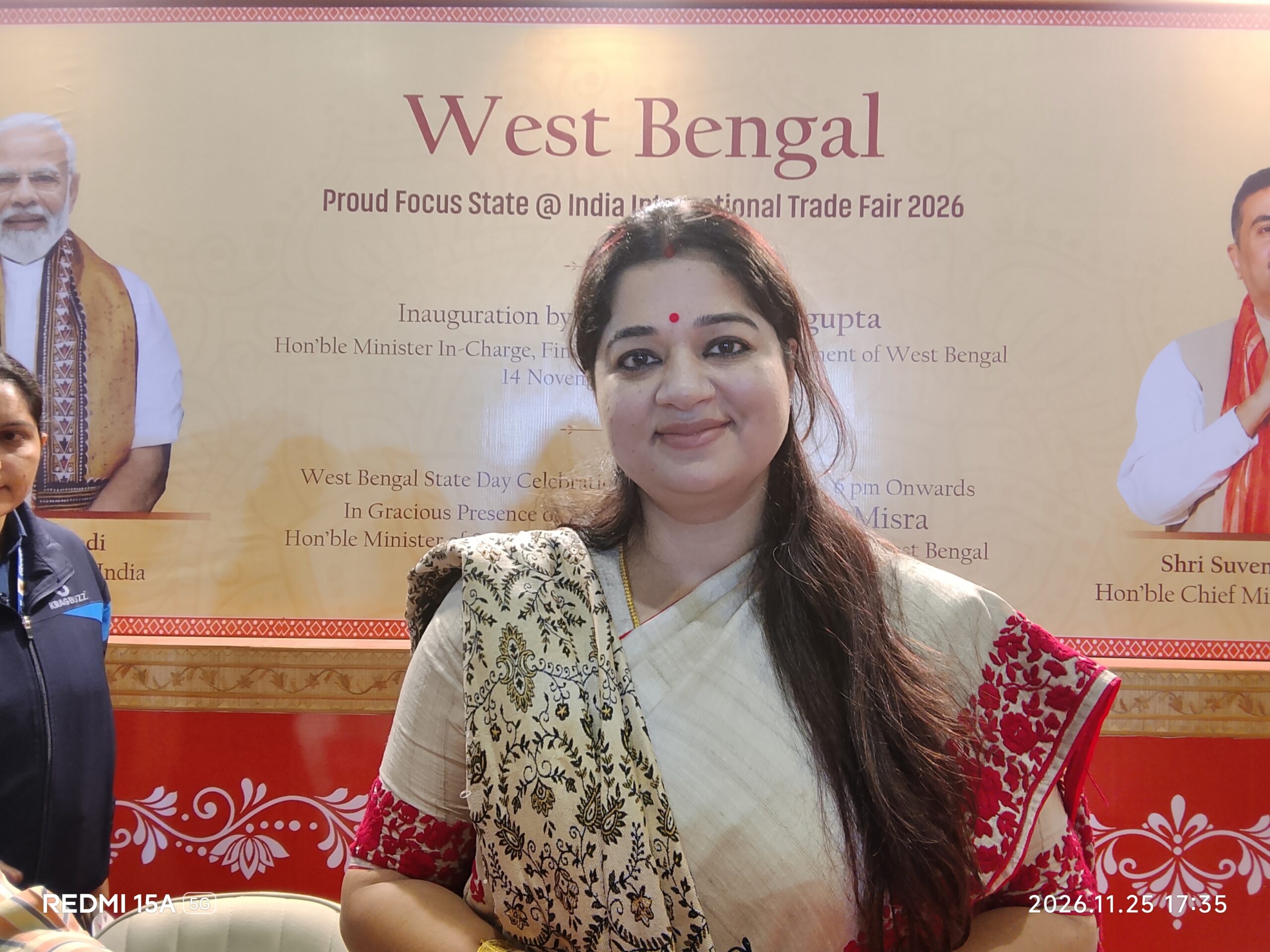
Sharing the response received at the Trade Fair, Smt. Moumita Biswas Misra said:
“The WBIDC accountant is also there. People have visited and already contacted us to meet at the office. They have also booked slots to visit the industrial parks in West Bengal,” said Smt. Moumita Biswas Misra.
INDUSTRY-FRIENDLY POLICY ATTRACTING INVESTORS
Explaining the growing interest, she added:
“Because of the new policy, and because our government and our Hon’ble Chief Minister have introduced an industry-friendly policy, investors are now very interested — from across the country and abroad as well,” she added.
“So, this is also one positive development that we have witnessed this time at the Trade Fair.”
₹34,000 CRORE IN INVESTMENTS ANNOUNCED IN FIVE MONTHS
During the media interaction, Smt. Moumita Biswas Misra also highlighted major investment proposals and industrial expansions undertaken in West Bengal over the preceding five months.
Responding to a question about significant industrial investments, she said:
“We are just here. Within these five months only, the West Bengal Government has taken expansion…”
She subsequently outlined a series of major projects spanning manufacturing, steel, healthcare, dairy and petrochemicals.
Major investments highlighted included:
- Dankuni – Manufacturing Expansion: Expansion of manufacturing facilities at an investment of ₹600 crore.
- Pakur – Integrated Steel Plant: A new integrated steel plant involving an investment of ₹15,000 crore.
- Adani Group – Healthcare Campus: A 2,000-bed healthcare campus, medical college and research facility involving an investment of ₹4,000 crore.
- Purulia, Raghunathpur – Greenfield Steel Plant: A 1.2 MTPA Greenfield Integrated Steel Plant involving an investment of ₹4,000 crore. This was described as the first Greenfield Integrated Steel Plant of its kind in West Bengal.
- Howrah – Amul Project: The Amul Bengal Project involved an investment of ₹700 crore.
- Haldia Petrochemicals: An investment of ₹6,000 crore in the previous month.
Together, these projects represented investments of nearly ₹34,000 crore.
“So, about, I think, ₹34,000 crore in investments has already come in during these five months,” said.
The investments highlighted the state’s efforts to accelerate industrial expansion and attract projects across multiple sectors, strengthening its manufacturing and economic base.
WEST BENGAL PAVILION: A COMPREHENSIVE SHOWCASE OF CULTURE, CRAFTSMANSHIP AND ENTERPRISE
Responding to another question on the pavilion’s principal attractions, Smt. Moumita Biswas Misra described the entire presentation as an attraction in itself, emphasising its expanded scale and the encouraging response from visitors.
Q: Visitors can see the West Bengal Pavilion here as well. What is the main attraction, and what have you tried to showcase?
Smt. Moumita Biswas Misra said:
“The entire pavilion is an attraction in itself. Visitors can clearly see the scale and vibrancy of what West Bengal has brought to the Trade Fair this year. While West Bengal participated in 2024, the pavilion was not present last year. This year, the pavilion is nearly double the size of what it was previously, making it even more engaging for visitors.
We are operating across approximately 730 square metres, featuring 31 stalls representing nine different government departments. The response from visitors has been overwhelming. Sales have already crossed ₹90 lakh, and with three days still remaining, we expect to surpass the ₹1 crore mark.
This success is a reflection of the beautifully curated stalls. I have personally visited all of them, and each one vividly represents the rich culture, heritage, craftsmanship and legacy of West Bengal. The appreciation shown by visitors has been truly encouraging.”
STATE DAY CELEBRATION: BRINGING BENGAL’S CULTURAL LEGACY TO A NATIONAL AUDIENCE
The West Bengal Day celebrations provided another opportunity to highlight the state’s contribution to India’s cultural and intellectual heritage.
Q: Today, West Bengal is celebrating its State Day at the Trade Fair. What aspects of the state’s culture will visitors get to experience?
Smt. Moumita Biswas Misra said:
“West Bengal has always held a significant place in India’s cultural and intellectual landscape. Whether in literature, industry, education, art or culture, Bengal has contributed immensely to shaping the identity of modern India.
Today, we are presenting the state’s rich heritage and diverse cultural traditions to a national audience. Under the vision of Viksit Bangla, aligned with the Hon’ble Prime Minister’s vision of Viksit Bharat 2047, we are working towards showcasing Bengal’s strengths and achievements on a larger platform.
The International Trade Fair provides an excellent opportunity to highlight our cultural richness, economic potential and entrepreneurial spirit. The response from visitors has been extremely positive, and people are appreciating what West Bengal has to offer.”
BENGAL’S TEXTILE HERITAGE ATTRACTS VISITORS
Bengal’s traditional textiles and handloom products emerged as another major attraction at the pavilion, drawing considerable attention from visitors.
Q: A great deal of art and culture from Bengal is being showcased here. What would you like to say about that?
Smt. Moumita Biswas Misra said:
“One of the most beautiful aspects of Bengal’s cultural heritage is its textile tradition. West Bengal is renowned for its exquisite fabrics, handlooms and textile craftsmanship. From elegant sarees to beautifully crafted garments and accessories, our products are admired not only across India but increasingly in international markets as well.
Women, in particular, are drawn to Bengal’s distinctive weaves, textiles and designs. West Bengal has long been a hub of creativity, craftsmanship and cultural expression through fabric.
Also Read: Tripura Showcases Heritage, Products and Investment Potential at IITF 2026
I would encourage every visitor to explore our textile and handicraft stalls. The products on display are truly exceptional. In fact, I have personally selected items from a couple of the counters, and the quality is outstanding. The exhibitors are doing remarkably well, and customers are leaving genuinely satisfied with their experience.”
With an expanded pavilion spanning approximately 730 square metres, 31 stalls representing nine government departments, and sales exceeding ₹90 lakh with three days remaining, West Bengal’s participation at IITF 2026 reflected a strong combination of cultural promotion, traditional enterprise and industrial ambition. The state’s vision of Viksit Bangla, aligned with Viksit Bharat 2047, provided the broader framework for presenting its heritage and development aspirations on a national platform.
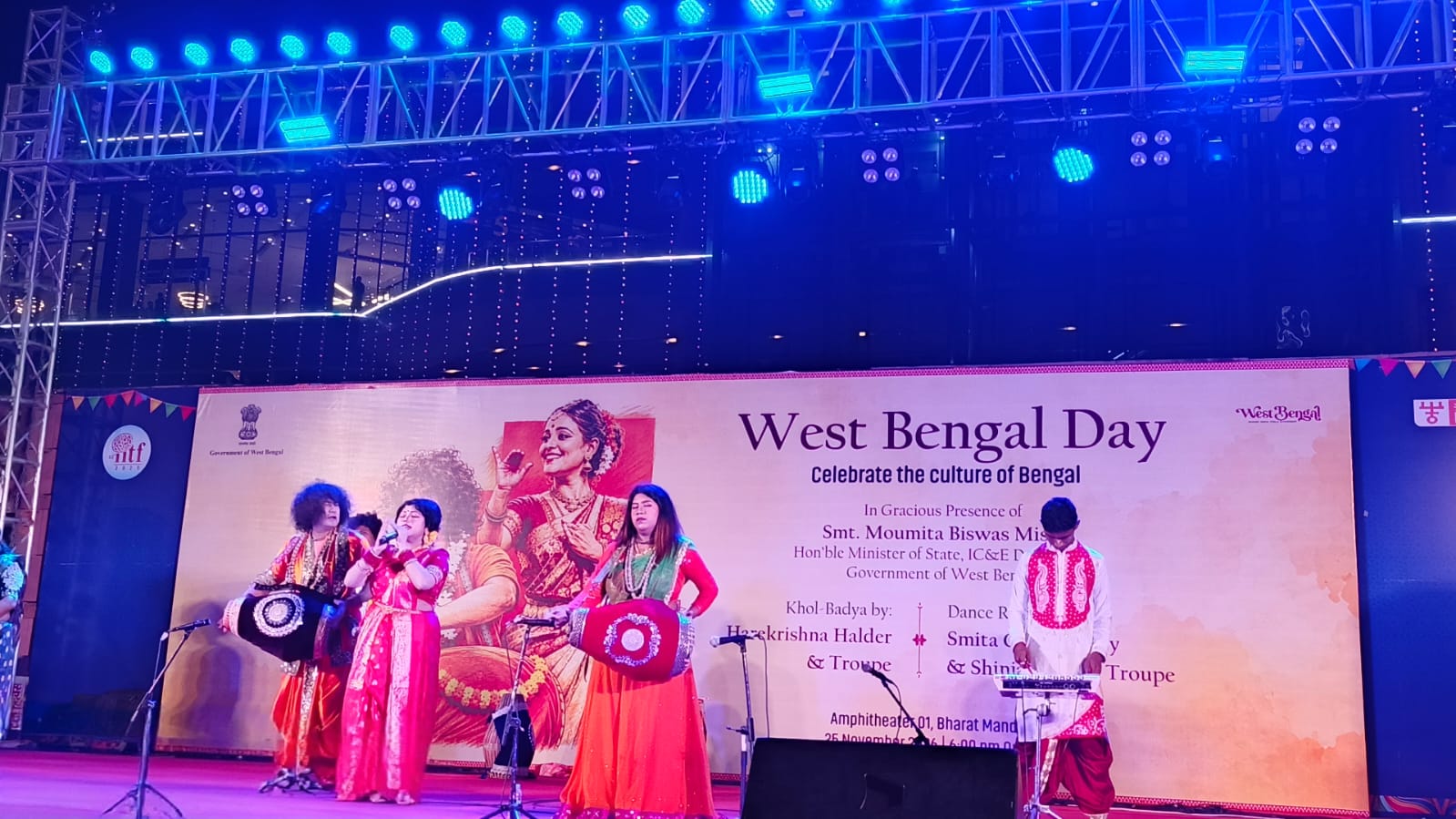
AN EVENING CELEBRATING BENGAL’S CULTURAL HERITAGE
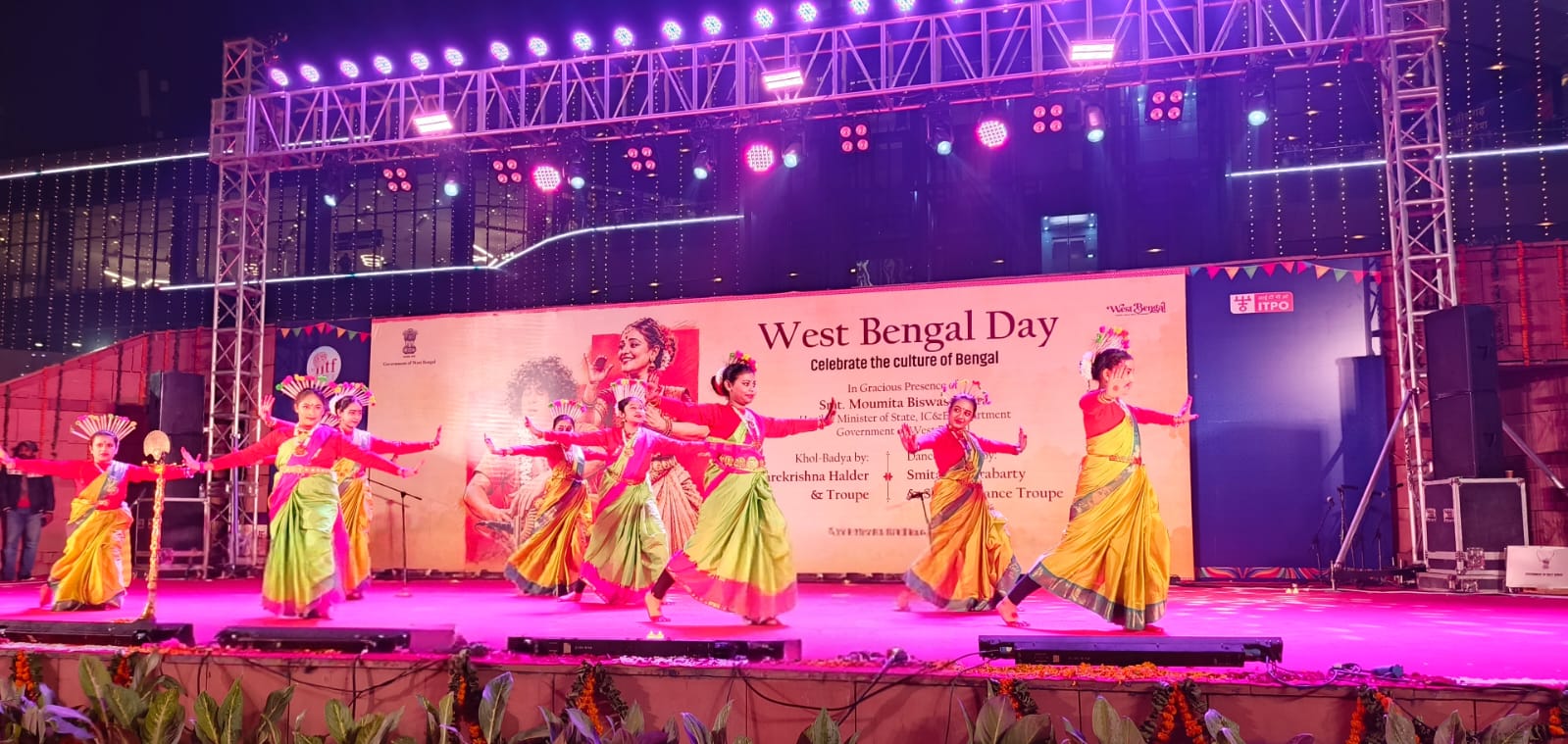
The West Bengal Day celebrations concluded with an evening of music, dance and artistic performances, offering visitors a glimpse into the state’s vibrant cultural traditions.
The cultural programme featured two distinctive expressions of Bengal’s artistic heritage, bringing together music, dance and tradition on the stage at Bharat Mandapam.
The evening’s cultural presentation was led by Dr Harekrishna Haldar and his troupe, who brought alive the rich artistic traditions of Bengal through their performance.
One of the highlights of the cultural evening was a visually captivating dance-drama presented by the students of Shinjan Dance Academy, under the artistic direction of Smita Chakraborty.
Blending Indian classical dance, devotional music and folk traditions, the production offered a moving tribute to India’s cultural heritage, spiritual ethos and timeless values.
The performance brought the day’s celebrations to a fitting close, reinforcing the central message of the West Bengal Pavilion at IITF 2026 — a state deeply rooted in its cultural legacy while steadily advancing towards new opportunities in industry, investment, entrepreneurship and development.
Also Read: Small Beginnings, Big Dreams: Start-up Entrepreneurs Find Their Footing at IITF 2026