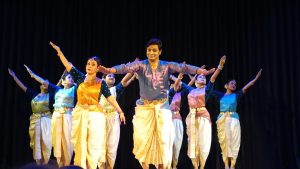
Dilip Guha, Sasraya News ★ Naw Delhi : South Kolkata Nrityangan, one of Kolkata’s leading Bharatanatyam institutes, presented two captivating dance productions — Antarātma and Rangiye Diye Jao — at the prestigious CD Deshmukh Auditorium, India International Centre, New Delhi, on April 18, 2026. Organised by Impresario India, the event drew an appreciative audience of art lovers and connoisseurs.
The institute was founded by renowned dancer Smt Jhinook Mukherjee Sinha, a senior disciple of Guru Dr Thankamani Kutty. South Kolkata Nrityangan had grown into a vibrant cultural hub with nearly 300 students, ranging from young girls to older women. The institute also extended its reach beyond the classroom and maintained a meaningful association with the orphanage, Refuge.
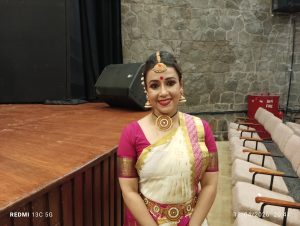
Smt. Jhinook Mukherjee Sinha had showcased her talent across continents, performing in the USA, Canada, the UK, Australia, Europe, Singapore, and the Middle East. She had graced the stage at the North American Bengali Conference (NABC) in the US and Canada three times, toured Turkey and Bangladesh as a representative of the Ministry of Culture, Government of India, and was invited to perform at the prestigious Nehru Centre in London by the High Commission of India. Her international engagements underscore her role as a cultural ambassador, bringing Indian classical arts to global audiences.
Read: Murder, Mystery and Laughter: Play Bitongsho Brings Classic Comedy Alive
The performing wing of the institute had built an impressive repertoire across India, gracing stages at major festivals and cultural platforms, including the Cuttack Mahotsav, Lingaraj Festival, Rathyatra Mahotsav Ujjain, India Habitat Centre New Delhi, Nadaneeranjanam Tirupati, and the G20 Summit cultural events in West Bengal.
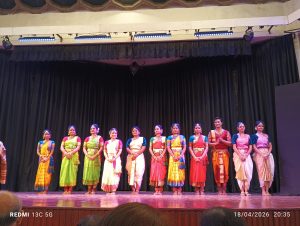
With Antarātma exploring the spiritual essence of Bharatanatyam and Rangiye Diye Jao celebrating vibrant dance expressions, the evening highlighted the institute’s commitment to tradition while embracing creative innovation.
Antarātma: A Bharatanatyam Journey Through Navarasa and Tagore
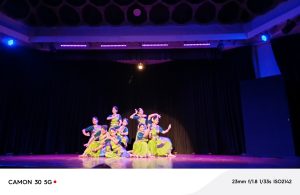
The evening opened with the institute’s debut presentation, Antarātma, a luminous exploration of the human spirit that seamlessly wove Bharatanatyam’s classical vocabulary with the timeless poetry and music of Rabindranath Tagore. The production offered audiences an immersive voyage into the nine rasas — the fundamental emotions described in Bharata’s Natyashastra.
Conceived, choreographed, and directed by Jhinook Mukherjee Sinha, Antarātma was scripted and narrated by Samya Karpha. The production drew on evocative recordings by celebrated singers Jayati Chakraborty, Rohini Roychowdhury, and Shounak Chattopadhyay, whose voices became the sonic backdrop for the dancers’ expressive journey.
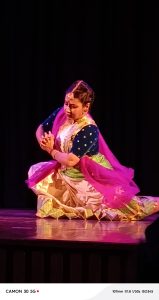
Traversing Shringaar (Love), Adbhutam (Wonder), Karuna (Compassion), Hasya (Laughter), Raudra (Rage), Veera (Heroism), Bibhatsam (Disgust), Bhayanakam (Fear), and Shantham (Peace), the choreography illuminated the vulnerability and richness of human experience. Each rasa was not merely performed but embodied, inviting the audience into a shared meditation on life’s emotional spectrum.
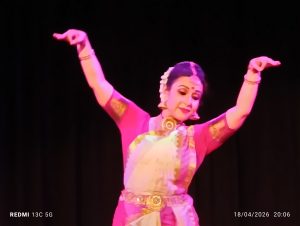
What made Antarātma distinctive was its dialogue between traditions: Tagore’s melodies, deeply rooted in Bengali cultural consciousness, were interlaced with Carnatic influences, creating a layered soundscape. This interplay allowed Bharatanatyam’s gestures and rhythms to converse with Tagore’s lyrical universe, producing a rare fusion of classical form and literary depth.
As an in-house production, Antarātma reflected the institute’s artistic ethos — nurturing tradition while encouraging innovation — and stood as a celebration of the universality of human emotion. For the dancers, it became both an inner voyage and a collective celebration, affirming the power of art to transcend boundaries and speak to the universality of human emotion — a celebration of the human spirit in all its colours.
Rangiye Diye Jao: A Lyrical Ode to the Enchantment of Spring
The second presentation of the evening, Rangiye Diye Jao, unfolded as a poetic meditation on spring—not merely as a season, but as a living, breathing presence. Conceived with evocative imagination, the production reimagined Spring as a charming prince—radiant yet elusive, gentle yet commanding—whose arrival transformed the very pulse of existence.
From the moment he stepped onto the stage, the atmosphere began to shift. The earth seemed to awaken in tandem with his presence: buds unfurled, the air softened, and an undercurrent of quiet anticipation rippled through the world. His movements were not forceful but fluid, carrying with them the promise of renewal—of warmth returning after endurance, and life reclaiming its rhythm after a period of stillness.
What set the production apart was its nuanced portrayal of influence without imposition. The Prince did not rule; he enchanted. Figures from across realms—human, natural, and mythical—were drawn toward him, captivated by the subtle magnetism he exuded. Through layered choreography and recurring visual motifs, the stage evolved into a responsive, almost sentient landscape that mirrored the transformative power he embodied.
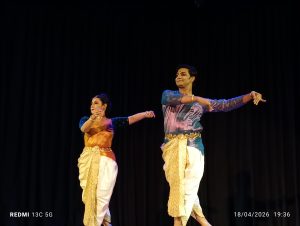
Rather than presenting spring as mere visual splendour, the production delved deeper into its emotional and symbolic resonance. The narrative unfolded gradually — from suggestion to intensity — ultimately enveloping the stage in a sense of transformation and longing. The conclusion left the audience suspended in anticipation, echoing the cyclical promise of spring’s return. Critics noted that the departure left the stage suspended in longing, alive with what had been awakened, and waiting—patiently, achingly—for the promise of his return. The performance was hailed as a powerful exploration of seasonal inevitability and human yearning, leaving audiences deeply moved.
Young Bharatanatyam Dancers Reflect on Artistic Journey
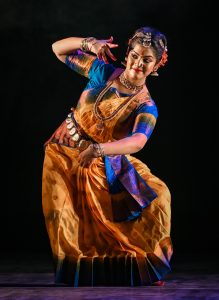
Among the performers was Ms Subhanwita Ghosh, an 18-year-old advanced-level Bharatanatyam student from South Kolkata Nrityangan, who had trained at the institute for a decade. She shared that her passion for the art form stemmed from its unique blend of rhythm, storytelling, and devotion. She explained that this connection had helped her engage deeply with Indian culture and tradition. She said,
“Our institute has played an important role in shaping my understanding of both dance and culture. Learning here has helped me see Bharatnatyam not only as a performing art but as a living tradition that carries history, values, and identity. The institution has taught me discipline, dedication, and respect for the art form, while also helping me appreciate the cultural depth behind every movement and expression.”
Read : IFFD 2026 to Celebrate Guru Dutt’s Birth Centenary with 4K ‘Pyaasa’ Screening
She described her training as a journey of discipline and growth, overcoming challenges through consistent practice and guidance from her teachers. Performing in Antarātma, she embodied the intricate balance of technique and expression, shaped through sustained practice and close attention to abhinaya, posture, and rhythm. She said, “Like any other classical dancer, I have faced challenges in training, including maintaining consistency, improving techniques, and balancing practice with other responsibilities. There were moments when certain movements and expressions felt difficult to master. I overcame these challenges through regular practice, patience, guidance from my teacher, and self-motivation. Each difficulty helped me grow stronger and more confident as a dancer.”
Expressing excitement about performing at the Delhi event, she called it a proud opportunity to showcase her dedication and cultural heritage. She added that she hoped her performance conveyed both the technical beauty and emotional depth of Bharatanatyam, leaving the audience inspired and appreciative of classical dance. “My performance piece was a Bharatanatyam production that reflected both rhythm and expression. I prepared for it through discipline, practice, repetition, and close attention to abhinaya, posture, and timing. I also worked on understanding the meaning of the piece, based on Navarasa, so that I could perform it with sincerity and emotional depth,” she said.
She expressed a heartfelt wish that the audience would experience the grace, energy, and emotional richness of Bharatanatyam. Beyond technical precision, she hoped spectators connected with its deeper cultural and spiritual essence. “If my performance inspired even a little appreciation for classical dance, I felt truly rewarded,” the dancer shared.
Acknowledging the support system behind her journey, she extended gratitude to parents, teachers, and fellow dancers. Parents, she noted, provided strength; teachers offered direction; and peers created a space of inspiration and shared growth. This collective encouragement, she emphasised, had been vital in shaping her path.
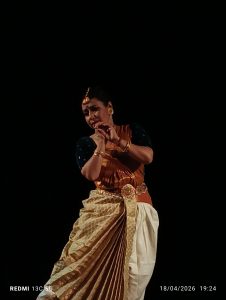
Looking ahead to World Dance Day, she described the occasion as a celebration of dance as a universal language that transcended boundaries. She highlighted its role as both an art form and a powerful expression of emotions, heritage, and humanity, urging everyone to value and support diverse dance traditions.
Reflecting on her personal journey, she expressed deep appreciation for every opportunity to learn and present Bharatanatyam. The art form, she said, “continued to teach patience and devotion. With sincerity, she looked forward to growing further as a dancer and carrying forward this tradition with pride”.
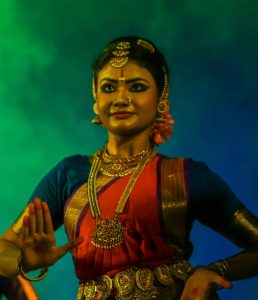
Ms Tannistha Chakrabarty , another dancer of the troupe, a 21-year-old advanced Bharatanatyam dancer trained at South Kolkata Nrityangan, reflected on her nine-year journey in dance, describing its evolution from a childhood fascination with rhythm and movement to a deeper engagement with the art form’s cultural, spiritual, and expressive dimensions.
“Training at South Kolkata Nrityangan has shaped my perspective profoundly. It has taught me that Bharatanatyam is not just a performance art, but a way of preserving and embodying culture. The emphasis on discipline, tradition, and emotional authenticity has helped me see dance as both an intellectual and spiritual practice, not merely a physical one,” she said.
Speaking about her performance in Delhi, she described the opportunity as both an honour and a responsibility, while highlighting her preparation for the production Antarātma, which explores human emotions through Rabindranath Tagore’s works.
“Performing in Delhi at such a prestigious platform is both an honour and a deeply humbling experience. At the same time, it comes with a sense of responsibility to represent my institution and my art form with sincerity and integrity,” she said.
Read : Priyanka Mohan Walks the Red Carpet at IFFD 2026; Made In Korea Garners Global Acclaim
Elaborating on her preparation, she underscored the importance of discipline, perseverance, and emotional authenticity.
“The work is deeply rooted in abhinaya, focusing on how these emotions manifest and transition within the human psyche. Preparation went beyond learning the choreography; it involved immersing myself in the emotional and literary depth of Tagore’s work, understanding each rasa not just technically but experientially. We worked extensively on internalisation of the emotions to ensure they feel authentic and lived, allowing me to truly immerse myself in the depth of the work,” she said.
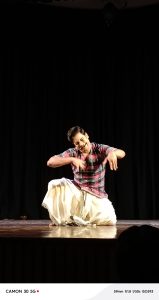
She also expressed gratitude to her gurus and peers, adding that she hoped her performance would create a lasting emotional connection with the audience and deepen their appreciation of dance as a powerful medium of storytelling and cultural preservation.
“This performance is part of a continuous journey rather than a final destination. Each stage, each audience, and each experience contribute to evolving as an artist, and I look forward to growing further through opportunities like this,” she said.
Commenting on the upcoming World Dance Day, she highlighted the universal appeal of dance.
“Dance is a universal language that transcends boundaries. On World Dance Day, I hope more people embrace it not just as entertainment, but as a means of expression, healing, and cultural preservation,” she added.
The evening, through its artistic excellence and emotional resonance, reaffirmed the enduring relevance of classical dance in contemporary cultural discourse. South Kolkata Nrityangan’s presentation stood not only as a showcase of talent but as a testament to the transformative power of art.
Read : Housefull Screens, Star Power, and a City in Sync: IFFD 2026 Makes a Landmark Debut