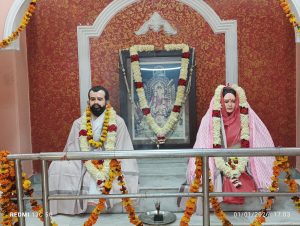
DILIP GUHA ★ New Delhi : Kalpataru Day, also known as Kalpataru Diwas or Kalpataru Utsav, is an annual religious festival observed on January 1 by monks of the Ramakrishna Math and devotees of the Ramakrishna Mission, along with Vedanta Societies worldwide. The day holds deep spiritual significance for followers of Sri Ramakrishna Paramahamsa, the 19th-century Indian mystic and a key figure of the Hindu Renaissance, whose teachings emphasised the unity of all religions and the pursuit of self-realisation. Kalpataru Day commemorates January 1, 1886, when Sri Ramakrishna’s disciples believed he revealed himself as an Avatar, or God incarnate, blessing devotees collectively for their spiritual awakening. The most significant observance takes place at the Cossipore Garden House (Udyanbati) in Kolkata—now the Ramakrishna Math—where Sri Ramakrishna spent his final days. Followers regard it as one of the “Lord’s special festivals.”
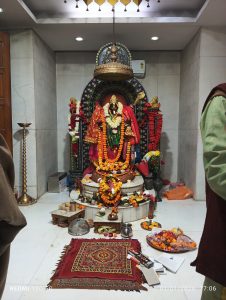
The origin of Kalpataru Day dates back to a profound spiritual event when Sri Ramakrishna, then gravely ill with throat cancer, was residing at the garden house in Cossipore. On that day, he asked his devotee Girish Chandra Ghosh, “Who do you say that I am?” Girish responded by declaring him God incarnate, moved by compassion for humanity. Deeply touched. Sri Ramakrishna, in a half-ecstatic state, with a divine smile, said: “What more shall I say? I bless you all, Be illumined!”
After uttering those words, he became overwhelmed with love and compassion for his devotees and entered into ecstasy. All the devotees assembled anxiously to bow down to him and take his foot dust. Their cries of ‘Jai Ramakrishna!’ resounded in all directions as one by one they bowed down to him. As they touched his feet, Sri Ramakrishna’s compassion burst as the ocean through all bounds and created an astonishing phenomenon. The Master, also in a semi-ecstatic state, began to touch each devotee present and blessed them, and their inner joy was boundless.
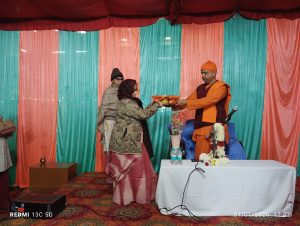
Sri Ramakrishna entered an ecstatic state and blessed his disciples, many of whom later described experiencing spiritual visions and inner transformation. Devotee Ramachandra Dutta interpreted this event as Sri Ramakrishna becoming the Kalpataru—the mythical wish-fulfilling tree of Hindu tradition—thus naming the occasion Kalpataru Day.
Each year on English New Year’s Day, thousands of devotees visit Kashipur Udyanbati (Cossipore Garden House) in Kolkata to commemorate this moment of self-revelation that occurred nearly 140 years ago. Kalpataru Day is also observed across India and abroad at various Ramakrishna Mission centres with special pujas, bhajans, homa, and spiritual discourses. In the Delhi NCR region, the main function is traditionally held at the Ramakrishna Mission, drawing large numbers of devotees in the early hours of the morning.
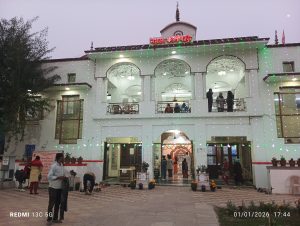
This year marked a significant milestone as the Noida Bengali Cultural Association (NBCA), Noida Kalibari, Sector 26, Noida, in association with Sri Ramakrishna Bhav Prachar Samiti Noida, observed Kalpataru Day for the first time. A special program titled “Significance of Kalpataru Day and Why Devotees Should Celebrate It” was organised on Thursday, January 1, 2026, at the Kalibari premises. Revered Swami Jyotiswarupananda Ji Maharaj, fondly known as Mangesh Maharaj from Ramakrishna Mission Delhi, presided over the event and delivered an enlightening lecture on the occasion. Present at the program were Noida Kalibari President Shaurja Chatterjee, Vice President Anupam Banerjee, Secretary Satyaki Guha, Treasurer Tapan Banerjee, along with Managing Committee members Achintya Ghatak, Ananya Dasgupta, Sujoy Pal, and Alpana Roy. Pranam Chattopadhyay of Sri Ramakrishna Bhav Prachar Samiti-Noida was also present.
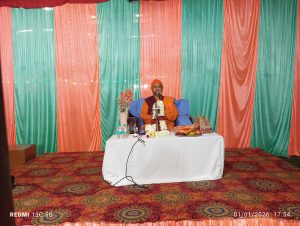
Addressing the gathering, Mangesh Maharaj said that Kalpataru Day symbolises the awakening and blossoming of inner consciousness. He noted that Sri Ramakrishna Paramahamsa showed humanity the path from darkness to light and emphasised harmony among religions by affirming that all faiths lead to the same ultimate truth. Explaining the spiritual symbolism of Kalpataru, he described it as a divine wish-fulfilling tree that represents Sri Ramakrishna’s compassion and his ability to fulfil spiritual aspirations. He elaborated on these ideas by citing incidents from the lives of Sri Ramakrishna, Sarada Maa, and Swami Vivekananda, which devotees listened to with deep attention.
The program concluded with devotional songs, including “Ramakrishna Saranam,” beautifully rendered by Moly Datta, Ananya Dasgupta, Nirmal Guha, and Pranam Chattopadhyay. Devotees observed Kalpataru Day with prayer, reflection, and collective devotion, reaffirming their commitment to Sri Ramakrishna’s teachings of unity, love, and spiritual enlightenment.
Aldo Read : Celebration Organized at Ramakrishna Math, Lucknow on Christmas Eve