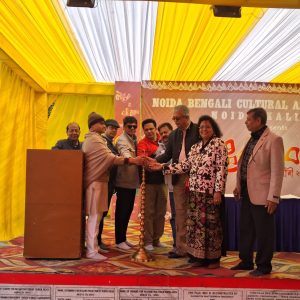
Dilip Guha ★ New Delhi : The crisp winter air of Noida carried the unmistakable fragrance of Nolen Gur and the lilting notes of Baul songs as Noida Kalibari hosted its much-awaited Poush Mela and Book Fair on January 10 and 11. Organised by Noida Bengali Cultural Association (NBCA) for two days, Noida Kalibari transformed into a vibrant “mini-Shantiniketan,” drawing crowds eager to immerse themselves in the cultural heartbeat of Bengal.

The Poush Mela itself traces its roots back to the late 19th century in Shantiniketan, founded by Maharshi Debendranath Tagore to celebrate the harvest season and promote rural artisanship. Over time, it grew into a cultural landmark, blending literature, music, crafts, and community spirit — a tradition that continues to inspire events like the one at Noida Kalibari.
From morning till late evening, the temple grounds buzzed with activity. Book stalls lined the pathways, offering treasures from Bengal and Delhi’s publishers—classics, poetry, and contemporary works that delighted bibliophiles. The cultural stage remained alive throughout, with Baul singers captivating audiences, folk dancers weaving stories through movement, and poets reciting verses that echoed Bengal’s timeless spirit.

Fun-Filled Activities: The event featured a wide range of entertaining and engaging activities that attracted enthusiastic participation from people of all age groups. One of the major highlights was the Pithe Puli Competition, where participants showcased their culinary skills by preparing a variety of traditional homemade sweets, reflecting rich cultural heritage and creativity. Food was, as always, at the heart of the celebration. Visitors queued eagerly at the Pithe-Puli stalls, savouring Patishapta crepes stuffed with coconut and jaggery, Dudh Puli simmered in milk, and steaming bowls of Gurer Payesh. “I wait all year for this taste,” said Ananya Roy, a resident of Noida, smiling as she balanced a plate of sweets. “It feels like home away from home.”
The Master Chef Competition added excitement to the program as contestants demonstrated their cooking expertise, presentation skills, and innovative recipes, impressing both judges and spectators. Food lovers tested their skills in the Master Chef challenge. “The Pithe-Puli competition was so much fun,” laughed Meera Banerjee, a participant, “and it reminded us how food binds families together.”

Beyond the culinary delights, the fair showcased Bengal’s artisanal heritage. Kantha-stitch sarees, terracotta figurines, and handcrafted décor drew admiration from shoppers. “These crafts connect us to our roots,” noted Sanjay Dutta, a visitor from Ghaziabad, as he examined a handwoven stole. “Buying them is not just shopping—it’s supporting tradition.”
The Quiz Competition tested participants’ knowledge and quick thinking, encouraging healthy competition while promoting learning and awareness on various topics.
Special attention was given to young participants through a Drawing Competition for children, where budding artists expressed their imagination and creativity through colourful artworks. Children sketched colourful scenes in the drawing contest, making the event enjoyable and memorable for the children.
families joined Tambola games, and A lively session of Tambola brought joy and laughter, with participants eagerly marking their tickets and celebrating wins, creating a cheerful and interactive atmosphere.
These activities contributed to a vibrant and festive environment, ensuring fun, learning, and active participation for everyone involved.
The vibrant spirit of Poush Mela was beautifully reflected in an evening of cultural programmes on both days that brought together classical, folk and contemporary performances, captivating the audience with Bengal’s rich artistic heritage.
The second day’s evening programme opened with a Group Song by Spandan, led by Luna Purkayastha, associated with Sec 45 Durga Puja, setting a melodious and festive tone for the evening. The cultural program continued with a graceful Group Dance performance by the senior students of Nrityangana Kala Manch, under the guidance of Smt. Vaishali Bhattacharya, a distinguished disciple of Padma Vibhushan Sri Birju Maharaj. Their disciplined movements and expressive presentation drew admiration from the audience. The stage resonated with a captivating classical dance recital, where the troupe’s refined abhinaya and rhythmic precision created a spellbinding atmosphere. The performance left a lasting impression on the spectators, earning heartfelt applause and appreciation.
Next, Smt. Seema Karmakar presented a few solo songs, enthralling the audience with her soulful voice and emotive rendition.
Young performers from IccheBitan, CR Park, stole the show with their captivating renditions of Bangla Gaan and Naach as a Shishu Goshti event. Under the expert guidance of visionary directors Nabanita Chatterjee and Siddharth Bhadury, the budding artistes won hearts with their innocence, enthusiasm, and confident stage presence.

Some of the popular Bengali folk numbers they performed included Poush Toder Dak dieche (Rabndra Sangeet), Khejur Gachhe Hari Badho Mon ( song with dance), Rongila Rongila Re Mon ( only song), Fagunero Mohonay ( song with Dance), Takdum Takdum Bajai Bangladesh er dhol ( song with dance). The kid’s soulful performances were a testament to the rich cultural heritage of Bengal. This showcased the talent and potential of the young performers, leaving the audience in awe. IccheBitan’s efforts to promote Bengali culture and arts among children are truly commendable.
The evening’s high note was a dynamic Group Dance by Deb Kala Sangam, choreographed by Susmita Ganguli, leaving the audience thoroughly entertained and appreciative.
The folk segment of the evening began, featuring Baul Sangeet and Bangla Lok Gaan by renowned Sudip Roy and Hira Sarkar. Their performance resonated deeply with the essence of rural Bengal and the philosophical spirit of Baul traditions.
Overall, the Poush Mela programme was a harmonious blend of classical elegance, folk authenticity and youthful energy, celebrating the cultural richness of Bengal and reinforcing the community’s commitment to preserving its artistic traditions.
This year, one notable point that remained was the community spirit infused in the event. Durga Puja committees from across Delhi and NCR presented vibrant cultural programmes, while competitions added a playful edge.
This is, as reflected by Anupam Banerjee, the Vice President of Noida Bengali Cultural Association, Noida Kalibari “This year, we extended invitations to various Durga Puja committees across Delhi NCR, and nearly 10 committees responded enthusiastically, agreeing to present their performances. Through this initiative, we were able to showcase the young talents nurtured within these committees. Our aim is to provide a meaningful platform for local youth, encouraging them to express their creativity and cultural pride.”

On the success of the event reflected by Satyaki Guha, Secretary NBCA_Kalibari, “Whether reconnecting with roots or simply enjoying a sunny winter afternoon, the Poush Mela brought people together in joy and warmth. It was a celebration of culture, community, and blessings from Bhabotarini Maa.”
As dusk fell and the Baul singers’ voices lingered in the air, visitors carried home not just books and sweets, but memories of a festival that stitched together heritage and community spirit. The Poush Mela at Noida Kalibari once again proved to be more than an event—it was an experience, a living reminder of Bengal’s soul thriving in the heart of Noida.
Read More : SurAlaap Global Music Concerts: Workshop on Bengali Folk Music and Sundarban Culture