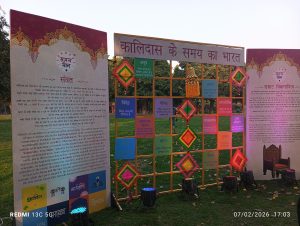
Dilip Guha, Sasraya News ★ New Delhi : A unique cultural festival, Kalidas ka Katha Lok, curated by Samay Yaan and the Indira Gandhi National Centre for the Arts (IGNCA), was held at Purana Qila, New Delhi, on 7 and 8 February 2026. The festival offered audiences a rare opportunity to experience ancient India not as distant history, but as a living civilisational continuum.
Samay Yaan, founded by Justice (Retd.) S. N. Dhingra, the principal organiser of Kalidas ka Katha Lok, has created a sanctuary for book lovers and culture enthusiasts alike. The initiative invites visitors to step into a world where the vibrant tapestry of India’s diverse literature and heritage comes alive. Located in the heart of Delhi’s R. K. Puram, the reference library and cultural centre house a remarkable collection designed to captivate the imagination.
Hosted at the historic Purana Qila, the festival gained added resonance by situating civilisational exploration within one of Delhi’s most significant archaeological landscapes. The event was supported by leading cultural institutions, including the IGNCA, the National School of Drama (NSD), and the Archaeological Survey of India (ASI).

The festival was inaugurated in the presence of Shri Kapil Mishra, Hon’ble Minister of State for Language, Culture and Tourism; Dr Sachchidanand Joshi, Member Secretary, IGNCA; Justice (Retd.) S. N. Dhingra, Founder of Samay Yaan; Dr Sandhya Purecha, Chairperson, Sangeet Natak Akademi; and Shri Chittaranjan Tripathi, Director, NSD.
Read : Soul of Bengal Comes Alive: Poush Mela & Book Fair at Noida Kalibari
Rooted in the theme “Kalidas and His India,” the festival drew inspiration from the era associated with Mahakavi Kalidas, nearly two millennia ago, to explore India’s philosophical depth, artistic excellence, social organisation, and cultural confidence. Rather than focusing on rigid timelines, the festival approached Kalidas’s period as a civilisational moment that continues to shape India’s ways of thinking, creating, and relating to the world.
Conceived as a form of cultural time travel, Kalidas ka Katha Lok brought together scholarship, storytelling, performance, and hands-on experiences to make India’s past tangible and accessible, particularly for younger generations. The initiative remained non-political, inclusive, and intellectually rigorous, encouraging inquiry without ideology.
Justice (Retd.) S.N. Dhingra, Chairman – Samay Yaan, said, “Kalidas ka Kathaalok is our attempt to bring ancient India out of textbooks and make it a live experience. We are not recreating history as a spectacle, but opening a space where stories, ideas, and emotions from 2000 years ago can be felt again. By combining performance, craft, music, and conversation, the festival allows people—especially young audiences—to engage with Kalidas and his world and feel the vibrant Bharat of his era.”
Project Head – Katha Lok Ms Bharti Dhingra said, “This festival is built around listening to stories, to places, and to the questions ancient India was curious about: love, power, nature, and society. Kalidas ka Kathaalok does not tell audiences what to think about the past. Instead, it creates the atmosphere that allows reflection and dialogue. By setting these experiences within Purana Qila, we invite visitors to move through history physically and emotionally, making the past feel present rather than distant.”

Chittaranjan Tripathy, Director of the National School of Drama, said, “At the National School of Drama, we believe theatre is one of the most powerful ways to understand society and history. Through Kalidas ka Kathaalok, we are excited to engage with young performers and storytellers to explore life in ancient India—not as mythology, but as a living reality. This festival gives opportunity and chance to express and reinterpret classical themes through contemporary performance, ensuring that Indian dramatic traditions continue to grow, evolve, and speak to new generations.”
Santoor Maestro& Music Composer Pandit Abhay Sopori said on the occasion, “Indian classical arts have always carried history not as memory alone, but as lived experience. Kalidas ka Kathaalok creates a rare space where poetry, music, and thought come together to awaken that continuity. Just as a raga unfolds emotion beyond words, this festival allows ancient ideas to resonate with contemporary sensibilities. It reminds us that our cultural inheritance is not something to be preserved in silence, but to be listened to, felt, and rediscovered by every generation.”
Shri. Sachchidanand Joshi, Member Secretary, the Executive and Academic Head, Indira Gandhi National Centre for the Arts (IGNCA), New Delhi, said, “To envision a literary festival devoted to Mahakavi Kalidasa is an inspired endeavour. A singular presence in world literature, Kalidasa enriched its traditions through the vast and luminous reach of his genius. It is deeply troubling that while our youth readily know Shakespeare, they remain largely unaware of Kalidasa, and even more regrettable, that he is casually termed the Shakespeare of India. This moment calls for reintroducing Kalidasa to the new generation, so they may engage with and take pride in our rich literary heritage. Through this festival, Samay Yaan undertakes this vital task—an effort worthy of the highest commendation.”
Also read: Poush Mela & Folk Festival: Bengal’s Heritage Blooms in Delhi
The Kalidasa Bands: A Celebration of Music and Innovation
On this occasion, the Kalidasa Bands musical competition brought together young talent from across Delhi, reimagining Indian classical and folk traditions through the lens of contemporary instruments. The event showcased the creativity and energy of college bands, each offering a fresh interpretation of India’s rich musical heritage.
The distinguished jury featured Shri Aman Nath, renowned composer, and Shri Rakesh Bhardwaj, celebrated member of the iconic band Euphoria. Their presence added gravitas and encouragement to the spirited performances.
The participating teams included Naksha, a six-member ensemble; Nirgun Naad (from Manzil Mystic); Mantarang (from Teerthanker Mahaveer Medical College); and Raagdhara (from Santosh Medical College). In addition, Musical Mavericks from GS University performed as a special non-competitive act. Together, these groups transformed the stage into a vibrant space where tradition met innovation, underscoring the timeless appeal of Indian music in contemporary forms. The competition highlighted the fusion of tradition and modernity, as young performers brought fresh energy to India’s musical heritage.
The Nirgun Naad Band from the Manzil Mystics organisation participated in the Kalidas ka Katha lok program, presenting a soulful musical performance rooted in India’s rich literary and cultural traditions. Manzil Mystics is an organisation that provides music exposure in schools and community spaces, working to make music accessible, sustainable, and meaningful for children and young people.

Speaking at the event, Priyanka, a member of the Nirgun Naad Band, said that she is a Learning Through Music (LTM) Fellow of Manzil Mystics. She explained that the team regularly visits schools and communities on a weekly basis to conduct music classes for children. At the Kalidas ka Katha program, the band performed a Kabir bhajan titled “Ghat Ghat Mein Panchhi Bolta Hai.” Explaining the meaning of the song, Priyanka shared that “ghat” refers to the human body and “panchhi” symbolises consciousness. Through this bhajan, Kabir conveys that emotions such as happiness and sadness arise from within oneself, emphasising self-awareness and inner responsibility.
Reflecting on the event, Priyanka said that Kalidas ka Katha lok provided a valuable opportunity to explore the works of Kalidas along with other renowned writers and authors. She described the initiative as a meaningful effort to promote Indian Sahitya (literature).“My team and I are grateful to be part of this program. It was a memorable experience for us,” she added.
Mahakavi Kalidas A Play- by NSD
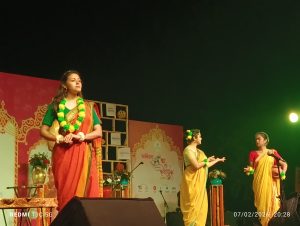
A specially curated show staged by NSD revolving around the life and works of Maha Kavi Kalidas, presented by sixteen theatre artists, designed and directed by Sh Ramji Bali on the occasion.
This play was a three-act theatrical production that explores the life and literary legacy of Mahakavi Kalidasa, one of the greatest figures in classical Indian literature. The play brings together legend and selected works to present a unified theatrical experience.
The first act introduces Kalidasa’s early life, drawing from the well-known legend of his marriage to Rani Vidyotama and his journey from ignorance to wisdom, which marks the beginning of his transformation into a great poet.
The second act presents a shortened adaptation of Abhijnanashakuntalam, capturing its essential themes of love and destiny.
The third act features a concise version of Vikramorvashiyam, portraying the emotional conflict between human desire and divine order.
The play aims to make Kalidasa’s life and works accessible to contemporary audiences while preserving their classical essence.
The Kalidas ki Kathalok festival created experiential spaces where audiences engaged directly with civilisational practices—from attar-making and traditional cuisines to ancient Indian board games and even had their names written in Brahmi script calligraphy—bridging centuries through touch, scent, and script.
Also read: New Hope and Light: Commemorating 163 Years of Swami Vivekananda at Vivek Utsav 2026 in Delhi
Ms Vidula from Khol Khel shared how their Open Play initiative revives ancient Indian play practices to bring people together. Having revived nearly 75 traditional board games—many recognised under the National Education Program (NEP) 2020—Khol Khel demonstrates how play supports social-emotional learning, cognitive development, and intergenerational connection.

She reflected that presenting these games at a festival on Kalidas felt natural, as both his poetry and their play arise from the same source—emotion, memory, and the quiet intelligence of Indian tradition, still alive and relevant today.
Complementing these experiences are curated scholarly dialogues led by eminent historians, scholars, and thinkers. Topics range from ancient Indian trade routes and economic systems to the intersections of science, philosophy, and aesthetics, as well as traditions of governance and social organisation. Designed to be rigorous yet accessible, these sessions invite audiences to reflect on how civilisational ideas endure and evolve.
Taal Yudh: A battle of Indian percussions where Pakhawaj speat to Tabla and Ghatam matched the rhythm with Mridangam also enthralled the audience. Main artists of the event were: Ghatam – Sh. Varun Rajasekharan, Mridangam – Sh.ManoharBalatchandirane, Tabla – Sh. Zargham Akram Khan, Dholak – Sh. Mahavir Chandrawat
Flute – Sh. Ravinder Rajput, Sitar – Sh. Soumendra Goswami.
Unheard stories from the times of Kalidas
Qissa Hunkara, QissaBetal, SinhasanBattisi, Maliva-Agnimitram, presented respectively by Priyanka Sharma and Manu Sikander Dhingra, Bharti Dixit and Abhinav Chaturvedi, ‘nanne’.
Complementing these experiences are curated scholarly dialogues led by eminent historians, scholars, and thinkers. Topics range from ancient Indian trade routes and economic systems to the intersections of science, philosophy, and aesthetics, as well as traditions of governance and social organisation. Designed to be rigorous yet accessible, these sessions invited audiences to reflect on how civilisational ideas endure and evolve.
A two-day cultural festival brought together eminent voices from diverse fields. The distinguished speakers included Sushri Neera Mishra, Founder of the Draupadi Dream Trust; Shri Balbir Punj, author, journalist, and former Member of the Rajya Sabha; Shri Sudhanshu Trivedi, Member of Parliament; Dr Ranjana Aggarwal, former Director of CSIR; and Capt. Praveen Chaturvedi, filmmaker and Founder of Prachyam.
Their participation added depth and perspective to the festival, which aimed to highlight India’s cultural heritage and contemporary thought.
Festival Concludes with Musical Showcase ‘Sur Samay Yaan’
The two-day festival concluded with Sur Samay Yaan, a magnificent musical presentation featuring thirty artists. The performance traced the evolution of Indian music from its origins to contemporary expressions across classical and folk traditions.
The presentation was inaugurated by Shri K. Satish Nambudiripad, Director General of Doordarshan, and was conceived and narrated by Pandit Abhay Rustum Sopori. The finale offered audiences a panoramic journey through India’s musical heritage, seamlessly blending tradition with innovation.
By combining scholarship with participation, Kalidas ka Katha Lok challenges the notion that history belongs only in textbooks—presenting it instead as a shared cultural inheritance that can be explored, questioned, and reimagined.
Read : UTSAV Collective presents WINTER MUSE