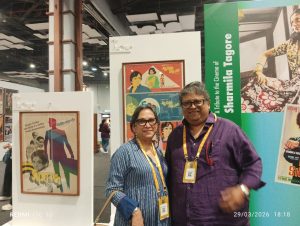
Dilip Guha, Sasraya News ★ New Delhi : Visitors at the International Film Festival at Bharat Mandapam in Delhi (IFFD) experienced the rich journey of Indian cinema from its inception. The exhibition not only showcases the evolution of Indian films but also highlights their global popularity and India’s influence as a soft power.
Also Read : Priyanka Mohan Walks the Red Carpet at IFFD 2026; Made In Korea Garners Global Acclaim
Cinema enthusiasts, researchers, and artists explored both Indian and global cinema through the exhibition, as stated in a statement.
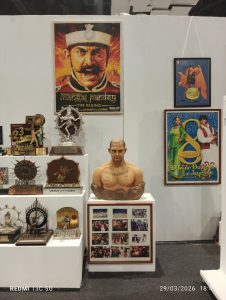
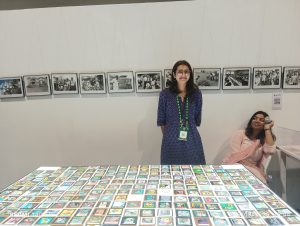
Art collector Neville Tuli curated the exhibition, featuring legendary artists from multiple generations and providing insights into the evolution of both Indian and global cinema—from the classic era to modern times—along with its challenges and achievements. The exhibition consists of 12 thematic sections.
Neville Tuli is a pioneering builder of arts, culture, and animal-welfare institutions dedicated to reshaping how India is studied and understood through its cultural heritage. Over three decades, he founded the Tuli Research Centre for India Studies and developed a research ecosystem that positions cinema, visual arts, and archives as core educational resources. His work emphasizes an interdisciplinary approach, treating visual, textual, and audio traditions as equally vital to understanding India’s diverse knowledge systems.
Speaking on the importance of exhibition, he said, “Cinema has always been far more than the films we watch. It is a vast universe of visual memory — posters, publicity art, photographs, booklets, and objects that carry the spirit of their time. Through these exhibitions, we hope to reintroduce cinema as a powerful educational resource, where the visual becomes a serious source of knowledge and dialogue across disciplines.”
Delhi Tourism Minister Kapil Mishra stated that the exhibition is a significant step toward establishing Delhi as a global hub for cinema and cultural research.
“It represents a confluence of cinema, education, and culture, and strengthens the dialogue between Indian and world cinema,” he said.
During the event, the Tourism Minister interacted with visitors and students attending the festival, gathering their feedback and suggestions. He noted that the IFFD is currently at its peak, witnessing enthusiastic participation from young talent, filmmakers, and prominent figures from across the country.
The series opens with The Golden Age of Hollywood, 1910–1960s, a rich Indo-American cinematic dialogue tracing movements from the silent era’s comedy and German Expressionism to epics, science fiction, horror, auteur cinema, and stardom. In parallel, Highlights of Indian Cinematography, 1913–1973 foregrounds the artistry behind the lens, celebrating pioneers such as Faredoon A. Irani, the Mitry Brothers, Shombhu Mitra, Dilip Basu, Radhu Karmakar, R.D. Mathur, and V.K. Murthy, while emphasising the unique role of song and music in Indian storytelling.

The exhibitions also spotlight rare film objects, including the Song-Synopsis Booklet, a hybrid of publicity material and audience guide, and Significant Artworks of Landmark Films of Bombay Cinema, 1940s–80s, which showcases original hoardings and vintage posters. The World of Satyajit Ray through the Lens of Nemai Ghosh, 1969–1990, offers intimate glimpses into the auteur’s creative journey, while Vintage Polish & Japanese Designed Posters, 1950–80s, highlights striking graphic traditions from two distinct cultures.
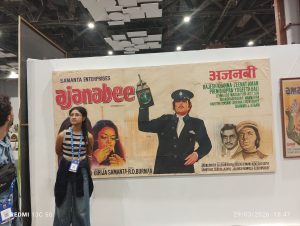
Tributes further enrich the showcase: A Tribute to Mughal-e-Azam revives the epic through memorabilia, while homages celebrate Dharmendra, Shakti Samanta’s centenary, and Sharmila Tagore’s cinematic legacy. Another exhibition juxtaposes the refined covers of international festival catalogues with the grandeur of film jubilee trophies, underscoring cinema’s cultural aura.
Together, these twelve exhibitions form a vast Cine Object Paradigm that extends the life of films beyond the screen. Ephemeral artworks, lobby cards, fan mail, trophies, and memorabilia evoke the world cinema inhabits, transforming passion into cultural memory. With its constellation of rare vintage material, the IFFD’s showcase is a landmark in India’s cinematic history—never before has such a wide-ranging archive of world and Bombay cinema been brought together under one roof.
Also Read : IFFD 2026 Draws Crowds, Star Power and Engaging Conversations