Dilip Guha, Sasraya News ★ New Delhi, March 27: In a significant push to strengthen the capital’s media and entertainment ecosystem, the Delhi Tourism and Transportation Development Corporation and Prasar Bharati signed a Memorandum of Understanding (MoU) to collaborate on the development of an Integrated Film, Television and Media Hub, popularly envisioned as the Delhi Film City on 27th March2026.
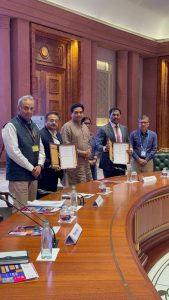
The MoU was signed on the sidelines of the International Film Festival Delhi 2026 at Bharat Mandapam, in the presence of the Minister of Tourism and attended by prominent film personalities, academicians, and industry stakeholders. Shri Suneel Anchipaka, IAS, Managing Director & CEO, DTTDC, and Shri Rajeev Roy, Member (Finance), Prasar Bharati, formalised the agreement on behalf of their respective organisations.
The agreement establishes a collaborative framework to jointly develop Delhi Film City by pooling resources across media production, infrastructure, and skill development. It also focuses on promoting innovation, research, and capacity building, particularly in the AVGC (Animation, Visual Effects, Gaming and Comics) sector, while positioning Delhi as a hub for media and entertainment to attract both domestic and global investment.
Prasar Bharati, which holds approximately 486.70 acres of land at Khampur in North Delhi, and DTTDC, the nodal agency for promoting tourism and cultural infrastructure, have expressed mutual interest in advancing the project. A Joint Coordination Committee (JCC), comprising equal representation from both bodies, will oversee its implementation.
The initiative aligns with the vision of Narendra Modi to strengthen India’s creative industries as engines of growth, employment, and global outreach, with the ‘Orange Economy’ emerging as a key pillar of the country’s soft power.
Addressing the gathering, Delhi’s Minister for Tourism, Arts and Culture, Kapil Mishra emphasised the importance of the Delhi Film Policy and highlighted the role of industry participation in revitalising the sector. He noted that ongoing policy revisions aim to support a robust media and entertainment ecosystem in the national capital.
A round table discussion on “Orange Economy – Leveraging Delhi’s Soft Power” was also organised, bringing together filmmakers, producers, academicians, and technology experts. Shri Suneel Anchipaka underscored the importance of governance and cross-industry collaboration in positioning Delhi as a creative capital.
Gaurav Dwivedi highlighted the expansion of media nodes and opportunities for collaboration, particularly in building an integrated AVGC ecosystem. Sabbas Joseph stressed the need for sustained engagement, while Sandeep Marwah pointed to Delhi’s central role in fostering institutional growth.
Filmmaker Rakeysh Omprakash Mehra advocated a calibrated approach to developing Delhi as a cultural capital through public-private partnerships. Actor Vani Tripathi highlighted the importance of continuous skilling initiatives, while Abhishek Chaubey emphasised expanding opportunities for technicians and craftsmen.
Other speakers, including Siddharth Jain, Boman Irani, and R. S. Prasanna, stressed mentorship, structured training, fellowships, and the integration of film education. Producer Medha Jaishankar indicated that OCI cards for overseas filmmakers of Indian origin are expected to be introduced to facilitate international collaboration.
Read : The International Film Festival of Delhi (IFFD) 2026 Honoured Icons of Indian Cinema
A representative from KPMG, citing global models such as Montreal and London, highlighted the importance of PPP-led development and the need for Delhi to emerge as a specialised hub for creative and digital skills.
The MoU signing and round table deliberations mark a coordinated step towards strengthening Delhi’s media landscape. The proposed Delhi Film City is expected to enhance institutional capacity, drive industry growth, and position the capital as a major centre for film, media, and cultural activities.